Tag: blog

  • IAPWE Review: Should I Join? How Much Does it Cost? Is it a Scam?

    IAPWE Review: Should I Join? How Much Does it Cost? Is it a Scam?

    If you’ve been looking for a IAPWE review, you’ve come to the right place. But first things first, what is IAPWE? This stands for the International Association of Professional Writers and Editors and their stated mission is to “bring legitimate opportunities to professional writers and editors.”

    Sounds great, right?

    Before we get too far in, if you’re looking for a quick review here’s what you need to know: IAPWE is more of a job board than an actual program that hires writers. This distinction is quite unclear on their website, which is the main takeaway from this review. We won’t go so far as to call the organization a scam, but there are a few red flags to pay attention to.

    [sps_reusable_block post_id=43043]

    When you Google “International Association of Professional Writers and Editors” or “IAPWE” and look at the “people also ask” area you see questions like,

    • Is the IAPWE or International Association of Professional Writers and Editors legit?
    • How much does the International Association of Professional Writers and Editors pay?
    • Are paid online writing jobs legit?

    So as you can see, other people have questions too.

    We’ll do our best to narrow in on what IAPWE offers, how they accept writers (and what that means exactly), and talk about a few other people’s experiences with the IAPWE program. But first…
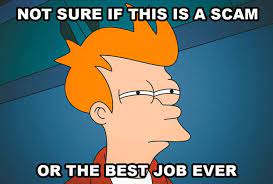
    Meme of Futurama character Phillip J. Fry making a suspicious face. The text says "Not sure if this is a scam or the best job ever." This is to illustrate the article IAPWE Review

    Is IAPWE a Scam?

    IAPWE is not BBB accredited and currently has a BBB rating of B.

    Reading through the IAPWE review posts shows quite a few unhappy people, mostly when it comes to canceling their memberships. From the reviews, it sounds like when you’re ready to cancel your annual membership you’ll have to jump through a few hoops.

    IAPWE might post legitimate opportunities in their job board, but one huge problem is they don’t mention how the job board works on their website. It also doesn’t indicate how long it will take to get approved, that you’re not working directly with the company, or that there’s a monthly fee for this service.

    Another confusing aspect of the website is there’s a listed rate, but it’s actually a job board. Does that mean they only post jobs that fit within those rates? Unclear.

    Professional writers and editors are generally happy to pay for membership in a freelancing group or mentorship/networking program, as long as the cost is worth it. However, because the fees seem to be hidden, and reviews indicate the actual writing jobs weren’t worth the cost, that’s a red flag.

    With this in mind, it might not be fair to say IAPWE is a scam, but there are some deceptive tactics. Whether that’s intentional or just poor website design and copywriting…well, we’ll leave that up to you to decide.

    Another note is they don’t post too much on their social media. This on its own doesn’t mean much, but I thought it worth mentioning.

    While I wouldn’t go so far as to call IAPWE a scam, since no one said the jobs themselves are actually fake, the true value the organization brings to freelance writers and editors is unclear.

    IAPWE Reviews (What Others Have to Say)

    I hunted around the Internet to see what people had to say about their firsthand experience with IAPWE. Here are a few less-than-positive ones to check out:

    For a positive review, I found this comment in a Reddit thread,

    I actually know quite a few people that have secured writing gigs via IAPWE. They’re not a “known scam,” they just need a lot of effort to utilize their resources, which can be tedious. I think many people want a quick, easy, high-paying assignment, with little to no effort. As IAPWE is not a get-rich-quick site, it leads to many negative reviews. The moral is: it’s not for everyone. Just because something doesn’t work for you, does not mean it won’t work for others.

    Reddit—PSA: The International Association of Professional Writers and Editors (IAPWE) is apparently not a legit organization.

    What is the International Association of Professional Writers and Editors (IAPWE)?

    IAPWE says it’s an organization that helps writers and editors succeed. Their website has articles and other resources for professionals to help them break into the industry and start their careers. They’re most popular for their job board, which lists a variety of jobs for both writers and editors.

    The questions we’re wondering are: are the jobs good quality and is the organization worth joining?

    How Much Does an IAPWE Membership Cost?

    Once you’re accepted into IAPWE, it seems as though you then need to upgrade your account to be able to access the job opportunities.

    There are conflicting numbers out there, but it seems to currently cost between $6 and $15 per month to access to the job board. This works out to between $72 and $180 per year, and you can write this type of expense off on your taxes in most countries.

    How to Work with IAPWE

    Most reviewers have mentioned coming across IAPWE hiring posts on Craigslist or job boards separate from the IAPWE job board.

    On the IAPWE website, it’s not easy to see how to apply to be a member. I had to search for the page on Google to find the application page!

    Below is a screenshot of the application page from 2022, at the time of this articles first writing (it has since been updated).
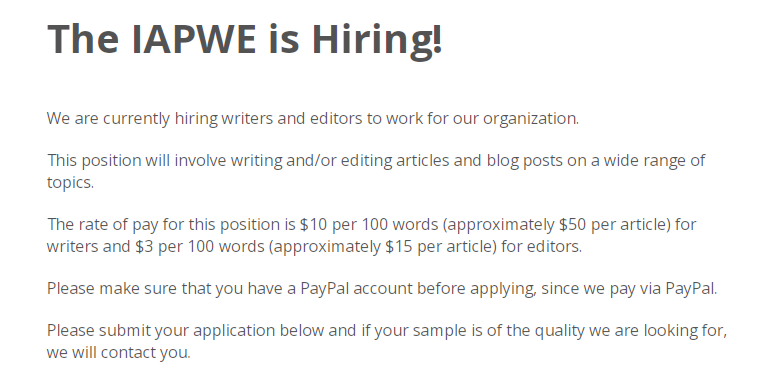
    This is a screenshot of an application page from IAPWE as part of an IAPWE review. It was taken in 2022

    If you have images turned off, here’s the short version of the screenshot: the IAPWE pay rate is $10 per 100 words and each article is approximately 500 words. For editors, their rate is $3 per 100 words.

    However, on this job post board for IAPWE, the rate is different. It lists $20 per 100 words.

    It also mentions on that site that 17,357 people have applied to this job. It says the salary is $40,000-$50,000 and that applicants must, “Work well as a team member with the rest of our content management and editorial staff.”

    We’ll also point out this information was gathered in 2022 when the article was originally written and it still states this is 2023 when we reviewed the links again.

    Here are the topics they currently offer writers and editors:

    • Health and Beauty
    • Fitness
    • Home Décor
    • Fashion
    • Sports
    • Do It Yourself (DIY)
    • Finance
    • Legal
    • Medical
    • Family/Parenting
    • Relationships
    • Real Estate
    • Restaurants
    • Contracting (Plumbing, Pool Building, Remodeling, etc.)

    Depending on your current rates as a freelance writer or editor, this might seem like a decent amount. But it also might not seem like enough. These rates are better than a lot content mills that pay closer to $0.02 per word instead of $0.10 per word.

    According to online reviews for IAPWE, once you’re approved and accepted as a member, you have access to the job board. You’re not given a position in the company and jobs aren’t a given.

    The organization pulls from 100 different companies—but they claim to only post legitimate freelance jobs. While I did not personally apply for IAPWE, some reviewers said it can take a month or more to hear back from them once you apply.

    Why Writers Should Double-Check Any Program Before Joining

    So many people dream of being able to write and work from home, and scammers know this. You should keep in mind that any program that says it’s an easy to industry to get into in just a few hours should raise some red flags.

    That’s not about this specific program, this should be a rule for any program or organization you want to join going forward.

    If you want to become a freelance writer, just know that there are as many legitimate programs and organizations out there as there are scams. For this reason, it’s always a good idea to do your due diligence and make sure it’s legitimate before you sign up. (Just like you’re doing now!)

    While no program is guaranteed to work and make you rich, you at least need to make sure it’s legitimate and can get you results if you put the work in.

    The Pros and Cons to Wrap Up This IAPWE Review

    You’ve made it to the end of the post! Well done! Here’s a quick review of what we talked about.

    Pros to Joining IAPWE

    • You’ll get access to resources about becoming a professional writer or editor
    • You have access to legitimate jobs all in one place

    Cons to Joining IAPWE

    • You have to pay a monthly fee to access the job board
    • It can be difficult to cancel your membership
    • It’s unclear if the posted jobs are worth the monthly fee

    Here’s an Alternative!

    If you’re just getting started as a freelancer, then we recommend the Freelance Writers Den. They have an incredible community and a wealth of helpful resources to help you grow your income as a freelance writer, editor, proofreader, and more. There is also a monthly fee for this membership program, so once again—make sure it’s right for you before joining!

    For a full review on the program, check out this article.

    [sps_reusable_block post_id=43043]

  • How to Write Female Book Characters

    How to Write Female Book Characters

    If you’ve spent any amount of time in online reading or writing circles, you’ve probably come across posts like this titled ‘X Times Men Didn’t Know How to Write Female Characters,’ each featuring screenshots of tragically sexist prose. Or maybe you, like me, were forged in the unforgiving fires of 2012-era Tumblr and have seen loads of posts like this or this.

    My point is, it’s not exactly news that badly-written women are an unfortunate feature in our media. While men often write the most egregiously poorly-written women, it’s not just men at fault here—people across the gender spectrum seem to struggle with writing compelling, three-dimensional women.

    If you don’t want your novel to end up screenshotted and added to the next article compiling grave, mildly-to-severely sexist authorial mistakes for the purpose of public shaming (which I do, in case it’s unclear, support), you’ll want to learn how to write women well. And luckily for you, that’s what we’re here to do today.

    In this article, we’ll talk about how to write compelling women, we’ll take a look at some common mistakes authors make when writing women, and we’ll look at some examples of well-written and not-so-well written women in movies, T.V., and books.

    How to write compelling women

    First things first, let’s talk about how to write female characters well.

    1. Women are people

    I’m going to get into detail about specific problems I see, but the bottom line and main takeaway is this: women are people, and female characters are characters. Writing a good female character means writing a good character.

    Female characters should be just as deep, interesting, and complex as male characters, and they shouldn’t be defined solely by being a woman (much in the way you wouldn’t define a male character by their identification as male).

    2. Give them complex motives

    What does your female character want, and why?

    You want to avoid ‘because she’s a woman, and women want that/behave like that/expect that’ as an answer. 

    Consider their upbringing and perspective. If this is a fantasy world, consider whether sexism plays a role in the way they interact with the world and how that character deals with it. How does this character see things? Once you have a solid idea of this, you can more accurately get at what this character wants and how they, as a person, will react to any given situation.

    3. Flesh out their interests and hobbies

    What’s your female character’s favorite movie, and why? What kind of food does she like? Where does she work, and does she like her job? Let her be a real person, and let her be a little weird. She should have anxieties, fears, dreams, and interests, and they should not all have to do with what men think of them.

    4. Honestly consider their relationships to other characters

    When writing relationships between any two characters, you’re looking at character A through the eyes of character B (and vice versa). You’re the author, so you already know what’s going to happen, and sometimes this makes it tricky to really piece out what information is literally there, in the text, and what you’ve got in your head.

    If you flesh out your female character like we talked about earlier, this is easier to do. You can tell, based on what kind of person she is, how she’s going to respond to other people. For example, if most people are at work, they won’t be flattered by strangers approaching them and hitting on them—they’ll feel uncomfortable, maybe even frightened.

    5. If the anatomy isn’t your own, research it

    This isn’t advice for female characters, strictly speaking, but it does often come up with specifically cis men writing cis women. If you’re writing about an anatomy that isn’t your own, research it a bit. It’ll be very silly if your book comes out and you let the whole world know that you have no idea what a tampon is or how it works—Google could have saved you.

    6. If the experience isn’t your own, get a second opinion

    Similarly, if you’re writing a perspective that isn’t your own, get a second opinion from that perspective. If you’re writing a trans woman, you’ll want to have trans women beta read your story and critique it so you can be sure that you’re offering a realistic, appropriate representation of a character in that demographic.

    Common mistakes when writing women

    So, what are some things to avoid when you’re writing women? I’ve compiled a list of tips, as well as some tropes to look out for as signs that you might need to rehash your approach to female characters.

    1. The lamp trope

    If you could replace the woman (or women) in your story with a lamp or sack of jewels without the story changing much, this suggests that the woman serves no purpose except to be rescued by the protagonist. This is objectification, and this woman is probably exceedingly one-dimensional. 

    2. One-dimensional women

    Writing women as vapid, vain harpies who care only about men and who hate every other woman is pretty overdone and generally insulting. Some women are vain, just like some men are vain, and some women are overly fixated on the opinions of men, just as men can fixate on the opinions of women, but as a character type, it’s often shallow, mean, and does more to point to the author’s internal sexism than to that specific character’s flaws.

    3. Fridging

    ‘Fridging’ is when a female character is introduced only to serve as a tragic backstory for the male protagonist. It’s usually his wife, and she almost always dies in some horribly brutal way which fuels his need for revenge. We get no sense of what the wife was like as a person, or she’s just vaguely perfectly feminine and lovely.

    Yes, people’s wives do die, and sure, I get that you want your male protagonist to have a compelling reason to be so brooding and tough. But inventing a woman to brutalize solely to enhance a male character’s Edge Factor isn’t the way to do it.

    4. Needless sexualization

    When men are described, we rarely get passages about how their jeans stretch over their butts or how their nipples show through their shirts. The purpose of introducing them isn’t to tell us how hot they are—it’s to tell us what they look like. However, it’s very normalized to introduce women in a way that clearly intends to show off how sexy the author wants us to think she is.

    Sometimes people argue that this is done because the male protagonist sees her that way. But the thing is, if the male protagonist is seeing her primarily as a sex object, that’s a serious character flaw which needs to be addressed, challenged, or otherwise explored unless you want your readers to think he’s deeply sexist. And it never is addressed! Weird.

    Examples of great (and not so great) women in fiction

    The Good

    1. Katniss Everdeen from The Hunger Games by Suzanne Collins

    Katniss is a wonderfully written teenager, at least in my opinion. Her relationships with her family are hugely important, her role as her family’s provider is instrumental to her character, and her motives are strong, complex, and not at all male-centric—she volunteers for the Hunger Games in the first place to save her sister, Prue.

    When it comes to romance, at least in the books, we never shake the lens of the Capitol. This is extremely deliberate, and it means that Katniss isn’t just a lovestruck teenager helplessly torn between two boys. She’s a kid fighting for her life while also being pressured to perform love for her family’s survival. Her feelings are being messed with, and this is incredibly compelling as a conflict.

    2. Shiv from Succession

    Women do not have to be good people to be good characters! Shiv from Succession is a solid example. She’s seriously abusive to her partner, Tom, she’s incredibly calculating, and she’s willing to throw anyone and anything under the bus in the name of getting in her father’s good graces.

    But this doesn’t come from her womanhood—it comes from her upbringing. All of the Roy siblings are impacted by their father’s abuse in their own way, and while hers is definitely influenced by her womanhood and by navigating the intense sexism of an ultra-conservative environment, they’re not just ‘because she’s a girl.’

    3. Amy from Gone Girl by Gillian Flynn

    Even if you haven’t read Gone Girl, you’ve probably heard of the ‘Cool Girl’ monologue. In Gone Girl, Amy’s playing with everyone’s expectations of who she is because of her womanhood—she’s able to deceive her husband, for example, because she knows how he perceives her based on his sexism and she knows how to use that against him. This makes her incredibly complicated as a character, and her manipulation adds a ton of nuance to her very strong choices.

    Again, not a perfect character—she’s not the pinnacle of feminism or divine femininity or anything. But she’s a woman written holistically, and that makes her interesting.

    The Not-So-Great

    1. Mikaela Banes in Transformers (dir. Michael Bay)

    This is maybe a tired example, but Mikaela Banes as played by Megan Fox is an example of the ‘Cool Girl’ ideal Amy rails against in Gone Girl. Mikaela’s versed in mechanics, a male-approved skill, but she owes all of her knowledge to her father. Thanks to a man, she knows about boy stuff. And she isn’t exactly presented by the camera as a respected auto mechanics expert—instead, we get leering shots of her bent over the hood of a car, encouraging the audience to stare at her body instead of listen to what she’s saying. She’s a character with the potential to be interesting—the bones are there—but the writing isn’t interested in exploring her character beyond how she serves as a love interest for our male protagonist.

    2. Anastasia Steele from Fifty Shades of Grey by E.L. James

    Anastasia Steele is the protagonist of Fifty Shades, and she’s written by a woman, but neither fact makes her a well-written female character. She’s incredibly naive—even by the end of the Fifty Shades trilogy, after she’s been exposed to tons of kink-related stuff (badly represented and explained kink, but still), she reacts like she’s never heard of sex before. It’s not a problem that she starts the series insecure, cloying, and naive, but it is a problem that she never grows, develops, or gains any agency in her relationship with Christian Grey.

    3. Christina from The Book of Henry

    In his essay “The Art of Storytelling and the Book of Henry,” Dan Olson explains how Christina functions as an example of the lamp trope. Christina is the step-daughter of the police commissioner Glenn, and they’re neighbors to the film’s protagonist, Henry. Henry sees Christina being abused by Glenn, and this is the impetus for his plan (and the film’s central plot) to kill Glenn. Olson explains that the film is, in concept, about a plan to save Christina, but in fact, Christina is really just an excuse—because the film isn’t interested with Christina as a character, she’s just a flat, one-dimensional excuse for Henry to make a plan to kill Glenn.

    New call-to-action
  • Book Writing Process

    Book Writing Process

    Writing a book is an art form, and that means that there’s not one right way to do it—it’s going to look different for everyone, and as long as someone’s method works for them, it’s fine.

    That said, if you’re a new writer looking for advice, this can make a project as big as a novel feel daunting. How do you even start to tackle a project that might be a few hundred thousand words long before it’s over?

    If you’re a painter, you need to learn about different methods and techniques and try each to see which resonates with you—you learn how people have been doing it, because that gives you a foundation of information to work with. With that foundation, you’ll eventually gain the experience necessary to use what works for you and leave the rest.

    It’s the same with writing. While you’ll eventually reach a point where you’ve got a book writing process which works for you, you may need to try a few different methods before striking gold. In this article, I’ve got five methods for you to add to your toolkit—feel free to mess with them as you need to so they’re effective for your project’s needs.

    For each process, I’m going to talk about how it works, who it might be helpful for, and what sorts of tweaks you could make to give you an idea of how to customize these processes. But before we get into that, I want to talk about brainstorming and outlining.

    Brainstorming and Outlining

    Before you start actually writing your book, you’re going to want some idea of what the book is about. You’ll probably need to know: 

    – who the characters are

    – where the characters are

    – what the characters want (at least in the beginning)

    & what the book is About (what big themes or ideas you intend to explore).

    Some writers have this more or less all in their head before they sit down to write, but I recommend jotting it down. Here are a few ways you might brainstorm before you start getting into the meat of your novel:

    1. Mind Map

    Write a word in the center of a piece of paper related to your novel—it might be a character’s name, the setting, an idea, a theme, whatever. Draw two lines away from that word and write the first related thing that comes to mind, and do this until the page is full of characters, plot points, settings, phrases, and so on which correspond to your novel.

    2. Stream of Consciousness

    Set a timer for two, five, or ten minutes (whatever works for you) and write down literally whatever comes to mind. If you’re writing ‘I don’t know what to write and I think this brainstorming idea is terrible,’ that’s cool. Keep going until you’ve got enough to work with.

    How do you know you’ve got enough to work with?

    There’s not a hard rule, but basically, you’ve got enough to work with when you feel that the brainstorming process is done. You feel ready to start writing. You may need to revisit the brainstorming process while you’re writing to work out plot holes or sticky spots, and that’s fine! This is just to help you get started with a solid foundation.

    And once you’ve got that foundation, you’re ready to write your book, and that’s where these five processes come in.

    The Snowflake Method

    Randy Ingermanson’s Snowflake Method is built on the idea that “good fiction doesn’t just happen, it’s designed.”  The Snowflake Method forces you to start small and expand outwards until you’ve got a fully fledged novel. This process is outlined in detail on Ingermanson’s website, but we’ll go over a brief summary here.

    Steps 1-7: Synopses and Character Description

    You start with an elevator pitch for your novel. If you’re not sure how to write one, look up one-sentence novel descriptions to get a feel for how they should look—they’re basically a summary intended to sell the listener on the story.

    Steps 8-9: Outlining

    Here, Ingermanson instructs to use a spreadsheet to outline your novel. You’ll use one line for each scene. Then, you take this information and write out a narrative description—basically, you’re converting the spreadsheet to a word document and writing out how the book plays out. He says this step is optional.

    If you’re using software like Scrivener, there might be a feature built-in for you to list your scenes. Otherwise, Google Sheets is free.

    Step 10: Drafting

    Draft the novel! You might need to take breaks to edit the design documents you’ve been creating as things change, and that’s okay. Ingermanson explains that these design documents will have to be edited if you’re doing well—as your ideas develop and change, you’ll have to reflect those changes in the pitch, character synopses, and plot summary.

    The Snowflake Method is great because it offers structure for the process without enforcing structure on your book itself. You can use this process with whichever plot structure you like, and at the end of it, you’ve got the documentation you’ll need to sell this book to publishers or market this book on your own as an indie author.

    If you’re going to tweak this method, tweak the time frames—Ingermanson lists how long each step should take (which is hugely helpful for keeping creative momentum going), but if you need to take more or less time on a given step or if you need to take breaks between steps, no one’s stopping you.

    New call-to-action

    Discovery Draft

    A discovery draft is what a lot of writers might refer to as ‘pantsing.’ For this, you might or might not have much idea of what you’re going to write about—if you have anything written down, it’s probably just a premise or starting point: a character in an interesting setting, a specific fight, whatever.

    The idea of a discovery draft is that you sit down and draft the novel as quickly as possible, figuring out details about characters, plot, and all that as you go. Some discovery drafters will edit as they go—I recommend that you don’t, but do make notes or keep a separate document going with the changes that come to mind as you work.

    This allows for a lot of creative momentum, because you’re discovering the story as you go—it’s exciting. The downside is that because you might not know where you’re going, you may get stuck. If this happens, I recommend slapping down a note that says “GOT STUCK HERE” and jumping to the next scene. If you don’t know what the next scene is going to be, that’s also okay. You can pause and brainstorm to figure out what happens next, or just decide what would be the worst possible (and realistic) thing to happen to these characters at this time and go with that.

    You’ll end up with a first draft that’s also an outline and also a character sheet. Once you’ve finished this draft, go through and identify character arcs and plot arcs and determine how to hone them. Almost none of your discovery draft is likely to end up in the finished product, but that’s true of any first draft.

    Bullet Point Outline

    A bullet point outline is a great option if you’re looking for something super flexible, and it’s the foundation for many other methods you’ll see. Basically, this is the spreadsheet step in the Snowflake Method.

    On a piece of paper, in a word document, or on a spreadsheet—doesn’t matter—you’ll dedicate a line to each plot point.

    If you want a super detailed outline, you might write each beat as its own line. If you do this, I recommend organizing your outline so that each chapter has its own heading, just to keep everything streamlined and easy to refer to. You can use highlighters or different-colored fonts to color-code based on character, subplot, or whatever you desire.

    If you don’t want to get that detailed, you can write down the major plot points in your novel and forget the rest.

    As long as you have enough information to feel comfortable drafting, you’re good to go. A detailed outline can help save time in the drafting process, but a loose outline might make you feel a little more free to change things up as you draft—if you get lost along the way, skip along to the next beat, and figure out how to close that gap when you revise.

    Start at the End

    Have you heard of Sagging Middle Syndrome? It describes the phenomenon wherein you breeze through the setup of your novel, then stall out in the middle—around the middle of act two, it becomes impossible to reach the climax. Characters hang out doing unrelated shenanigans until the climax comes to rescue them (and the reader).

    This is a pretty natural thing to happen, especially in a first draft. If it’s a particularly tough struggle for you, try starting your novel at the end. Where do your characters end up? Who wins, and what happens as a result of that? Knowing how the story ends makes it easier to figure out how to get there.

    Another variant on this method is starting with the climax. If you’re the type of author to get an idea for a really cool climax before you think of anything else, just write that climax down. Yes, it’ll probably change dramatically as you rework it—this is inevitable.

    After you’ve written the end or the climax or whichever scene you’ve decided to start with, ask yourself the following questions:

    – who are these characters?

    – how did they get here?

    – who ultimately wins in this confrontation?

    You can keep working backward, or you can pause and switch to a bullet outline—whatever works for you.

    Storyboard Method

    If you’re a visual learner, this might be your ticket.

    Storyboards are commonly used for visual mediums like comic books, T.V., or movies, but you can use them for novels, too. Use index cards to draw out the scenes you want to have happen in your novel and tape them to a piece of posterboard, the floor, the refrigerator, or your bedroom wall. Instead of drawing the scenes, you could also write them out using short sentences or descriptions.

    Again, if you want to use color-coding or some other unique marker to pick out characters and subplots, go for it! If not, cool. This method is great because it allows you to literally see missing spots in your plot, and it allows you to literally pick up and move scenes and see what they’d look like in other parts of the story.

    Some writing software like Scrivener has features which allow you to do this, so if you’re looking for a way to do this that saves some space, you might find that useful.

    When you’ve got everything lined up the way you want it, take that information and put it into a word document. This will serve as a bare-bones first draft, which you can get straight into revising!

    New call-to-action
  • Different Types of Characters in a Story

    Different Types of Characters in a Story

    When you’re writing, you have different tools and components at your disposal—plot, structure, character, theme, etc. You manipulate these things to make your work the best it can be, and having a good understanding of how all of these components work means you can move them around with intention.

    Characters are sort of like pawns. To know what to do with them, you need to know what they’re doing in your story—what purpose do they serve, and what are readers going to expect from them based on similar characters from other stories?

    In this article, we’re going to talk about the different types of characters in a story that you’ll encounter across mediums (T.V., movies, books, etc.). Not only will this make it easier for you to analyze the media you encounter, but it’ll help you more intentionally and thoughtfully craft your own work.

    Character Roles

    Let’s first talk about characters by the role they play in your story. This is the function they serve in terms of the story, and these terms are used across genres and mediums (a protagonist is called a protagonist whether you’re talking about a children’s adventure book or a grisly war movie).

    These roles often overlap—antagonists may start out as deuteragonists, for example, and in a series like Heroes of Olympus by Rick Riordan, characters who are protagonists in one installment may not get as much on-page time as they do in another. 

    Protagonist

    The protagonist is the main character of your story. They’re the ones driving the plot and undergoing the most change, usually. The story is about them, and the story’s main arc will be tied directly into their own internal character arc. A story told from multiple points of view may have multiple protagonists—if this is the case, each character should have similar weight.

    Examples: Luke Skywalker in Star Wars, Miles in Looking for Alaska by John Green

    Character Development Worksheet

    Antagonist

    The antagonist directly opposes the protagonist. We see this in superhero movies all the time: the antagonist wants to destroy the world while the protagonist wants to save it. They often need to be defeated by the protagonist in order for the plot to resolve. The antagonist’s chief job is to create problems for our main characters.

    Examples: Sauron in Lord of the Rings, Logan Roy in Succession, Nurse Ratched in One Flew Over the Cuckoo’s Nest by Ken Kesey

    Deuteragonist

    A deuteragonist is the character who is secondarily important to the protagonist. This is often the protagonist’s closest friend and companion. Because of their proximity to and influence over the protagonist, they play an enormous role in the plot, and they often undergo significant change themselves—conflict between the deuteragonist and the protagonist is a common subplot meant to steer the protagonist toward the inner change needed to succeed in the climax.

    Examples: Dr. Watson in The Adventures of Sherlock Holmes by Sir Arthur Conan Doyle, Sam Gamgee in Lord of the Rings

    Tertiary Characters

    Tertiary characters are the third most important characters in a story. These characters don’t often see a lot of character development, or at least not particularly complicated development—they mostly exist to flesh out the world and add texture and depth to the setting, as well as to deliver one or two pieces of information to the main cast. They might be townspeople, henchmen, or miscellaneous council members.

    Example: Pintel and Ragetti from Pirates of the Caribbean: the Curse of the Black Pearl

    To know how to name characters, click here.

    Character Archetypes of the Hero’s Journey

    An ‘archetype’ is sort of like the blueprint. An ‘archetypal mother,’ for example, would be the picture of a mother—not necessarily the perfect mother, but the perfect example of a mother. In The Hero’s Journey, Joseph Campbell outlines eight major character archetypes which pop up in fiction.

    The Hero

    The hero is usually the protagonist. This is the character who has to battle their internal struggles to overcome the antagonist and save the day in the end—the reader generally roots for them and wants them to win. They tend to be aligned with moral good.

    Examples: Marvel’s Captain America, Percy Jackson from The Lightning Thief by Rick Riordan

    The Mentor

    This character exists to offer advice and guidance to the hero. They don’t usually have much of an arc unto themselves, instead serving as a plot device—they show up when the hero needs a key piece of wisdom to help them on their internal journey. This character tends to be older, but that’s not necessarily a rule.

    Examples: Yoda from Star Wars, Gandalf from The Lord of the Rings

    The Ally

    The ally is the hero’s right hand man. This is usually the deuteragonist—this person wants to help the main character achieve their goals, and their interests are tightly aligned with the hero’s. If they become misaligned, this is the source of enormous conflict, as the ally and hero tend to depend on one another.

    Example: Nick Carroway from The Great Gatsby

    The Herald

    The herald isn’t always a character—this can be a person, but it could also be an object, like a message. The herald’s purpose is to herald, or signal, an upcoming change for the hero. This typically happens at the start of the story—a character’s living their regular life until the herald calls them to adventure.

    Examples: the letter from Hogwarts in Harry Potter, the summons from Fiona’s parents in Shrek 2

    The Trickster

    The Trickster is there for comic relief. Sometimes this is also the protagonist’s best friend (you see this a lot in buddy-cop movies), since having a sidekick who tags along to make wisecracks is an easy way to keep the mood light. They may also provide emotional support or serve some other function, but this character is the one you think of as ‘the funny one.’

    Examples: Donkey from Shrek, Jaskier from The Witcher 

    The Shapeshifter

    While most of the main characters undergo change in some form or fashion, the shapeshifter’s change is different—they cross the line between ally and enemy. Someone who starts out as an ally and is later found out to always have been an enemy is an example—so is a redeemed villain who always had a heart of gold.

    Examples: Zuko from Avatar: The Last Airbender, Rhea Jarrell in Succession

    The Guardian

    The guardian, also known as the threshold, is a character who stands between the hero and his destination. They warn the character about the danger ahead, either explicitly in the form of a verbal warning, or implicitly by their dangerous nature. The hero has to defeat, outsmart, or otherwise work around the guardian to proceed with the quest.

    Examples: Cerberus from The Lightning Thief by Rick Riordan, The Minotaur from The Lightning Thief by Rick Riordan

    The Shadow

    The shadow character is the antagonist, or the antagonistic force. This is the threat which looms over the story and which ultimately must be defeated by the hero. They also represent an opposite world view from that of our protagonist—usually this looks like a morally good protagonist who represents evil.

    Examples: Darth Vader from Star Wars, Gollum from The Lord of the Rings by J.R.R. Tolkien

    Character Tropes by Genre

    Character archetypes, as you can see by the examples listed above, span over many genres and mediums. Within specific genres, though, these archetypes take the shape of character tropes.

    Tropes are commonly used elements within a story—they’re building blocks to which a reader will instantly assign meaning based on their previous interactions with that trope.

    To know how to create believable worlds for your character, click here.

    Character Tropes in Sci/Fi Fantasy

    The Wizard

    The Wizard usually acts as a mentor figure. They tend to be older (sometimes centuries old or immortal), and they often have some supernatural abilities which give them transcendental knowledge which they can impart to the protagonist. They also tend to be loners and live in seclusion.

    Example: Gandalf from The Lord of the Rings

    The Chosen One

    The Chosen One is a trope where the main character is literally destined for the plot. They’re the only person who can, for some plot-provided reason, save the day. The Chosen One will often grapple with this enormous responsibility, and their decision to take on that responsibility or abandon it will make up their inner arc.

    Example: Harry Potter

    The Reluctant Hero

    The Reluctant Hero is one who doesn’t want to save the day. They want to go about their regular lives, but eventually, the plot demands that they take on the role of the hero.

    Example: Shrek

    The Dark Lord

    The Dark Lord is a very powerful wizard, sorcerer, or magician-type character who also usually serves as the story’s antagonist. They tend to represent evil, and they tend to have an all-powerful aura about them—Dark Lords often have armies, henchmen, and so on which must also be reckoned with during the quest.

    Example: Voldemort

    Character Tropes in Romance

    Secret Billionaire

    The Secret Billionaire knows that they’re a billionaire, but their love interest and the story’s secondary characters don’t. This means that the love interest falls in love with them purely for their personality and not for their money, which is what the Secret Billionaire is used to, and which is why the Secret Billionaire will resist the exposure of their wealth so hard.

    Girl-Next-Door

    The girl-next-door is a little naive, friendly, and helpful. They’re not supermodel beautiful or insanely talented in any particular regard—their strengths come from their down-to-earth goodness, patience, and sensibility. These are common protagonists in romance novels, since they function as great self-inserts for readers.

    Newbie

    The newbie trope, also known as the virgin trope, is where we have a character (most often a young woman) who is completely new to the world of romance, sex, and dating in general. When handled poorly, we get characters like Anna from Fifty Shades, whose naivety feels almost supernatural in nature and who is frequently infantilized for the purpose of fetishization.

    Character Tropes in Horror/Thriller

    The Scholar

    The scholar character is the one who does a ton of research—they might be a professor, lab assistant, or doctor—and provides the protagonist with this information at some key point in the story. In a supernatural horror, this information might be lore about the entity haunting the cast. In a realistic thriller, it might be a detective or police force sharing what they know with the protagonist.

    The Amateur Sleuth

    The amateur sleuth, commonly the protagonist, has no background in solving crime. They’re often an everyday person who becomes forced to investigate the mystery themselves when proper authorities aren’t an option, either because they refuse to take on the case or prove incompetent.

    The Lonely Monster

    The lonely monster is usually the antagonist. This character, as the name implies, lives alone, and if that loneliness is highlighted by the story, it might give them a sympathetic edge. This might be a ghost kicking around an old asylum, a monster hiding out in an abandoned warehouse—they still often need to be defeated by the heroes, but they might not feel great about it.

    Character Development Worksheet
  • How To Use Sensory Language In Your Writing

    How To Use Sensory Language In Your Writing

    The term “sensory language” refers to language used in writing that connects the readers to real life senses—touch, sight, sound, smell, and taste.

    Writing with sensory language falls into the “show don’t tell” realm of writing advice, where painting a vivid picture of what you want your reader to see is much more impactful than just listing the facts of that scene.

    Mastering writing with sensory language can elevate your prose, help your audience empathize with your characters, and create an overall more engaging story.

    Let’s look at some examples and tips for how to use sensory language in your writing.

    Why is sensory language important?

    Using sensory language is important in creative writing for lots of reasons, including the ones listed above. Here are a few more areas of improvement you can achieve by writing with the senses.

    Make your writing more engaging.

    Using sensory language can plug your reader into the scene. Impactful description can make them feel like they’re actually experiencing the story. Writing with a robust range of senses helps with reader immersion.

    When the reader is immersed, they’ll read for longer, and they’ll become more engaged with your story. An engaged reader is a loyal reader.

    *Here are tips to write clearly.

    Help your audience connect with the characters.

    Sensory description can help your reader feel closer to your characters. In a way, effective description should help your audience empathize with your characters, because they have a better grasp of exactly what the character is feeling through the tangible description.

    Reveal things about your characters and their perspectives.

    Not only can sensory language help your audience connect with the characters, but it can also reveal things about your characters. What you choose to describe and which senses you choose to include can reveal their personalities, goals, and perspectives.

    Set the scene.

    Setting up a scene with sensory language as opposed to straight listing of facts just makes a scene more fun to read. Your description sets the atmosphere of the scene, which can strongly affect your reader’s emotions!

    Here’s a video that talks more in-depth about atmosphere and how to create it with sensory language:

    Sensory language brings your story to life and lets your readers walk in the character’s shoes to really experience the story.

    Examples of Sensory Language

    Here are the general categories of sensory language, plus examples of how they might be employed.

    1. Sight

    Sight covers anything your character sees, obviously. It describes objects in view, visual textures, colors, lighting, dimension, perspective.

    Visual description is the most frequently used and most important sense to write with. The other senses build a more complex and immersive atmosphere, but sight is the absolute minimum for a scene to be understandable.

    2. Smell

    Smell can convey a lot of different things! A bad smell can make a room really uncomfortable. It can be distracting, it can give you a headache. If you’re dropping a character in an uneasy scene, using an off-putting smell is a great way to get your readers to connect with that emotion.

    Olfactory memory is one of the most powerful emotional triggers, but it becomes tricky to write about because you can’t actually trigger an olfactory memory with words, obviously. But you can try to emulate that emotional trigger by writing about common scents that your target demographic will most likely be familiar with.

    3. Taste

    You’ll typically see taste employed when a character is eating, but don’t overlook environmental tastes! Some smells sit on the tongue or the back of the throat, which make taste and smell related. If you’re writing with one, you’re likely writing with the other.

    4. Sound

    Sound is anything the character hears. Trees rustling in the wind, squirrels chittering, a child singing, a car honking. To enhance a sound, consider the effects that auditory sensation would have on your character.

    A character blasts the stereo in their car—can they feel it rattling up their spine? Maybe their speakers peak and the additional screech pulls goosebumps to their skin. Is it vibrating the floor of the car?

    Your character hears a loud and close scream that jolts them from sleep—how did that sound affect their body? Are they startled, shaking, heart pounding? Or are they groggy and confused?

    After you describe the sound, ask yourself how that sound is affecting your character.

    5. Touch

    Touch involves anything your character can feel. Pain, pleasure, and everything in between.

    Physical feeling can also include internal reactions. Things like nervous energy, nausea, fear and other strong emotions, dizziness, and hunger also count as touch sensory descriptions.

    6. Kinesthesia

    Kinesthesia is the general feeling of movement. These descriptions might fall into touch as well, but it specifically refers to the sensation of motion. Like a heart pounding, wind beating against your clothes, blinking rapidly.

    7. Combo moves!

    It’s great to twist more than one sense together to enhance a description.

    Smell and taste are very closely related—if you’re describing one, it’s easy to mesh them together for a more rounded description. It’s so natural for these to come in a pair that writers often do this by accident.

    Similarly, many of the same words can be used for touch and sight—you can say something feels or looks like something. Like a bunny can look fluffy and feel fluffy. A cockburr can look and feel spiky. The way you describe visual elements often comes with the implication of a physical feeling.

    Smell can affect touch as well! Something can smell warm and comforting, which would reflect in how your character feels physically. It could sting their throat or their eyes. It could make them anxious and their chest tight.

    Sight can affect touch—think of a bright light suddenly shone on you.

    Taste can affect touch—think spicy food. Or something like a description of ice cream, where your character will taste it and significantly feel the cold.

    A quick trick to combine senses is to ask yourself how the sensory input would physically affect your character.

    How to write sensory language

    So we know why sensory language is important, and we know what is included in sensory language—now how do we write with it?

    Check out this video about writing strong scene descriptions.

    1. Develop the idea of the thing you’re describing.

    In order to effectively describe something, we need to know exactly what it is. Picture the thing in your mind. Imagine the smell, tastes, feeling of it. What does it look like where it is? How is it lit? What context does it hold in the scene?

    Once you clearly know the thing you’re describing, you can convey that idea to your readers. If you can’t “picture” it in your head, it likely won’t translate to words effectively.

    2. Be clear on what it is.

    “Show don’t tell” is often a helpful bit of advice to make us write with concrete imagery, but also make sure that you state what the object/thing is that you’re describing. It’s great to state the facts of the scene in plain language, then get into the weeds of your character’s sensual experience.

    3. Consider which senses are relevant.

    Not all sensory descriptions will enhance a scene. If you try to hit all five every time, you’ll likely overdo it. Think of which senses are important to convey the tone, mood, and character perspective. Which senses would be the most overwhelming in that setting? What would the character notice first?

    For example, if your character has been dropped in a sewer, it’s probably too dark to see much right away, but they’d definitely smell it! That scene should likely be written olfactory-first, because that sense would be the most overwhelming.

    After that, they might notice the sounds—water dripping, rats scurrying, maybe the sound of pumps depending on where in the sewer they are.

    With smell and sound covered, enough time has probably passed for your character’s eyes to adjust to the dark. Now what do they see?

    Describing the scene in that order puts the reader in the character’s shoes, experiencing the environment at the same pace.

    4. Connect the description and senses to the character or story.

    Make sure the senses you chose to include are relevant to the character, scene, and story.

    Remember: In a POV character’s scene, we should see (and hear and smell and taste and feel) what they’re noticing. Think about what your character would be noticing and why, then incorporate that into your sensory language choices.

    5. Don’t overdo it.

    Many new writers tend to “checklist” things like their sensory language—they’ll think of how the scene looks, sounds, tastes, smells, and feels, and they’ll describe all of those things in sequence.

    That method could be a fine way to get your first draft out! But with revisions, try to nail down which descriptions are relevant for the character and/or scene. Trim back the descriptions that aren’t serving your story in any way.

    Another way to avoid the “checklist” feeling is to combine your senses. Like we covered earlier, there are many situations where senses overlap. Combining them can make it seem less formulaic, plus add uniqueness to your description.

    6. Let it sit, then read it over.

    As with any effective prose, the real writing happens in the revisions. Don’t rush it!

    Let your scene sit for a while, then look it over again and see how you like it. That might mean taking a break over the weekend, or it might mean setting your project aside for a month or two. Every writer and project is different, but make sure you take some amount of space from your book before you come back to polish up your sensory language.

    Writing with sensory language

    is always worth the time and consideration. Think of your description as the container you’re presenting the gift of your story in—if your container is lackluster, boring, or confusing, your recipient is less likely to open the box.

    Clean prose with intentional sensory language is like a good book cover. If the presentation is sloppy, you might lose readers before they can give you a chance. So invest time and effort in your language, and happy writing!

    TWL. CTA. Book Outline Template
  • How To Become A Literary Agent

    How To Become A Literary Agent

    If you want know how to become a literary agent, you have a great goal. Agents are the link between the writer and the publisher, and largely responsible for making a book go from the writer’s hands into the hands of the public. 

    Without literary agents, traditionally published authors would have an extremely difficult time getting published. If you are passionate about books, writing, interacting with others, and pitching projects you are passionate about, becoming a literary agent could be the perfect step for you.

    There is a process you can follow to help you reach your goals, salary expectations, and of course, a training pathway. In this article, we discuss all three:

    • Process
    • Salary Expectations
    • Training Pathway 

    Ready to dive in and get familiar with how to pursue your dream? Let’s go! 

    Process

    When choosing to become a literary agent, it’s important to follow three core steps. You could dive in and work to figure it out as you go, but to succeed long term, it’s crucial to set yourself up for success. 

    #1 – Familiarize yourself with the process.

    There are quite a few steps between the conception of a book idea and its final publication. As an agent, it’s your job to understand these steps, be able to articulate them to your client, and help them through the process. Below is a brief but not all-inclusive overview: 

    • Writer writes the book and proposal 
    • Agent shops the manuscript to acquisition editors 
    • The acquisition editor (if they like the book) research the writer’s platform and comparative titles
    • Acquisitions editor sets up a meeting with the publication board (pub board) and presents their findings
    • Often, an acquisition editor may contact the agent at this time and bring them up to speed on their progress 
    • Pub board votes on the project (either unanimous or majority vote)
    • If the vote goes through, the agent is notified and calls their client 

    Next, network with others in the industry. 

    #2 – Network.

    The more industry professionals you know, the higher your chances of engaging with the right writers, acquisitions editors, and publishers. If you want to become an agent but lack contacts, networking is a great way to start.

    Attend writing conferences, join live webinars, create a Twitter account and join the #WritingCommunity, or reach out to writing groups. The more people you know, the better your chances of becoming an agent and securing the right book deals with the right publishing houses.

    #3 – Intern with a professional agent.

    Even if you are post high school or college, an internship can be a great way to get your foot in the door and learn the process. Just as when you start a new job, you are trained, when learning how to become an agent, it’s helpful to have an agent train you.

    Working with a senior agent allows you to see the behind-the-scenes of the process, take notes on how agents and writers work together, and see details of the job you may otherwise miss. An internship, paid or unpaid, is an invaluable way to get hands-on experience in your desired job role.

    Salary Expectations

    Most agents require about a 15% commission rate on the published works of their clients. This commission is all-inclusive, meaning it encompasses anything from film rights to audiobook rights. 

    Note that the commission rate will likely be higher for you if the work includes a language translation or foreign rights sales.

    This commission fee is one reason why it is crucial to take on a client list you believe in and are passionate about helping. It is also crucial to vet writers before taking them on. Ask yourself the following questions before taking on a writer:

    • Are they hard workers? 
    • Is writing more of a side hobby or is it a career goal they’re willing to work for?
    • Are they actively learning how to write better, networking, and building their platform?

    An agent and writer contractual relationship may last for at least two years, so make sure you work with writers you truly do want to work with.

    Training Pathway 

    The pathway to becoming an agent varies person to person, but there are a few key steps you can start taking today to journey closer to your goal. Many of these steps are simply self-educating on the multifaceted industry that is publishing: 

    #1 – Learn what good writing is.

    If you want to make that 15% commission selling your client’s work, it’s important they are a great writer. Learn the difference between bad writing, good writing, and what makes writing truly great. 

    Learn to pick up the difference between passive and active writing. Identify first and third person stories and why each one used a different tense. 

    #2 – Learn about proposals.

    Your client’s book proposal can make or break the possibility of a great book deal. Learn what goes into developing a strong marketing plan, why endorsers matter, and the various checklists a writer needs to follow when including competitive titles. 

    #3 – Learn about acquisitions.

    As an agent, it will be your job to submit your client’s book proposal to an acquisitions editor. Knowing what they enjoy, what they are looking for, and the genres a particular house accepts is vital to you and your client’s success.

    Additionally, knowing when to pitch is an important element of successful pitching. Does December seem like a great month to pitch?* Make sure you know these answers. 

    *(December is typically not the best time to pitch because most publishers wind down their acquisitions between Thanksgiving and New Years.) 

    #4 – Get familiar with pitching (don’t apologize).

    There is a difference between pitching an idea, apologizing for adding to an editor’s inbox, and ending with “I completely understand if you do not want this title.” 

    Instead, learn how to pitch boldly, know the worth of your client’s idea, and pitch it well. Understand how to tread the line between being professional and personal, and learn the art of saying as much as possible with as few words as necessary.

    Take Your First Step Today

    If this article seemed a little overwhelming, don’t let it stop you from pursuing your dream. Yes, there was a lot of content, but you don’t need to pursue it all at once! In fact, it’s likely better to take it one step at a time.

    Rather than try to master each of the above steps, focus on one to educate yourself on today. Buy a book on how to write a great proposal or browse the web for free articles on the topic. Learn what goes into a proposal, and maybe try writing one yourself. 

    This will allow you to empathize with future clients while giving you concrete experience. The better you know how to complete the steps on your own, the more you can encourage your clients in the right direction.

    Becoming an agent is an exciting endeavor. You get to bridge the gap between their dream and its reality. This is not something to take lightly, but neither is it something to let overwhelm you. Enjoy the process of learning how to become an agent, signing on your first client, and don’t forget to celebrate when you both earn that first book contract!  

    Read here to find how people search for literary agents.

    TWL. CTA. Book Outline Template
  • 5 Quick Literary Agent Tips — Where And How to Find One

    5 Quick Literary Agent Tips — Where And How to Find One

    If you want to become an author, you’re going to need to find a literary agent. Agents can help you not only get your book ready to be published, but they can help you get your foot in the door to potential publishers.

    Finding a publishing company on your own versus trying to find one through an agent can be a much different experience. Most agents know people at publishing companies or they have a reputation for finding great books, so you can leverage their reputation to get your book published.

    The question is, how can you find a good agent and get them to represent your book?

    In this article, we’ll be going over literary agent tips. You will learn what they do, how you can find one, what you need to know as a writer, how to pitch one, and more.

    What Does A Literary Agent Do?

    Literary agents are the middle man between you and a publisher. They’re the ones who help get your manuscript in front of publishers who could publish your book.

    Once you find a publisher, they will often be the one to help you go through the process of putting all the publishing details together, such as negotiating contracts, putting together a solid manuscript, and fighting for you to get paid what you’re worth.

    If you feel comfortable pitching and negotiating with publishers, you might not need an agent. However, most writers just want to be creative and write instead of having to do everything else that comes with getting a book published. In that case, you’ll need an agent.

    Plus, agents can save you a ton of time since they know the industry and people in it, so they can get right down to business. If your agent has a good reputation, people in the industry are more likely to talk to them compared to a new author they don’t know.

    How Literary Agents Help You Get Published

    Not only do literary agents help you find a publisher, but they also help you prepare before you even begin the pitching process.

    Good agents will help you prepare your manuscript and make sure it’s ready to impress potential publishers. They will know how to position your book in a way that will intrigue publishers so your book has a better chance of being picked.

    Some of the biggest publishing companies will often only speak to agents and rarely take any individual manuscripts from independent authors.

    Keep in mind, most agents make their money through commissions so they are going to fight to get you the best deal as an author possible. Due to the commissions, some authors choose to self publish because it can be quite a big percentage.

    Generally, agents receive a 15% commission on book deals.

    Literary Agent Tips

    If you’re ready to commit and find a literary agent, let’s go over how you can get in touch with one and prepare to pitch them.

    Above all, you’re going to want to focus on finding an agent that has a good track record and is a good fit for your type of book. You want an agent who understands your style and is ready to promote it on your behalf.

    Otherwise, you could waste a ton of time talking to and trying to pitch agents that won’t help you publish your book.

    Different Types of Literary Agents

    There are different types of agents out there, depending on what kind you need or what kind of book you intend to publish.

    For the most part, you will find an agent that works on their own agenda.

    Some of those include the ones who just want to make a quick buck, the ones who want to help you perfect your art, and the ones who want to work with you long-term.

    They will all offer different things, so it’s important to sit down and ask yourself what you need out of an agent. Do you need more support? Someone tough at negotiating? Someone to help guide you? Someone you want to build a career-long relationship with?

    Answering those questions will help you find a good fit.

    Where to Find Literary Agents

    Let’s dive into where to find an agent that could be a good fit for you.

    Literary agent databases

    There are databases all over the internet with lists of agents you could get in touch with.

    Some sites include:

    Twitter

    Twitter is a popular platform for authors and agents to find each other. You’ll want to join writing groups and keyword search various agents on that platform to connect.

    This can also help you keep up to date with the editors you might want to work with. You can know when they’re looking for new writers, other passions they might have, and stay in contact with them.

    You might find certain hashtags, lists, or Twitter Spaces related to publishing. It might take a bit to find the ones that are a good fit, but it will be worth every second of work if you are able to sell your book.

    Networking events

    There are plenty of literary networking events that you could attend. Meeting someone face to face has such a bigger impact than a faceless email.

    You will want to spend the time to improve your elevator pitch before you attend an event. Having a solid reason why editors should be involved and excited about your book will help you stand out among the other writers out there.

    How to Pitch A Literary Agent

    You will need to make sure you do your research before you start to pitch to an agent. You’ll need to know the basics of who they are, what other types of books and authors they already represent, and why you would be a good addition to their list.

    The last thing you’ll want to do is pitch an agent who isn’t interested in your genre or style, mainly because you’ll just end up spinning your wheels trying to have them pick you.

    Instead, you’ll want to pitch agents where they would already want to pick you based on a certain number of factors.

    If you’re going to do the hard work of reaching out to them, you might as well make sure to stack the odds in your favor.

    Creating Your Query Letter

    While there are a lot of common errors with query letters, there isn’t always a set way to formulate these. However, there are some guidelines you can work within.

    First, you’ll want to make sure it’s no more than two or three paragraphs. You want to grab attention as fast as possible and keep your pitch right to the point.

    Once you know the general length, you’ll want to make sure you cover:

    • Why they should be interested in your book
    • A very quick summary of what your book is about
    • Why you think that agent is a good fit for you
    • Information about who you are (if you’ve won any writing awards, this is the time to mention them)
    • A manuscript (only if requested as some do not accept them without request)

    Be sure to make each of the queries personalized. Too many writers just send the same one over and over and then wonder why they don’t hear back from anyone.

    Related:

    Staying Persistent

    Keep in mind, you will often have to send hundreds of pitches and queries to get a response from an editor, especially if you’re a first-time author.

    Rarely will you hit it out of the park in your first few pitches.

    You should keep building your brand, keep writing, and keep pitching. All you need is one of them to say yes, but you will need to stay persistent.

  • How to Write Creepy Books for Adults

    How to Write Creepy Books for Adults

    Halloween has come and gone, but readers of all ages love to cozy up with a good horror book throughout the fall and winter. So why not try your hand at writing a creepy book

    People have been fascinated by creepy subject matter since… well, forever. Ghost stories have been around since people have, and it’s not hard to see why. Horror is a way for us to explore one of our most primal emotions—fear—and it’s a way for us to talk about subjects that are often taboo in regular conversation, like death.

    If you’re in the mood to write something scary this season, you’ve come to the right place. In this article, we’ll talk about what makes a book creepy, then we’ll walk you through the process of how to write creepy books.

    What makes a book creepy? (Things to consider)

    First and foremost, let’s clear something up: you don’t have to write a horror story to write a creepy story.

    Horror is a genre that intends to disgust or frighten the reader. The entire goal is to make the reader feel unpleasant. If you’re writing a horror novel, you want that at the forefront of your mind.

    However, not every book with scary elements is horror. Paranormal romance, for example, often includes frightening creatures or spooky settings, but the objective isn’t to scare the reader—it’s to tell a love story. The reader is meant to feel all the feelings they might get from a romance, just with a side of creepiness. For more on romance tropes, read this article.

    This is all to say that you can use these tips even if you’re not writing a straightforward horror novel. Got a fantasy adventure with a scene in which your characters have to crawl through a haunted dungeon? You’ll want to know how to write that haunted dungeon to its full creepy potential. Got an action thriller with a torture sequence? If you want it to land, you’ll need to know how to use suspense and how to write violent scenes.

    So, what makes a book creepy?

    Dark atmosphere and tone

    The atmosphere in your book is the mood you’re creating for the reader. You could say it’s the book’s ‘vibe.’ Atmosphere varies from chapter to chapter or scene to scene (this comes with emotional variance—some scenes will be happy, some will be sad, etc), but there’s still an overarching sense of atmosphere throughout a given novel.

    In order to manipulate your novel’s atmosphere, you have to manipulate your tone. Grammarly defines tone as “the attitude your words employ.” To explain this, let’s take a look at two examples.

    Example A: “Mike’s totally crazy. He totaled Dad’s car doing donuts in the Hobby Lobby parking lot last weekend, and honestly, it’ll be a surprise if Dad lets him off the hook this time.”

    This feels like someone telling you a story. The words here aren’t very formal, the sentences aren’t super complicated, and overall it reads casually. This is a conversational tone.

    Example B: “Mike’s madness settled. In the dim light of the Hobby Lobby parking lot, his tires squealed, circling like the crows dumpster-diving behind the adjacent Olive Garden. He should go home. He knows he should go home. But his father will be there, and this time, Mike’s not getting off the hook.”

    Okay, so the Hobby Lobby thing aside, this is a different vibe. Words like ‘madness’ and phrases like ‘dim light’ give this telling a more serious, creepy flavor. This is a sinister tone.

    To create a creepy atmosphere by using tone in your story, focus on sensory details and use figurative language to create associations with spooky stuff. Vary your sentence structure to add tension or drama. ‘Leaves crunched under their feet’ is okay, but ‘leaves crunched under their feet like broken teeth’ makes me think of chewing leaves or chewing broken teeth, and both are gross! Which is what we want.

    There are all kinds of literary devices that will help you develop your creative writing.

    Uncomfortable setting

    Another way to make your book creepy is to put your characters in an uncomfortable setting. You can do this the obvious way by putting your characters in a cold, damp, dark, generally claustrophobic environment, but they don’t have to be in a creepy cave or scary dungeon to have a terrible time.

    The setting should pose a problem for the characters. Maybe this is a beautiful home, but the people in it are kind of evil and scary. Maybe it’s a decent hotel room, but there’s no smoking allowed, and our protagonist is starting to yearn for a cigarette.

    Use the setting and the characters’ circumstances to layer discomfort until they’re swaddled in a thick, itchy blanket of misery.

    Paranormal activity

    Paranormal activity includes monsters, ghosts, the undead, spirits, demons, fairies, that kind of thing. The paranormal doesn’t have to be scary, but it definitely can be. If you’re including paranormal activity in your book, decide on the creature’s limitations and abilities and stick to them while you’re writing. This will keep your reader from getting confused and pulled out of the story by seemingly random, unexplained events or new powers coming out of nowhere.

    Nail-biting suspense

    Suspense is necessary for any storytelling—you’ll find a little suspense in most children’s books as well as books for adults. Suspense is what makes readers anticipate what’s coming up next, and if they don’t care, then they’re probably going to put the book down.

    Adding a ton of suspense, though, takes the reader past anticipation and into discomfort. It puts them on the edge of their seat and, ideally, they’re afraid of what’s going to happen next, but too invested to quit.

    How do you create this experience in the reader? It might seem difficult, but it’s a trick as old as time: setup and payoff.

    You want to establish the threat early on—in a horror story, this might be the opening scene where some unnamed character is murdered so we can see and fear the monster. Once you’ve set up the threat, you’ve done most of the work. The audience will be waiting for that threat to show up, and when it does, they’ll be both horrified and satisfied to see the setup paid off.

    You can play with suspense (and with setup and payoff) in other ways to unsettle the reader. Having things go not quite the way the reader expects them to will, in general, make them uncomfortable and eager to see the problem resolved. You just want to make sure that problem is resolved.

    Say your main character, Sarah, checks into a hotel. The staff all greet her warmly as “Paige.” When Sarah corrects them, the staff seem confused, and they don’t actually listen to her—they just keep calling her Paige.

    That’s kind of creepy—it’s definitely intriguing. Who’s Paige? Why are the staff so vehement about all this? We’re unsettled, and we want to know what’s going on. If we keep reading and the novelist never gives us any kind of a reason for why this is going on—in other words, it’s dropped—this immediately becomes frustrating because it’s a waste of time. There was no need for it—it didn’t matter to the story.

    How to write a creepy book

    Now that you know how writing creepy books works, you’re ready to get started on your own. We’re going to talk about the process from brainstorming all the way to revisions, so buckle up!

    Mindmap

    First, you’ll want to brainstorm—I suggest a mindmap. Mind Maps are word-association tools used to generate new ideas quickly, and they’re great for visual learners.

    To make one, find a mind-mapping software. Or, do it the old-fashioned way and write a word down in the center of a page. Write a line coming out from that word, and write something you might associate with it. We’re writing a creepy book, so we want things to stay on theme. If your first word is ‘nighttime,’ your associated words might be ‘haunting,’ ‘nightmare,’ ‘sleep paralysis demon,’ or ‘storm.’

    Do the same thing with those associated words until you’re all out of ideas. You should end up with what looks like a big web of ideas, images, characters, and plot points.

    Outline

    Take all the ideas, images, characters, and plot points you generated using your mind map and turn them into an outline.

    There are a few ways to go about this, none of them wrong: you might make a bullet-point list of the beats in your story, and you might include images or bits of dialogue as notes off to the side. An outline could be index cards taped to a piece of posterboard or to your wall, with each index card containing a nugget from your mind map.

    This is basically a guide for you to use while you’re drafting so that if you get stuck, lost, or scared, you’ve got a way to keep going instead of giving up. Do whatever works for you. Some people (myself included) like to do a combination brainstorm, outline, and rough draft—others find that separating these into different processes saves them time.

    Rough Draft

    With your outline handy to serve as your guide, you’re ready to start the drafting process. When you’re writing the rough draft of your novel, your objective is to complete the story as quickly as possible. 

    Pause as little as you can—if you hit a plot hole or unforeseen snag that threatens to stall the draft for days, if not weeks, make a note, accept that you’ll have to fix it later, and just move on to the next thing (that’s what your outline is for, remember?). If you think of a new idea, make a note (try a separate document or notebook if that helps to keep things sorted) and keep moving.

    Rough drafts do not need to be good—in fact, they’re not going to be. Any given rough draft is going to be almost entirely rewritten during revisions anyway. (I’m talking to myself a little bit, here, as someone who tends to let perfectionism hinder the actual completion of a draft.) Jane Smiley said that “every first draft is perfect because all the first draft has to do is exist,” and she’s perfectly right.

    Revise

    Almost all of the writing process takes place in revisions. You’re going to rewrite almost everything you wrote in your rough draft several times. I don’t say this to overwhelm you, but rather to help you set reasonable expectations—this is going to take a while, and that’s normal.

    But how do you avoid endlessly rewriting, creating new problems, and working in circles?

    Keep your story top of mind. Your first few passes at revision should be about things like character’s motives, pacing, fixing plot holes—structural stuff. Are you setting up a good satisfying scare for your audience, and if so, are you paying it off later? Once you’ve got the structure down, you’ll start looking at word choice. Are you using tone to set a creepy atmosphere when you want to?

    While much of the drafting process is up to you, it is really recommended that you do structural edits before line edits. Otherwise, you could labor over sentences, paragraphs, pages, or even chapters that end up just getting deleted.

    Next Step

    Now that you know what makes a book creepy, and have an overview of how to write one, it’s time to get started. Check out this resource to help you take the next step.

    twl-fiction-prompts
  • How to Get Paid to Read Books: 4 Exciting Options

    How to Get Paid to Read Books: 4 Exciting Options

    If you’re an avid reader, you might be wondering how to get paid to read books. There are multiple ways you can make money on the side, or even a full-time income, reading books.

    For the most part, there are two main ways to get paid to do so: you either are involved in the book editing process or you’re involved in promoting or reviewing the book after publication.

    Both options have their strengths and weaknesses, which we’ll dive into.

    You can also choose to do it just on the side and make a little income here and there, or if you truly love it, you can go all-in and make this your full-time income and career.

    how to get paid to read books
    Image: https://negativespace.co/reading-book-morning/

    Getting involved in the book industry

    When it comes to getting paid to read books, there are multiple routes you can take. You can try out multiple, do them on the side of your full-time job, or turn it into your career.

    Some of the main options for how to get paid to read books include:

    To get your foot in the door for each of the options, you might need to build a portfolio or freelance on the side to get some experience. Even something as simple as reviewing the books you’re currently reading on Goodreads could be a first step.

    It also wouldn’t hurt to spend some time in your day-to-day schedule networking with people who could hire you later on. You might want to spend your time chatting with authors, editors, book bloggers, and anyone else who might help you get your official start.

    Few key things to keep in mind

    Now, if you want to learn how to get paid to read books, there are a few things you’ll need to keep in mind.

    First, you’ll need to decide if you want to be a part of the editing process before the book is published or do you want to part of the process after the book is published.

    If you have a desire to get involved before the book is published, you will most likely need editing, grammar, or similar skills.

    Otherwise, you’ll most likely be more involved in the promotion or reviewing side of book publishing.

    You might also need to work your way up in the beginning. For example, you might need to do a good handful of your reviews for free or for payment of an advanced copy of the book before you’re able to start charging for it.

    Just consider it a learning curve and know that eventually the work will pay off, especially if you keep networking and writing.

    Experience needed

    Depending on how you want to get involved in the industry, you might need certain experience or connections to get your official start.

    Keep in mind, you don’t always have to have traditional experience, such as a college degree. If you’re simply passionate about books, there is a way for you to get involved in the book industry as you build your reputation and skills.

    If you want to get a traditional job in the book world, you might need to get a few different traditional qualifications, but you can also spend time freelancing or doing an internship.

    However, if you choose to go down a different path, you might want to simply focus on publishing your reviews online to gain experience that way.

    How to get paid to read books — the options

    When it comes to figuring out how to get paid to read books, you might approach it in a few various ways.

    This will outline all of the clear-cut options for you to pursue, but also know that many people rotate between all of the options or create their own completely unique paths.

    Proofreader

    As a proofreader, your job will be to make sure the book is free of spelling and grammatical errors before it is published. You’ll need an intimate knowledge of grammar and formatting rules.

    If you’re someone with a sharp eye for small mistakes, this might be a great way to get paid to read books.

    To get your foot in the door, either for a job or as a freelancer, you’ll need to be able to showcase your editing skills. You can start to build these even through freelancing or joining groups to edit people’s work.

    The average salary for a proofreader is $53,800.

    Editor

    Becoming a book editor will take a little more work than some of the other paths, but it’s certainly not impossible to get into.

    Many people who eventually become book editors start as book reviewers.

    Editors are important because not only are you often catching things like typos or grammatical errors, but you are also often tasked with helping steer the direction of the book.

    You will need to be able to see how various chapters weave together, how they overlap, and what needs to be added or removed. It’s much more involved than proofreading, so know that it can be a much bigger time commitment. However, it can be exciting to know that you’re involved in how a story comes together.

    If you’re someone who often thinks, “This chapter didn’t even make sense” or see how there are missing key plot holes in stories, this might be a perfect career for you.

    The average salary of a book editor is $63,946.

    Early reviewer

    Becoming an early reviewer is an exciting prospect as you’ll get advanced copies of books before anyone else gets to read them.

    If you’re truly making a name for yourself in the industry as a reviewer, some publishers will even pay you for your time to deeply review the book and give your feedback.

    When it comes to payments as an early reviewer, keep in mind that payments range anywhere from a few bucks to hundreds of dollars. The various amounts usually are dependent on your reputation, the site you’re submitting your reviews to, and the length of the review.

    Goodreads is one of the biggest platforms for book reviews, so if you’re just dipping your toes in you might at least want to start building a portfolio and reputation there.

    Some sites that pay for actual reviews include Kirkus Media, Online Book Club, Booklist, and more.

    If you choose to go more of a traditional route, most major publications also have a book review section. If you choose to go this route, you will want to start building your portfolio sooner than later, which you can do on almost any of the major book review sites.

    Book blogger or brand

    If you choose to go down your own path, you can start up a blog and start writing about books. You can cover books you’ve read, books you’re looking forward to, pick a particular type of book niche, or cover anything else about books you want to.

    Building up a blog can be a labor of love in the beginning, but tons of book bloggers are sent advanced copies of books or are even paid to review books on their own blogs.

    If you were truly ambitious, you could also create related social media profiles, podcasts, YouTube channels, or anything else you wanted so you could build a brand in the book world.

    For example, book discussions on TikTok are (at the time of writing this article) one of the most popular ways reviews are spreading across the internet. They’re so popular, even Barnes and Noble is dedicating an entire section of their website and stores to books currently popular on the platform.

    Next step

    If you’re ready to get paid to read books, choose your path based on the advice listed above. Luck favors those who take action.

    And if you’re ready to build a full freelancing career around one of these paths, check out the Freelance Writers Den.

  • Camp NaNoWriMo – Guide For Writers

    Camp NaNoWriMo – Guide For Writers

    If you’ve spent any amount of time in online writing circles, you’ve probably already heard of NaNoWriMo, an annual contest which challenges its participants to write fifty-thousand words during the month of November. The contest is designed specifically for novelists, but it attracts writers from all corners of the web looking to push their word count to its limit.

    But NaNoWriMo isn’t the only writing contest the organization runs. Have you heard of Camp NaNoWriMo?

    In this article, we’re going to talk about what Camp NaNoWriMo is, why you might be interested, how to enter, and what you can do to make the most of your Camp NaNoWriMo experience.

    What Is Camp NaNoWriMo?

    Camp NaNoWriMo is a writing event which takes place during the months of April and July. Like NaNoWriMo, the event lasts for the entire month. Unlike NaNoWriMo, the event does not involve writing fifty-thousand words! Also, as the name implies, Camp NaNo is more of an event than a contest—you can still win, but there isn’t as much of a competitive edge.

    Let’s break down the rules for Camp NaNoWriMo:

    1. The event begins at the start of the month (either April or July) and ends at the end of the month.

    2. Participants can set their own word goal. This can be fifty-thousand words, but it could also be literally any other number.

    3.  Participants are invited to write anything. Where NaNoWriMo asks its participants to put fifty-thousand words towards, specifically, a fiction novel, Camp NaNo does not. Nonfiction, fan-fiction, memoir, poetry, grocery lists, and break-up texts are all fair game.

    And that’s really all there is to it! This event is more lax compared to NaNoWriMo, and to me, that’s what makes it feel less competitive. Of course, you can technically write whatever you want for NaNoWriMo itself, and there’s no one forcing you to personally decide to write fifty-thousand words (NaNoWriMo is a self-challenge, which means you’re holding yourself accountable for meeting the goal or not).

    However, the lowered expectations around Camp NaNoWriMo create a more relaxed atmosphere. It feels more like a camp, where everyone’s taking a break from their regular stuff to hang out and talk about their projects, meet other writers, and hear from published authors. Camp NaNoWriMo also boasts a host of resources for writers to learn from as they work on their projects.

    Why do Camp NaNoWriMo?

    Maybe you hated NaNoWriMo, and the thought of voluntarily subjecting yourself to another month of similar torture sounds asinine. First, that’s a little dramatic, but second, I think Camp NaNo is worth a shot even if NaNoWriMo didn’t work out for you. Here’s a brief list of reasons why.

    1. It’s easy to participate… and to win

    We’ve already talked about Camp NaNo’s comparatively lax criteria to NaNoWriMo and how that lax criteria gives the whole event a calmer feel, but I’d like to elaborate a little bit here.

    First, even though participants technically can do whatever they want for NaNoWriMo, Camp NaNo means you can set your own goals without feeling left out or anything like that. There’s literally no ideal word count, and that means it’s pretty hard to rib yourself for not getting fifty-thousand words, even if you told yourself you couldn’t.

    Second, participants get two different chances to participate in Camp NaNo—April and July—and that makes it more likely that you’ll be able to do it. November is a busy time of year, especially for students and teachers, and especially with the holiday season right around the corner, so it’s not always possible to drop everything and commit to a project at that time.

    2. Camp NaNoWriMo’s resources can be helpful

    Camp NaNo also boasts resources for writers to take advantage of while they’re working on their projects. Let’s go over two of the biggest features as listed on Camp NaNo’s website.

    First, NaNoWriMo (the organization which hosts both National Novel Writing Month and Camp NaNo—don’t be confused!) hosts regular local writing events like write-ins, author q+a’s, and workshops around specific topics. Check what they’ve got going on in your area, not just during Camp NaNo, but year-round!

    Here’s the Google Calendar for NaNoWriMo’s events in July, for reference:

    And here’s that same month in agenda form, so you can see the specific events a little more clearly:

    In addition to these local events, Camp NaNo also has Camp Counselors—these are published authors who offer support, advice, and guidance throughout the month. This was the Camp Counselor lineup for July:

    3. Camp NaNoWriMo offers community

    The resources that Camp NaNo has to offer are great for keeping you grounded and supported throughout the process. It’s great to feel like someone’s rooting for you, and it’s awesome to have professionals to turn to for mentorship!

    It’s also great to have a community surrounding your writing and the writing of other authors in your area. You might not know any other writers in your day-to-day life—this is pretty normal! It’s an oft-isolating industry, usually done alone, and usually not involving a ton of connection to other people.

    And if you don’t love the idea of in-person events, guess what? Camp NaNo also has a ton of chances for online connection—their forums allow you to get in touch with local writers online and support one another as you work. You might even make some lifelong friends!

    How to Make the Most of Camp NaNoWriMo

    Now that you know what Camp NaNoWriMo is and why you should definitely try it out, let’s talk about how to make the most of your experience. Even if you prefer not to connect with other writers and instead do Camp NaNo totally solo, some of these tips will help you out!

    1. Pick a project you’re excited about

    Ultimately, you can choose to work on anything, but in my opinion, these kinds of events are best when you’re working on something that excites you. If you’ve got an idea for a book, but you just haven’t found the time to get started, guess what? The time is now! If you’ve got a weird idea for a poetry collection, bam—Camp NaNo material.

    You can also use Camp NaNo to knock out a project that’s been stewing on the back burner for a while. Maybe there’s work to be done, maybe there are essays for college to be written—if it’s not something that you’re super stoked about, at least pick something that you’ll be glad you worked on.

    Is there anything you shouldn’t bring to Camp NaNo, you might ask?

    This is absolutely one-hundred-percent just my opinion, but I don’t like to bring established, deep-in-the-works projects to events like this. Usually I’ve already got a clear idea of where I want to go with the project, so I’m not looking for a ton of feedback, and it’s usually developed enough that there’s not a lot of exciting new stuff happening with it. I’m talking about novels that I’ve already drafted a few times, short stories that just need polishing—stuff like that.

    Camp NaNo creates a ton of energy, and in that way, at least to me, it’s like rocket fuel. Some of your projects or ideas might need rocket fuel to take off and get going—some of your projects might not. You’ll be the best judge of that.

    2. Use Camp NaNoWriMo to establish good writing habits

    Unless you’re already writing for a living, you probably don’t write super regularly. Events like Camp NaNo might be the only months out of the year that you’re consistently returning to the keyboard for regular writing time. And that’s completely fine!

    However, if you want to be a pro, you’re going to have to develop discipline. This doesn’t mean drafting everyday (in fact, it definitely does not mean drafting every day), but it does mean coming to your keyboard as consistently as you can to keep your skills honed and your story fresh.

    Try finding a consistent time to work on your Camp NaNo project. You might find that you work better in the evening, or that you prefer outlining by hand, or that you prefer ten-minute writing sprints to twenty-minute writing sprints. Maybe you envisioned writing during your lunch break, but it turns out the break room at work is way too distracting—that’s good to know! Take note of what works and what doesn’t and bring that knowledge with you beyond Camp NaNo.

    3. Try getting involved with the community around Camp NaNoWriMo

    Of course, the option to do Camp NaNo solo is available to you. It’s a self-challenge, and as such, you’re free to keep to yourself, work on your project, and pat yourself on the back at the end of the month when you’ve completed your goals.

    However, consider this: Camp NaNo is putting you in touch with other writers. Likely, some of these other writers are also readers who might be interested in reading your book when it’s published. And to be clear, I am not saying you should get close to people under the guise of friendship with the ultimate intent of selling them something—in fact, don’t.

    What I am saying is that if you are self-publishing, you’re going to want to build a platform. Platforms require readers, yes, but they also require connections to other authors. Who else is publishing in your genre? What kind of stuff are they writing? Connecting to these other authors means building up your platform a little bit, and that’s going to be absolutely vital when it comes time to publish.

    Additionally, working with other self-published authors is a great opportunity to compare resources. Someone might know a great editor for your genre, and someone else might have already tried the cover designer you have in mind. You can combine knowledge in this way to save yourself some time and make the best decisions possible for yourself and your work.

    4. Have some fun

    Here’s the thing: ultimately, Camp NaNo is meant to be fun. Going in with some kind of plan will help you optimize your experience, but if you don’t have one, I absolutely encourage you to log in on July or April 1st, set up an account, and announce a project, even if you literally just thought of it on the spot. In fact, that might be the most wholesome way to participate.

    However you choose to play, have fun out there!

    Have you ever done Camp NaNo? How did it compare to NaNoWriMo? Let us know in the comments! 

    TWL. CTA. Book Outline Template