Tag: craft

  • 34 of the Best Books On Writing: Inspirational Reads

    34 of the Best Books On Writing: Inspirational Reads

    What’s the number one thing you can do to improve your writing? Read. A lot.

    Read anything and everything you can find, and you’ll become a better writer.

    Read your favorite genre, whether that’s historical fiction, creative nonfiction, or personal essays. Read books that are similar to what you like to write. And surround yourself with writer paraphernalia, including great books on writing.

    The titles below will help you with all aspects of your writing, from learning to write better to finding inspiration to figuring out where to pitch your ideas. We’ve even included some books about how to make money writing.

    Books on Becoming a Better Writer

    1. “On Writing” by Stephen King

    Part memoir, part guidebook, this Stephen King classic will appeal even to those who avoid his renowned horror-packed tales. In this book, King discusses how he came to be the writer we know today, plus he shares the basic tools of writing every writer needs.

    2. “Bird by Bird” by Anne Lamott

    Bird by Bird” is an essential part of any writer’s toolbox. In this work, Lamott shares herself and her craft with readers, including anecdotes that tie the pieces together into all-around great writing. If you need help finding your voice and passion, Lamott’s advice is sure to spark creativity.

    3. “Writer’s Market” edited by Robert Lee Brewer

    Writer’s Market” helps aspiring writers become published. Its listings contain hundreds of pages of suggested markets for nonfiction writers, as well as those who want to sell short stories, including details for how to pitch your work. Because this guide is updated regularly, you’ll always have the most up-to-date information about how to publish and get paid for your writing.

    4. “On Writing Well” by William Zinsser

    Although this classic book targets nonfiction writers, Zinsser discusses many forms of writing, from interviewing and telling stories about people to writing about travel. In addition to writing tips on consistency, voice, editing and more, he also includes the fundamentals of craft that can help you grow as a writer in any genre.

    5. “The Elements of Style” by William Strunk, Jr. and E.B. White

    For years, writing teachers have assigned “The Elements of Style” to their students to teach them about grammar, structural writing rules and the principles of composition. Brushing up on the basics from time to time is critical for continually developing your skills, and this book contains simple truths that every writer needs to know.

    6. “The Associated Press Stylebook” by the Associated Press

    AP Style is known by many as the “go-to” writing style for journalists and public relations pros. The Associated Press Stylebook contains more than 3,000 entries detailing rules on grammar, spelling, punctuation, capitalization, abbreviation and word and numeral usage to help you master news writing.

    (Heads up: This stylebook is updated annually, so always be sure you purchase and study the most recent version!

    7. “How to Write Bestselling Fiction” by Dean Koontz

    While many books on this list are aimed at nonfiction writers, this one is for those who dream up their own stories to tell. If anyone is qualified to tell people how to write bestselling fiction, its prolific author Dean Koontz, who’s sold more than 450 million copies of his books. This book was written in 1981 and is out of print, so if you buy it online, you’re paying for a collector’s item. But the book has timeless, valuable insights for writers who manage to snag a copy. (Consider checking your local library!). After four decades, it’s still one of the best books on writing fiction.

    8. “Writing Down the Bones” by Natalie Goldberg

    Goldberg’s insightful book examines the craft of writing including how to start brainstorming, the importance of learning how to listen, the vital role verbs play in writing, and even how to find an inspiring place to write. No matter the stage you’re at with writing, this inspiring read will give you the encouragement you need to keep going.

    9. “Plot & Structure” by James Scott Bell

    Written for fiction writers, this book tackles everything from story structure models and methods to a variety of techniques to help you craft great stories from start to finish. You’ll even find tips on how to create plot diagrams, plus the tools to overcome various plot problems that can arise.

    10. “Writing Short Stories” by Courttia Newland and Tania Hershman

    Broken into three comprehensive parts, this book examines the craft of short stories and teaches writers how to do it successfully. It explores the nature and history of this form, provides useful tips from noteworthy short story writers and how to look deeper into your characters. Plus, if you’re struggling with writer’s block, Newland and Hershman’s book can help you there, too.

    11. “I Should Be Writing: A Writer’s Workshop” by Mur Lafferty

    For writers who should be writing—erm, all of us—this book is like your personal writing workshop condensed into a flexibound journal. Lafferty shares writing exercises to help the strength of your writing blossom, plus writer’s prompts, tips on how to refine your creative process and hone your craft. Most of all, you’ll learn how to ignore your inner writing bully. 

    12. “Getting Into Character: Seven Secrets A Novelist Can Learn From Actors” by Brandilyn Collins

    Award-winning and best-selling novelist of 30 books Brandilyn Collins created this in-depth guide to help writers understand the psychology of your characters. That way, you’ll know how to express it in your stories and bring your characters to life. Because it draws on popular acting methods that’ve been used professionally for decades, reading this book will teach you techniques and concepts that’ll change the way you look at writing.

    13. “Self-Editing for Fiction Writers” by Renni Browne and Dave King

    When you can’t hire a professional editor to ensure your manuscript is print-ready, pick up this book to learn how to edit yourself into print. Written by two professional editors, “Self-Editing for Fiction Writers” teaches editing techniques like dialogue, exposition, point of view and more so you can turn your work-in-progress into published novels and short stories.

    A close-up photo of old books with a text overlay that says 34 Best Books On Writing

    Books on Overcoming the Struggles of Writing

    14. “The Writing Life” by Annie Dillard

    The Pulitzer Prize-winning author of “An American Childhood”  shares words of wisdom in this handy book where she discusses the difficulties of writing. She writes about how it’s sometimes necessary to destroy paragraphs, phrases and words to reform them as something even better. She also shares advice all writers need a reminder of, like this one: Be more diligent and less self-berating. 

    15. “The Artist’s Way” by Julia Cameron

    From time to time, every writer suffers from burnout or writer’s block, and Julia Cameron understands that. Her book focuses on the craft of writing and training yourself to be even more creative.

    She offers valuable techniques, like starting each morning with a free-writing exercise and exploring one subject you find fascinating per week. Her tips for gaining the self-confidence to reinvigorate your creative juices could be of help to any kind of writer.

    16. “Word Work: Surviving and Thriving as a Writer” by Bruce Holland Rogers

    Word Work is packed with practical advice to help you navigate core elements of the writing process. Whether you want to overcome procrastination, find happiness in writing and even conquer writer’s block, this roadmap is filled with useful exercises to help you achieve your goals. It also covers how to handle rejection and success.

    17. “A Writer’s Guide to Persistence” by Jordan Rosenfeld

    This book focuses on how to be a happy and successful writer throughout your career. It covers everything from finding joy as a writer to avoiding burnout to the all-important challenge of balancing writing with a busy life. It also discusses how to fine-tune your craft, get in touch with your creative flow, revise your work, find critiques, and learn how to be resilient.

    18. “War of Art: Break Through the Blocks and Win Your Inner Creative Battles” by Steven Pressfield

    Published in 2012, this book helps writers and creators of all kinds overcome the biggest obstacle of all: our inner naysayer. The Amazon description says this book is “tough love…for yourself,” so if something inside of you keeps you from your biggest accomplishments, this is the right book to pick up.

    PS If you’re a Steven Pressfield fan, be sure to check out selfpublishing’s podcast interview with the author!

    19. “Steal Like an Artist” by Austin Kleon

    Steal Like an Artist: 10 Things Nobody Told You About Being Creative” will help you understand that nothing is original. To discover your true artistic side and build a more creative life, read this book to be inspired by Kleon’s transformative principles about the power of embracing influence. Instead of writing what you know, this read will give you the courage to write what you want and be imaginative in your work.

    Books on Writing as an Art Form

    20. “The Writing Life: Writers on How They Think and Work” edited by Marie Arana

    This book contains columns from a decade of The Washington Post’s “Writing Life” column, with contributors as diverse as Jimmy Carter, Joyce Carol Oates and Carl Sagan. Each essay is paired with biographical information about each author, which helps readers learn more about these skilled contributors and their timeless ideas on the craft of writing.

    21. “The Paris Review Interviews”

    A notable magazine, The Paris Review offers 16 in-depth interviews with some of the leading names in the literature world, from novelists to playwrights and poets. If you want insight into how superstars like Ernest Hemingway, T.S. Eliot, Kurt Vonnegut, Toni Morrison and more penned their esteemed works, check out this book to learn from their revelations.

    22. “Art & Fear: Observations On The Perils (and Rewards) of Artmaking” by David Bayles & Ted Orlando

    This book reflects on the artistic side of being a writer. Making art is no easy feat, and Bayles and Orlando—both artists themselves—explore the challenges of making art and the various obstacles that can discourage people along the way. Originally published in 1994, “Art & Fear is now an underground classic, dishing out relatable, valuable advice about what it means to create.

    23. “The Sense of Style: The Thinking Person’s Guide to Writing in the 21st Century” by Steven Pinker

    Steven Pinker offers a new take on some of the classic writing manuals. Inside “The Sense of Style”, he analyzes examples of modern prose, pointing out fantastic writing styles from those he considers awful. To help you improve, Pinker also provides tips to spruce up lackluster work.

    24. “Zen in the Art of Writing” by Ray Bradbury

    Ray Bradbury, author of “Fahrenheit 451, put together this book of essays portraying his passion for the craft. It was published in the 90s, but this collection still offers wise advice for aspiring and practicing writers.

    25. “The Lonely Voice: A Study of the Short Story” by Frank O’Connor

    World-renowned Irish author Frank O’Connor takes on the short story in this favorite book on writing. Short stories are challenging, but O’Connor shares tips and tactics that can help any writer begin to feel more confident about mastering the art of the short story and crafting their own works. According to many readers and writers, this is one of the best books on writing short stories.

    26. “Consider This” by Chuck Palahniuk

    In this memoir-like read, Palahniuk reflects on the art of storytelling through advice he shares about what makes writing and sharing stories powerful. In between anecdotes and decades-worth of postcards from his time on the road, you’ll find a love story to the world of fiction paired with concrete examples of strong storytelling.

    27. “The Emotional Craft of Fiction” by Donald Maass

    Readers shouldn’t just read your story; they have to feel it as well—that’s what makes strong fiction, according to “The Emotional Craft of Fiction: How to Write the Story Beneath the Surface.” A former literary agent, Maass breaks down story elements to show you how to write fiction that creates an emotional experience for your readers.

    Books on Making Money Writing

    28. “Published. The Proven Path From Blank Page To 10,000 Copies Sold” by Chandler Bolt

    Published.” equips readers with the key to unlock the story that has been burning inside them, calling them to share their wisdom with the world. Then it shows authors how to scale their impact, influence, and income from their books.

    Attorney and self-published author Helen Sedwick uses her 30+ years of legal experience to help aspiring self-publishers navigate the business side of writing. This first-of-its-kind guidebook covers everything from business set up to spotting scams to helping keep writers at their desks and out of court.

    30. “How to Make a Living With Your Writing” by Joanna Penn

    Joanna Penn’s “How to Make a Living With Your Writing” and her companion workbook can help any writer examine their current writing situation and make a plan for the future. Penn discusses her multiple income streams and shares the breakdown of her six-figure writing income, which includes book sales, affiliate marketing commissions, a series of courses she offers and speaking fees.

    31. “Writer for Hire: 101 Secrets to Freelance Success” by Kelly James-Enger

    Divided into five sections James-Enger ’s book dives into critical topics, such as when it makes sense to ignore per-word rates, how to ask for more money, how to set goals and even how to fire troublesome clients. This book is a valuable read if you want to build a sustainable career as a full-time freelance writer.

    32. “Scratch: Writers, Money, and the Art of Making a Living” edited by Manjula Martin

    In her anthology, Martin includes a series of essays and interviews from well-known literary icons such as Roxanne Gay, Cheryl Strayed, Jennifer Weiner, and Jonathan Franzen where they discuss the intersection of writing and money.

    33. “Everybody Writes” by Ann Handley

    This content-creation book, “Everybody Writes: Your Go-To Guide to Creating Ridiculously Good Content, drives home the point that anyone with a website or social media channels is a writer.

    It focuses on how to craft quality writing that boosts business and helps find and retain customers. Plus, it includes writing tips, content help, grammar rules and much more. Despite the growing world of hashtags and abbreviations, writing matters more now than ever.

    34. The Breakout Novelist: How to Craft Novels That Stand Out and Sell” by Donald Maass

    This must-have reference for novel writers provides innovative and practical information about how to turn your writing into engaging and marketable fiction that stands out. With more than 70 exercises to help you evaluate your writing and lessons from Maass’ 30+ years in publishing, you’re sure to walk away with knowledge and strategies to become an author with a successful career.

    Want more writing advice?

    Subscribe to get our latest content by email.

      We won’t send you spam. Unsubscribe at any time.

      This post contains affiliate links. That means if you purchase through our links, you’re supporting The Write Life—and we thank you for that!

      This is an updated version of a story that was previously published. We update our posts as often as possible to ensure they’re useful for our readers.

      Photo via Andrii Kobryn/ Shutterstock

    • How to Write a Memoir: 7 Ways to Tell a Powerful Story

      How to Write a Memoir: 7 Ways to Tell a Powerful Story

      Whether you curl up with memoirs on a frequent basis or pick one up every now and again, you know powerful memoirs have the capacity to take readers for an exhilarating ride.

      While all memoirs are different, the best ones have certain elements in common. Knowing what makes a memoir compelling and riveting is key when sitting down to craft your own.

      When I teach people how to write a memoir, we talk about how to tell a compelling story.

      In this article, we’ll review some common memoir elements so you can weave them into your own work. Before we start, let’s define memoir.

      What is Memoir?

      Memoir is not an autobiography. In other words, it is not the story of your whole life. Memoir is a slice of life, a story of part of your life or a story from your life.

      The scope of memoir will vary depending on the subject matter, but more often than not, aspiring memoirists come to the page with too much story that needs to be pared down. One way to do that is to get clear about your themes. Memoir is often reined in by the writer knowing what her themes are and writing each scene while holding two questions in mind:

      1. How does this scene relate to my theme?
      2. What sense am I trying to make of my story through writing this scene?

      Memoir is about creating understanding, making sense of your story so that others can relate. Memoir is not “what happened,” because unless you’re famous, what happened to you in your life is not what will draw readers to the page. What draws readers is the subject matter (surviving a trauma, trying to live by the tenets of self-help books, living in prison) or the theme (addiction, parent-child relationships, repeating family patterns, identity). 

      A memoir that lacks an author’s effort to extract meaning from their story is usually a slow read. A reader may find themselves wondering what’s the point? If there’s nothing in the story for the reader, the memoir is lacking reflection and takeaway, which are two key elements that are unique to memoir.  


      The Write Life has teamed up with Self-Publishing School to create a training called, Writing and Publishing Your Life Story. In it, you’ll learn the three core elements of memorable memoirs. Click here to sign up for this free workshop.


      How to Write a Memoir

      If you’re planning to write a memoir, your goal should be to take your readers on a journey they won’t forget. Here are seven tips for how to write a memoir.

      1. Narrow Your Focus

      Your memoir should be written as if the entire book is a snapshot of a theme or two from your lived experience. Consider a pie, where your life represents the whole pie, and you are writing a book about a teeny-tiny sliver.

      Since your memoir is not an autobiography, you can figure out your themes by making a timeline of your life. In the classes I teach, we call these “turning points” and it’s a valuable exercise to discover where the juice is, to sort out where to focus and where you might have the most to extract from your story. You want your readers to walk away knowing you, and a particular experience you lived through, on a much deeper level, but also to apply their own understanding of their own experiences to your story.

      Perhaps you are familiar with Angela’s Ashes by Frank McCourt. This memoir focuses on Frank’s life as a child growing up in Ireland. Angela is his mother, and much of the storyline focuses on the mother-son relationship, and how Frank saw her, as well as the role of outside forces like alcoholism, loss, and trauma on their entire family.

      2. Include More than Just Your Story

      Even as you narrow your focus, we also need to think bigger in our writing pursuits.

      For example, if Kamala Harris wrote a memoir about being a wife and stepmother while pursuing her career, she would pull in tidbits about how she juggled these roles when she had such a big job and big ambitions. She would let us into the intimate moments, including fights she might have had with her husband over the impossible kind of balance women in power who also have families face.  

      Likewise, if Madonna was writing a memoir about reinventing herself after 20 years away from the public spotlight, she most likely would include what it felt like to return to the music scene and how she continued to travel and perform while raising her children.

      How does this apply to you? Imagine you are writing a memoir about your three-week trek through the Himalayan Mountains. While the focus would be on your trip, as well as what you learned about yourself along the way, you would be wise to also include other details about the place, the people your experience, and what you learned not only about yourself, but about human nature and the wider world.

      You could describe the geography and history of the area, share interesting snippets about the people and animals you interacted with, and discuss your exploration of the meaning of it all as you progressed along your arduous journey.

      Your readers want to know about you, but also about what got you to this place to begin with. What prompted the trek? What is your backstory? What did you learn about yourself along the way? It’s these kinds of vivid details and astute observations that make for a powerful memoir.

      3. Tell the Truth

      One of the best tips for how to write a powerful memoir is to be honest and genuine. This is often tricky because we don’t want to hurt or upset the people (our family and friends!) we’ve written into our books. But it’s important that you mine for the truth of your story—even if it makes your journey as an author more difficult.

      When Shannon Hernandez wrote her memoir, Breaking the Silence: My Final Forty Days as a Public School Teacher, she knew she had a major dilemma: “If I opted to tell the whole truth, I would pretty much ensure I would never get a job with New York City Public Schools again.”

      But she also knew teachers, parents and administrators needed to hear why great teachers are leaving education in droves and why the current educational system is not doing what’s best for our nation’s kids.

      “I wrote my book with brutal honesty and it has paid off with my readers. It’s bringing national attention to what is happening behind closed school doors.”

      Shannon Hernandez

      One more note on honesty: Memoirs explore the concept of truth as seen through your eyes. Never write in a snarky manner or with a bitter tone. The motivation for writing a memoir shouldn’t be to exact revenge, whine, or seek forgiveness; it should simply be to share an experience that readers can relate to.

      Don’t exaggerate or bend the truth in your memoir. If you find you can’t remember, that’s alright. You can write composite scenes. You can lean into what “would have been true,” insofar as the details—your mother would have worn a particular style of dress, your best friend would have been chewing her favorite gum, your brother would have yelled something like the insult you decide to write.

      You don’t need to fabricate or embellish, but you also didn’t live your life with a tape recorder strapped to your belt, so memoir is all about recreating what happened while honoring the emotional truth of your story.

      4. Put Your Readers in Your Shoes

      Powerful writers show, not tell. And for a memoir writer, this is essential to your success, because you must invite your reader into your perspective so she can draw her own conclusions.

      The best way to do this is to unfold the story before your reader’s eyes by using vivid language that helps your reader visualize each scene. Mary Karr, author of three memoirs and the book, The Art of Memoir, writes that you must zip the reader into your skin. Another way to think of it is to imagine you’re carrying an old-school camcorder on your shoulder as you guide your reader through the scenes of your life. You want to place your reader right there next to you, or better yet, inside of your experiences. 

      Perhaps you want to explain that your aunt was a “raging alcoholic.” If you say this directly, your description will likely come across as judgmental and critical.

      Instead, paint a picture for your audience so they come to this conclusion on their own. You might write something like this:

      “Vodka bottles littered her bedroom, and I had learned the hard way not to knock on her door until well after noon. Most days she didn’t emerge into our living quarters until closer to sunset, and I would read her facial expression to gauge whether or not I should inquire about money—just so I could eat one meal before bedtime.”

      [sps_reusable_block post_id=43046]

      5. Employ Elements of Fiction to Bring Your Story to Life

      Think of the people in memoirs as characters. A great memoir pulls you into their lives: what they struggle with, what they are successful at, and what they wonder about.

      Many of the best memoir writers focus on a few key characteristics of their characters, allowing the reader to get to know each one in depth. Your readers must be able to feel emotions about your characters—love or hate or something in between.  

      To bring your characters alive, bring details like the characters’ tone of voice, how they talk, their body language and movements, and their style of speech. Read other memoirs to get a sense of how writers introduce place and setting into their stories through their characters—their accents, their behaviors, their shared values.  

      While your memoir is a true story, employing elements of fiction can make it far more powerful and enjoyable for your readers, and one point of craft is learning how to create strong characters your readers will feel like they know.

      6. Create an Emotional Journey

      Don’t aim to knock your readers’ socks off. Knock off their pants, shirt, shoes, and underwear too! Leave your readers with their mouths open in awe, or laughing hysterically, or crying tears of sympathy and sadness—or all three.

      Take them on an emotional journey that motivates them to read the next chapter, wonder about you well after they finish the last page, and tell their friends and colleagues about your book. The best way to evoke these feelings in your readers is to connect your emotions, as the protagonist, with pivotal reflections and takeaways about the happening throughout your narrative arc.

      Most of us are familiar with the narrative arc. In school, our teachers used to draw a “mountain” and once we reached the precipice, we were to fill in the climatic point of the book or story. Your memoir is no different: You need to create enough tension to shape your overall story, as well as each individual chapter, with that narrative arc.

      In Children of the Land by Marcelo Hernandez Garcia, we witness a boy growing up undocumented in the United States, the child of parents who crossed him over the US-Mexico border when he was just five years old. You’ll never find Marcelo telling us he was sad, angry, or devastated. 

      Instead, he writes of his disappointment after his mother didn’t get her green card:

      “It’s okay, mijo, we tried,” Ama said to me as I drove her to church one day.

      “Yeah, Amá, we tried, I said, hoping that between each of our admissions, at least one of us would actually believe it was worth it.

      Marcelo Hernandez Garcia

      Or of his fear when ICE raids his childhood home: 

      We stood there, frozen, unsure of what to do. The inner urge to flee was replaced with paralyzed submission—we were cemented in place. In that moment, if anyone wished to do so, they could have walked through the door, commanded us to cut ourselves open, and we would have probably listened. 

      Macelo Hernandez Garcia

      7. Showcase Your Personal Growth

      By the end of your memoir, you need to have shown growth or change or transformation of yourself, the protagonist of your story.  

      Whatever experiences you had throughout your book will carry more weight when you show how they affected you along your journey, and how you grew and changed as a result of what you lived through, or what you survived. How did what you went through change your approach to life? Change how you thought about others or yourself? Help you become a better or wiser person in some way?

      This is often the hardest part of writing a memoir because it requires introspection—sometimes in the form of hindsight, certainly in the form of self-reflection. It requires you sometimes to write with an understanding that your character might not have known then—at the age you were. This is why it’s so important to learn how to weave in reflections that don’t break the fictive dream.

      You don’t want to constantly interrupt your narrative with asides, like:

      • “Now I understand… ”
      • “I still wish my mother had treated me better … ”

      Instead, allow for the reflection to exist almost as if it’s an omniscient knowing, because in many ways it is. No one knows your story better than you—and you’re allowed, throughout your story—to extract meaning and apply understanding. Not only are you allowed, the genre demands it.  

      If you make meaning from your story, your readers will find meaning in your story too.

      Memoir Examples as Inspiration

      Let’s look at a few memoir examples.

      We broke these into three categories of memoirs, those that can help us learn about structure, theme and takeaway. Each of these are essential elements of the genre.

      Examples of Memoirs that Use an Effective Structure

      Although you’ll hear from memoirists who didn’t use an outline, or who prefer a process over a structured experience, most memoirists can benefit from having a structure in place before they start writing.

      The most straightforward memoirs are those that start at point A and end at point B, moving the reader along in linear time.

      Some examples include coming-of-age memoirs, like Kiese Laymon’s Heavy or Daisy Hernandez’s A Cup of Water Under My Bed, or memoirs that are narrowly focused, like Lori Gottleib’s Maybe You Should Talk to Someone, or Jennifer Pastiloff’s On Being Human.

      Then there are framed memoirs, like Dani Shapiro’s Inheritance which chronicles the A to B linear journey of finding out that the father who raised her was not her biological father, making use of flashback and memory to piece together the front story of what’s happening as she figures out the truth of who she really is. Wild by Cheryl Strayed, is another famous framed memoir, because the A to B story is her trek along the Pacific Crest Trail, but the use of flashback and memory has her constantly leaving the front story and entering into the backstory to give context for why she’s on this journey in the first place. 

      There are also thematic memoirs, like Terese Marie Mailhot’s Heart Berries, which focuses on themes of identity and trauma and its impact on her and her family, but reaches more broadly into the experience of being Native American. 

      Examples of Thematic Memoirs

      Thematic memoirs abound typically sell better than other memoirs because they’re what the industry calls “high-concept,” meaning that they’re easy for buyers and readers to wrap their minds around.

      Countless categories of memoir point to big-picture themes: addiction and recovery; parenting; travel; cooking; coming-of-age; dysfunctional family; religious experience; death and dying; divorce; and more.

      Your theme (or sometimes themes) infuses every chapter you write, and it/they can be quite nuanced. For instance, a theme might be healing through running.

      Once you identify your theme, you must always keep sight of it. I liken this to wearing a pair of tinted glasses. If you put on glasses with purple lenses, you can still see the entirety of the world around you, but you will never forget that you’re wearing the glasses because everything you look at is tinted purple.

      The same should be true with good memoir: introduce the reader to your world, but keep your memoir contained and on point by keeping your principal (and sometimes secondary) themes front and center.

      Single-issue memoirs about things like addiction, body image, or illness — including books like Hunger: A Memoir of (My Body) by Roxane Gay;  Smashed: Story of a Drunken Girlhood by Koren Zailckas; Sick: A Memoir by Porochista Khakpour; or Laura M. Flynn’s Swallow the Ocean: A Memoir, about growing up with a mentally unwell parent are all great examples. 

      For travel memoirs, or food memoirs, or memoirs of leaving home, check out books like The Expedition by Chris Fagan; or A Tiger in the Kitchen by Cheryl Lu-Lien Tan; or Blood, Bones, and Butter by Gabrielle Hamilton.

      Examples of Memoirs with Strong Takeaways

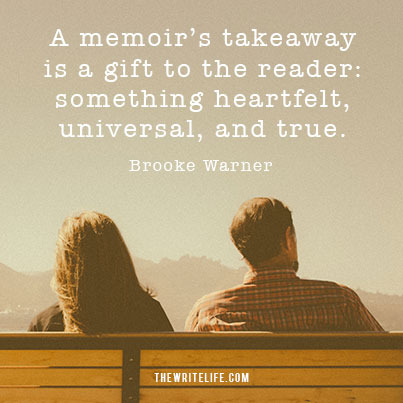
      Takeaway is your gift to the reader. It’s a message, reflection, or truism.

      Sometimes these fall at the end of scenes or the end of chapters, but that’s not always necessary. Takeaway can happen at any moment, when the author shares something heartfelt, universal, and true.

      It’s those moments in reading memoir that hit you hard because you can relate—even if you haven’t had the exact experience the author is describing.

      quote about a memoir's takeaway being a gift to the reader

      Understanding takeaway is a long process, and some authors, when they first start thinking about takeaway, make the mistake of being too overt or trying too hard.

      These are subtle moments of observation about the world around you, a wrapping up of an experience through a lesson learned or the sharing of the way something impacted you. The idea is to sprinkle these moments into your chapters, without overwhelming or spoon-feeding your reader.

      Good writers do this so seamlessly you don’t even realize it happened, except that you feel like he or she has burst your heart, or crushed you with the weight of their insight. You feel like you know the author because it’s as if she’s speaking directly to you.

      Good takeaway is, in fact, mirroring. It’s a way of relaying that we are not alone and the world is a crazy place, isn’t it?

      As an example, here’s a reflective passage from Elizabeth Gilbert’s Eat, Pray, Love: One Woman’s Search for Everything Across Italy, India and Indonesia:

      But is it such a bad thing to live like this for just a little while? Just for a few months of one’s life, is it so awful to travel through time with no greater ambition than to find the next lovely meal? Or to learn how to speak a language for no higher purpose than that it pleases your ear to hear it? Or to nap in a garden, in a patch of sunlight, in the middle of the day, right next to your favorite foundation? And then to do it again the next day? Of course, no one can live like this forever.

      Elizabeth Gilbert

      Not all reflective passages have to be questions, but you can see that this technique is effective. Gilbert is ruminating over the life she’s living, but which she cannot maintain; in her experience—through the vantage point of her American understanding of the world—it’s not possible, and undoubtedly 99% of her readers agree.

      We all know what it feels like to be saddled by the burdens of everyday life. Gilbert’s readers would feel this passage on a visceral level, even if they’d never before been to Italy, because everyone understands the longing that’s wrapped up in allowing yourself to just let down. And that’s what makes this a takeaway; it’s a universal connection to the reader.

      Now get out there and write!

      When you follow these examples and these seven guidelines for writing your memoir, you will captivate your audience and leave them begging for more.

      But more importantly, you will share your own authentic story with the world.

      Ready to learn more about sharing your story with the world?

      [sps_reusable_block post_id=43046]


      This is an updated version of a story that was previously published. We update our posts as often as possible to ensure they’re useful for our readers.

    • 5 Nonfiction Writing Techniques That Will Captivate Readers

      5 Nonfiction Writing Techniques That Will Captivate Readers

      Do fiction and nonfiction writing have anything in common?

      After all, their goals are fundamentally different. One wants to entertain, the other one mainly educates.

      But take a look at Hunter S. Thompson’s work and you will know better. Thompson was a master at crafting tight, compelling fiction, and he used these very same fiction techniques to become one of the most highly acclaimed and fascinating nonfiction writers in history.

      [sps_reusable_block post_id=43045]

      How to write a nonfiction book using fiction techniques

      There’s no doubt: If you want to hook your audience, some story techniques come in extremely handy. It’s basic human psychology.

      Take a page from your favorite fiction writer and adopt these five nonfiction writing tips.

      1. Tell a memorable story

      Humans have been fascinated by stories since the dawn of time. At lunch, we tell our newest stories to our co-workers; at night, we tell fanciful tales to our kids and then consume suspense from our flatscreens.

      We remember stories much better than abstract rules, formulas or concepts. Your post or essay will be stronger and more relatable if you include little examples, experiences and comparisons.

      For example, instead of saying “Spinach is healthy,” you could tell a story about a runner who improved his performance by eating a lot of spinach. Just two or three additional sentences is often enough to help your words hit home for the reader.

      2. Bait your audience

      Great fiction grabs you right at the beginning and doesn’t let your attention go until the end. Why not do the same with your nonfiction?

      If your article is online, it’s in direct competition with thousands of other articles; your reader can choose from all of them instantly, and mostly for free. She could also just close her browser and go watch TV. In today’s multimedia world, attention is the number one commodity.

      Does your first sentence make the reader want to read the second? Does your second sentence evoke curiosity for the third? Here are a couple of options for beginnings that I found worked best for my blog:

      One strategy is beginning with a little personal or historical story. Take a look at the storytelling tips above and make sure to always keep the reader wondering what’s next. Before he knows it, he will be halfway through your article.

      You could also ask a question that moves your audience. If you write an article about how to save money, how about a start with “Isn’t it frustrating that at the end of any given month, there is no money left in your wallet?“ That’s how you put yourself in the reader’s shoes, to make her identify with you and your article.

      You could start with an interesting or funny thought, too. When you’re writing about the phases of the moon, why not begin the post like this: “Did you know that on the moon, you would only weigh 16.5 percent of your weight on Earth?”

      By using one of these strategies, you have a better chance of catching your reader’s attention — and keeping it.

      3. Use emotional language

      Bad nonfiction pieces are overly factual and prosaic. (Think of the last academic paper you read. Snooze!) They often employ a certain “code” of complex sentence structures and foreign words to make them seem more credible and expert-like.

      The antidote: use more imagery, more emotion and more personality. Metaphors are also an interesting way to add some spice. Instead of writing “double-digit percent fluctuations,” write, “a rollercoaster ride of ups and downs.”

      The less abstract your nouns, the better. Any noun of something you’re able to touch physically is better than something you can’t touch. Palpable words draw the reader into your text more effectively, so he experiences them instead of simply reading them.

      Certain words like ”confession” or “magic” are emotionally charged power words that hit your audience strongly. They make them feel your content. Power words can evoke vibrant emotions, and emotion will keep the reader’s eyes glued to every single word of yours.

      So read some Hemingway or Dickens, reconnect with the emotional side of your writing, and stir up your audience’s feelings!

      4. Say it simply

      Have you ever given up on an article or instruction manual because its wording frustrated you? If you have great content, don’t encrypt it. Provide even more value for your reader by cutting the content down into easily digestible bites.

      Look at any post on The Write Life: The content is top-notch, but it’s all packed into short sentences and easily understandable vocabulary. Ideas are broken down into detail. You see short paragraphs and a lot of white space. All the components of tight, simple writing are right before your eyes.

      Many great novels are written in a fairly simple style. They impress with story rather than with wording. Take any novel by Charles Bukowski: Do you think his prose would have the same effect if it used long-winded, multi-clause sentences and a jungle of technical terms? Rather than trying to make a sophisticated expression, Bukowski conveys emotion and character.

      Say it as simply as possible, but make sure your idea comes across.

      5. Surprise the reader

      Good fiction is full of surprising twists, but nonfiction often reads predictably, which is to say, dull.

      Do it better and include an unexpected twist or turn when you can. It will keep things interesting and fun for your audience. Why do we watch dramas and why do we like our gifts wrapped up? It’s for the kick of the surprise that awaits us.

      Keep readers on their toes by asking them a question and answering it in a way they wouldn’t have expected. For example, if you are writing an article about robots, you could ask: Which famous person drew early plans for a robot?

      (Answer: Leonardo da Vinci drew up plans for an armored humanoid machine in 1495.)

      You could also make a statement and follow it up with a point that seems like a contradiction. Don’t forget to explain and reconcile your points. A surprising joke or a provocative comparison can keep the reader interested as well, provided it fits your style and the format of your writing. Be imaginative, just like a fiction writer.

      Finally, how can you train yourself in the above techniques?

      One way helps for sure: read a lot of great fiction. The storytellers’ styles and strategies will spill over into your unconscious, and before you know it, you’ll be a master at helping every reader fall in love with your writing.

      What do you do to grab your reader’s interest? Share your secret weapons in the comments!

      This is an updated version of a story that was previously published. We update our posts as often as possible to ensure they’re useful for our readers.

      [sps_reusable_block post_id=43045]

      Photo via Dean Drobot / Shutterstock 

    • Get Paid to Write What You Want, Skip Boring Writing Jobs

      Get Paid to Write What You Want, Skip Boring Writing Jobs

      It’s been said that a good writer can write about anything.

      That might be true, but it’s usually mentioned as a subtle jab when you’re resisting an assignment. And it completely ignores whether you want to write about some tedious topic just to make a buck.

      I was once paid $25 per hour to ghostwrite articles on overt and covert pre-employment testing. I did hours of research on topics like how to use these tests to identify drug users or to screen out employees who are more likely to file worker’s compensation claims. It was interesting for a while, and then it wasn’t anymore. Despite having a satisfied client, I had to quit after writing a few articles.

      I’m not suggesting you never write about subjects that bore you. We all have to pay the bills, and good writers can write about most subjects with a little research. Hey, I spent a hundred hours writing for my website about carpet stains. It wasn’t fun, but I’ve earned more than $59,000 from the site, so I guess it was worth it.

      However, writing for my website about ultralight backpacking was much more interesting, and you know what? That site has generated $56,000 of income over the years.

      How to get paid to write what you want

      What can you learn from my story?

      Figure out ways to get paid to write what you want to write.

      Before you say it’s impossible, here are five options to try.

      1. Create a website or blog

      First, a warning: It’s tough to make money with a website or blog.

      For many years my wife and I wrote about anything that interested us, put it on our websites, and made money from Google AdSense ads. At one point we made more than $10,000 per month, but alas, that revenue is now down to about $900 per month and it continues to fall due to changes in the search engine algorithms.

      So it’s no longer that easy to make money from a website. In fact, to succeed now you need a decent niche based on keyword research, search engine optimization skills (if you don’t pay for help) and a solid marketing plan.

      On the plus side, there are many ways to make money from a blog besides Google AdSense. Create and sell ebooks, or dive into affiliate marketing. And for a freelance writer, the most obvious might be to use it as a way to connect with clients.

      Since you can start a blog for less than your weekly coffee budget and write about whatever you want, it might be worth a shot, right?

      2. Approach clients you want to work with

      Freelancing has some limitations, but subject matter isn’t necessarily one of them. Just choose the right clients.

      OK, if you get a particularly lucrative contract to write about the historical spread between short and long-term interest rates, go for it (remember those bills).

      But why not also seek out the owners and editors of businesses and websites you love and send out a few proposals and queries?

      Writing in a niche you enjoy makes the work go much quicker — plus, it’s fun to get paid to write about experiences or subjects you love.

      3. Write first, sell later

      In a previous post I suggested writing an article before pitching it, but I forgot to include what may be the biggest advantage of that strategy: You can write exactly what you want.

      Yes, an editor may want changes, but at least you get to write what you want about a subject you enjoy.

      I wrote this article because I wanted to. You’re reading it because I wrote it first, then proposed it to The Write Life. If they hadn’t wanted to run it, I would have tried selling it elsewhere, or maybe I would have put it on one of my websites to make something from ads on the page.

      When you write an article just because you love the topic, you can have a particular client in mind, or you can look for a buyer once the piece is finished. All sorts of websites pay for content — there are even websites that pay for personal essays — so why not write a few pieces you really want to write? You might sell some of them.

      4. Write a book and get it published

      It isn’t easy to publish a book traditionally, and even if you succeed and then use all the tricks for maximizing your book profits, you may not make much. While selling books can be a challenge, there are many major success stories. Consider the iconic example of J.K. Rowling becoming a billionaire from her Harry Potter series. You never know!

      Here’s my more modest example: I wrote 101 Weird Ways to Make Money because an editor at Wiley discovered my website and my 5,000-subscriber newsletter on that subject. (Keep that in mind; publishers love to see that you already have an author platform.) He called me and asked me to write the book.

      I had the website and newsletter because I’ve always been fascinated by ways to make money, and I love writing about them. So I spent six weeks writing a book on one of my favorite subjects. In four years, I’ve made only $19,000 in royalties because I’m a slouch when it comes to marketing my book. But I enjoyed writing the book and I got paid.

      So write the book you want to write, and then see if you can get it published. It’s worth trying at least once. If you don’t find a publisher, consider the next option…

      5. Self-publish your book

      When you self-publish, you can write whatever you want. You don’t need to send query letters, make unwanted changes or get approval from anyone for anything. I’m not saying you should ignore good advice or skip hiring an editor, but it is nice to have more control over your work.

      Of course, publishing in printed form can get expensive. Authors who share what it costs to self-publish their books report a wide variety of experiences, but I spent less than $900 each of the two times I’ve self-published print books. I may have lost $100 on one book — the one I most-enjoyed writing (sigh). I made about a $3,000 profit on the other, and it took me a month to write it.

      Rather than publish in print, I prefer to self-publish on ebook platforms like Amazon Kindle. I’ve made thousands of dollars from the books I’ve published there, and the most I have ever spent was $15 each for a few cover designs. With royalties of up to 70%, you don’t need huge sales number to make decent money with Kindle books, so write what you want and throw it out there to see if it will sell. Here are some more useful tips on how to self publish a book.

      Of course, spending time and money on marketing could have helped my sales, but I just wanted to write. I’m not suggesting you emulate my apathy toward marketing. It’s far more important to your success than your writing skills if you hope to make much money from your work. But I was content to take what should have been marketing time and spend it writing yet another ebook, hoping that too would sell a few copies.

      Just write what you want

      At some point, I’ll probably have to write again about employment tests or something equally boring (to me) just to pay the bills.

      But for now, I’m going to finish this article and work on a short story about a disease that stops people from killing each other. Who knows if I’ll ever get paid for that (not likely), but sometimes you just have to write what you want to write.

      How often are you able to make money from your most enjoyable and creative work — the stuff you want to write?

      This is an updated version of a story that was previously published. We update our posts as often as possible to ensure they’re useful for our readers.

      Photo via  Igisheva Maria/ Shutterstock 

    • Conduct Better Phone Interviews: 5 Strategies for Freelance Writers

      Conduct Better Phone Interviews: 5 Strategies for Freelance Writers

      For freelance writers who work with magazines or online publications, completing phone interviews is a way of life.

      Technology, social media and email have certainly made it easier to connect with sources, but when it comes to writing a feature story, phone interviews beat email every time.

      Why? As a writer, when you speak with a source on the phone, you’re able to:

      • Build rapport and a comfortable dialogue with a source.
      • Put an interviewee at ease, making them more likely to share compelling information.
      • Ask provocative questions that build off of previous questions and answers.
      • Hear and feel the person’s emotions as he shares his story, giving you a better understanding of the given topic.
      • Find new angles or hidden gems that might not have been shared if the interview had been completed via email.
      • Save the interviewee the work and time of having to type her answers out in an email.

      Strategies for conducting an effective phone interview

      After completing phone interviews with sources and experts for magazine feature stories, I’ve found a few strategies can lead to better, more insightful conversations.

      Here are five phone interview tips that will help you write better stories.

      1. Be prepared for the interview

      There’s nothing worse than jumping on a call with a source with little to no background information.

      Do your homework and research the person before your interview. Ask your editor for as much information as possible about the source ahead of time, and come to the call with a list of pre-written questions to get the conversation going. Not only will you appear more prepared, you’ll put the source at ease with your level of professionalism.

      Plus, when you prepare well beforehand, you can often complete an interview much more quickly than if you hadn’t done your homework. I like to schedule phone interviews for 30-minute blocks. With the right amount of pre-work, I’m able to stick to that timeframe, helping me complete interviews more efficiently, and feel confident I’ve collected all the information I need.

      2. Start with a softball to break the ice

      To get the best interview possible, you need your interviewee to feel comfortable. When a source feels relaxed and at ease, you’re in a better place to find the most compelling angle and capture quotes that will enhance your story.

      Start the phone interview with general pleasantries and small talk. I find this strategy often helps the source feel more comfortable speaking with me because he recognizes that I’m a real person, just like him.

      To ease into my list of interview questions, I like to ask this one first: Tell me a little bit about who you are and how you got to where you are today.”

      This question helps the interviewee open up, gives you some much-needed background information and lays the groundwork for the questions that will come later in the interview. Also, this open-ended question gives you the chance to learn something new that might help the story and trigger other interview questions.

      3. Listen (and resist the urge to talk)

      Depending on if writing is your full-time gig or a side hustle, listening carefully may prove difficult.

      In my role as the founder and CEO of a content management agency, I’m usually the one talking, consulting and teaching my clients. Being quiet and truly tuning in to a source can be challenging. I find myself wanting to have a two-way conversation, and while it’s great to build rapport with the person you’re interviewing, you’ll get a better story when you keep your mouth shut and let the other person do the talking.

      On some calls, I don’t speak for 10 minutes — I’m busy furiously listening and taking notes. I don’t record my interviews, so taking clear, concise and accurate notes is of utmost importance, making listening carefully even more crucial.

      And these calls where I don’t speak for 10 minutes at a time often give me the best information.

      Resist the urge to interrupt with further questions or comments while a source is telling her story. Instead, write down your comments or questions and wait for the interviewee to finish speaking before you jump in and move the conversation forward.

      4. Embrace the silence

      Silence can feel uncomfortable, but in the case of phone interviews, it can be pure gold. Sources often share crucial bits of information if you let the silence linger just a little bit.

      Because of the feeling of discomfort or awkwardness, the person you’re interviewing will generally jump to fill the silence…and he’ll often fill it with great information you may not otherwise have been able to pull out of him.

      Plus, when you leave room for a little silence, the interviewee has a moment to reflect, gather his thoughts and perhaps share information in a different and more quotable way than before. Don’t fear the silence; practice embracing it and you will soon be reaping the benefits.

      5. End interviews with this question 

      Here’s the best question you could ask at the end of an interview: “Is there anything else I should know?”

      As the writer, you’ve come to the interview with a list of questions. You have an idea of the information you need from a source to complete your story. However, the interviewee is usually a wealth of knowledge… and there may be an important question you haven’t asked.

      To make sure I get all the information I need before hanging up the phone, I end all my interviews by asking the source if there’s something she hasn’t had the opportunity to share but feels would benefit the story. Usually there is a question I haven’t asked, and some information the source is dying to share.

      It’s usually a hidden gem that I only discover in asking that last open-ended question.

      Or, sometimes the interviewee doesn’t offer new information, but summarizes everything you’ve talked about with a quote that’s the perfect addition to your story.

      You’re a writer, yes. But you can make your job a whole lot easier — and do that job better — if you ask good questions.

      This is an updated version of a story that was previously published. We update our posts as often as possible to ensure they’re useful for our readers.

      Photo via GuadiLab / Shutterstock 

    • How to Be a Successful Writer: Stop Comparing Yourself to Others

      How to Be a Successful Writer: Stop Comparing Yourself to Others

      When I get frustrating news from my literary agent, and then I see famous writers I admire tweeting about their successful careers, it can make me feel bad.

      Likewise when I haven’t had a productive writing day, and I notice writers chatting away in a Facebook writing group about their amazing daily word counts.

      It’s hard not to compare yourself to your peers, your colleagues, or even the people you look up to in this age of nonstop social media. Comparing yourself to other writers, though, is not only unproductive — it can be downright harmful. And it certainly doesn’t help you figure out how to be a successful writer.

      The next time you feel the urge to compare yourself to Stephen King and wonder why you’re not yet a bestseller, here are some reasons why you shouldn’t sweat it.

      1. Each writer has a different process

      You may read about writers who write first drafts quickly and don’t edit until they are finished. But maybe you like to edit as you go.

      You may read an article about how productive it can be to write in the morning. But maybe you work better at night.

      Just because one way of writing works well for one writer does not mean you’re not allowed to write in a different way. It can certainly be helpful to find out about different writing processes, but don’t be afraid to try different things and find the process that works best for you.

      2. No writing advice works for everyone

      It’s important to read writing craft books, to take writing classes, to read blogs like this one, and to seek advice from other writers. A lot of this writing advice will be extremely helpful to you, but some of it won’t.

      In a workshop, you might be advised to kill off a character in your story or to take out that last line in your poem. Sometimes advice won’t resonate with you or help you to create the piece you want to create. It’s a good idea to listen to those who have studied the craft, but don’t forget that all art is subjective. Don’t be afraid to listen to your gut and think for yourself.

      3. Each writer has a different publishing journey

      Some people write eight books before they finally publish the ninth. Some people have a dream about vampires and try writing for the first time and have a bestseller on their hands within two years.

      It takes some people two months to get a literary agent and sell their manuscript to a publisher. It takes others two years.

      And self-publishing? It works really well for some writers, but others won’t even touch it, preferring the traditional route. Even within the realm of self-publishing, some writers love Kindle publishing, and some writers love iTunes and Barnes & Noble.

      There are so many different ways to go about publishing your work. If you try to follow someone else’s publishing path, it may not work. You have to find your own.

      4. Your passions and experiences make you a unique writer

      It may be tempting to look at J.K. Rowling and think you really need to write a story about wizards because that seemed to work for her. But it’s more important to find the story only you can tell.

      What are you passionate about? What excites you? What kinds of experiences have you had that makes your writing unique? Instead of trying to imitate a story that was successful for another writer, find the story you need to tell. Find out how your writing is unique and embrace it.

      So next time you find yourself reading your favorite author’s tweets and feeling like you aren’t going anywhere because you aren’t having the same experience, stop.  

      Take stock of the things that are working for you in your writing and in your career.

      Maybe you don’t have a bestselling novel, but your short story was just accepted by a publication you admire. Maybe you didn’t write 3,000 words today, but you wrote 1,000.

      Instead of comparing your writing and publishing experience to the experiences of others, take a minute to appreciate the experience you’re having.

      Ever get caught in the comparison game? How do you snap out of your funk and appreciate your own writing journey?

    • 6 Tricks for Writing Eye-Catching Headlines Your Editor Will Love

      6 Tricks for Writing Eye-Catching Headlines Your Editor Will Love

      When you’re pitching an article or writing a blog post, nothing is more important than your headline.

      Goldfish have longer attention spans than Internet users, so how can you expect your audience to stick around for 900 words if they’ve already checked out halfway through your title?

      If you want to keep readers locked to your content, try using these six psychological ploys that writers have been using for decades. Alone or in combination, they’ll help you create killer headlines.

      1. Ask a question

      When a person reads a question, one of two things happens.

      On one hand, they may realize that they don’t know the answer to the question:

      How Much of a Facebook Creep Are You Compared to Everyone Else?

      Human beings are chock-full of curiosity. Once we find out we don’t know something, we feel an urge to shore up that knowledge gap. That blue, underlined text is a tiny promise that instant gratification in the form of an answer is just a click away.

      On the other hand, they may think to themselves that they do know the answer:

      Ever wanted a Glow-In-The-Dark Toilet?

      Even if the answer is “no,” this tiny bit of interaction creates investment for the reader. A headline structured as a statement can glide through a reader’s mind without them forming an opinion, but a question forces a reader to personally engage an idea.

      That may seem like a small thing, but even the smallest degree of investment is crucial on the Internet. Remember: You are competing with cats jumping and missing their landings.

      2. Start with a number

      6 Old-School Rules You Should Break as a Freelance Writer

      Before we begin a task, we generally like to know how long it will take. This is why the Pomodoro Technique is so popular and why the DMV is so unpopular.

      When a headline begins with a number, it lets the reader know about how long it will take to read. Medium caters to this same psychological need by tagging each article with a length in minutes.

      If your audience is in a rush, use a number to let them know you won’t take up much of their time.

      3. Attach yourself to an established brand

      The parody site Clickhole demonstrates how effective this technique can be by regularly posting articles that are effectively lists of celebrity names devoid of any context whatsoever. These lists generate enough traffic that they’ve become a staple of the site.

      Some non-humorous examples include headlines like:

      36 Things Everyone Who Loves “Jurassic Park” Will Appreciate

      Should I Try the Matthew McConaughey Diet?

      By attaching your article to an established idea, product, or person, you can “piggyback” off the reader’s pre-existing interest. Of course, this only works if the reader is already a fan of whatever you are attaching your article to. Someone with no interest in Matthew McConaughey or Jurassic Park (what a sad person) would be far less likely to click on the above links.

      4. Begin with “How to”

      How To Get Clients as a Freelance Writer: 10 Brilliant Strategies

      This may just be the most powerful tool in the box. Everyone has problems, and everyone is scouring the Internet looking for solutions. As a writer, one of the most useful roles you can serve in the lives of other people is that of a problem solver.

      Starting with “how to” says, “Reader, I know you have a problem, and I sympathize with you. But the good news is that I know the solution to your problem, and even more: I’m going to show you how to resolve it in a series of clear steps.

      That’s a lot of muscle for just two words. “How to” communicates a promise of no-nonsense, valuable content that the reader can put into action in his or her life.

      5. Engage curiosity

      Are you ready to know the writing community’s best-kept secret for engaging a reader’s curiosity? Don’t write another blog post until you’ve mastered this simple trick!

      Ah, the neverending search for truth, treasure and secrets. Asking a question isn’t the only way to make a reader eager to continue reading. If you really want to hook a reader by the gray matter, use your headline to hint at secret knowledge you’ll reveal in your article:

      9 SEO Secrets Every Business Should Know

      Of course, in the age of the Internet, real secrets are few and far between. The combined knowledge of human experience is at our fingertips, after all. So what articles like the one above really do is dress up useful information in an alluring way. An article titled “Practical SEO Strategies for Businesses” might contain the exact same content as the link above, but the headline is far less engaging.

      Another way to do this is to tell a micro-story that sets up a reader’s expectations and promises that they will be surprised. This trick has been around since at least 1926:

      They Laughed When I Sat Down at the Piano, But When I Started to Play!

      6. Threaten

      This can be something of a shady trick, but it’s definitely effective and this list wouldn’t be complete without it.

      People don’t like the idea of losing something important to them. Deep down, we’re all scared to lose our health, our physical appearance, our children, etc… For everything a person can love, there is a fear that the object of our love will be taken away or suffer harm.

      As a result, headlines that tap into suspicion, paranoia and insecurity always garner a lot of attention:

      19 Signs You’re Dating a Loser

      The Shocking Truth About Alien Abductions (They’re More Real Than You Think)

      This technique is so effective and works so well across varying audiences that major news outlets have been using it for years in spite of the fact the world is safer now than it has ever been.

      What are your nifty tricks for penning a compelling headline? Share your favorites in the comments!

    • This Writer Reads 365 Short Stories a Year. Here’s Why

      This Writer Reads 365 Short Stories a Year. Here’s Why

      It is hard to deny the power of a short story. A good one can command your attention, present unique characters in unpredictable situations and deftly tie up all the loose ends by the end.

      Unlike a novel, a short story doesn’t give an author sixty thousand words to shoehorn in every possible idea or to resolve complex situations. Short stories have to contain tight plots and believable (but not clichéd) characters, and they have to convey everything concisely.

      This is no easy feat, which is why reading and understanding short stories offers an author so much value — and why I now read one every day.

      Why writers need to read short stories

      About a year ago, already an avid novel reader, I resolved to read more short stories. My rationale was simply that I hadn’t read enough of them, and should be more familiar with the form.

      After reading more than 50 of them, I realized I intuitively understood far more about the craft of writing fiction than I ever had before. It wasn’t an instantaneous progression, but as I worked on my own short stories and novels, as I fleshed out characters, as I reworked plots, my writing became more fluid and I felt like I had a sudden wealth of stories to draw on.

      I’ve been reading and writing regularly since I was seven years old, so why would I suddenly understand more after a few weeks of a new habit?

      Because short stories offer a condensed version of everything a novel does.

      Short stories aren’t missing any important elements of fiction; they still contain a complete story arc and developed characters, they still reach a climax and include a denouement. While they may be notably shorter in length, short stories include all the same elements as novels, crafted extremely well to preserve space.

      This is why I was suddenly improving so rapidly. A regular short story reader can quickly become familiar with hundreds of plots, hundreds if not thousands of characters, new settings, styles and other elements of the story. While reading a novel might show you a particular author’s interpretation, plot structure and character development, a collection of short stories can easily provide 15 or 20 “case studies” in the same size book — so you can learn much more quickly.

      But then there is the problem of actually reading them. How many short stories have you read? Is it more than novels? It should be. After all, they’re shorter. But most of us decline the opportunity and favor longer works instead.

      There is comfort in reading novels because once you’re familiar with a character, you can enjoy a fairly long journey together until the end. In a short story, however, you only have each other for a handful of pages before it’s over. Appreciating each short story requires a little extra focus and dedication, and this makes it easy to say, “another time maybe. Today, a novel.”

      How to make more time to read

      Everything is easier when you have a habit in place. If you take time off from work to write but don’t have any habits or schedules, you’ll eventually crawl back to your cubicle, forced to admit that you somehow spent the entire staycation browsing the Internet, binge watching Netflix and eating Nutella straight out of the container.

      This is a normal human behavior (well, maybe not the Nutella part): Without an effective schedule, it is entirely too easy to push off the work you want to do and prevent yourself from being productive in the short term. It is a myth that reading or writing requires a lot of time.

      Create a daily habit

      First, set a goal. Having seen the benefits of reading short stories, I’ve resolved to read 365 a year — one short story, every single day.

      The best way to solidify a daily habit is to decide to do it before anything else. The earlier in the day you enlist a new habit, the more likely you will do it because you don’t have any good excuses. If you plan to do it before you go to bed, you’ll tell yourself you’re tired, you’ll do it tomorrow night, you pushed it off too long. If you do it first thing in the morning, however, you wake up and there it is, your new habit.

      I’m sure if I was really dedicated I would read my story before making coffee, but that’s too extreme for me. So I get up, make coffee, and start my day by drinking coffee and reading a short story. As it probably takes me 20 minutes every morning to drink my coffee anyway, it doesn’t even impact my morning schedule. If you’re a habitual morning rusher, then maybe get up 10 minutes earlier. You don’t need a lot of time.

      The first day I tried this habit, I didn’t expect I would like it. Before even cracking my first anthology of short stories, I anticipated it would feel weird — usually, I’m a night reader — and mornings are meant for boring productive things like newspapers and shaving, not reading stories about pro bono detectives searching for missing husbands in stairwells. But I went ahead and read a story anyway.

      It was awesome. I felt more awake after I finished it. I spent the day occasionally thinking back to it, processing themes and concepts, and — most importantly — even if I got jammed up at work, wrecked my car and got lost in the Amazon with nothing but a toothbrush and some duct tape, I had already read a short story. No matter what, I met my goal for the day.

      Enjoy discovering new inspiration

      It proved to be an easy habit to initiate and an even easier one to maintain. Set a deadline first thing in the morning, be aware of the big picture (365 stories a year) and stick with it.

      If it seems like a simple suggestion, that’s because it is. This isn’t a groundbreaking system, just a way to familiarize yourself with almost 400 extra plot lines, tons of fascinating characters, and great examples of pacing, narration and sentence structure, all while drinking your morning coffee.

      Do you read short stories for inspiration or to improve your craft as a writer? Have you noticed a difference in your work?

    • Writing a Book? How to Know When to Stop Editing and Move On

      Writing a Book? How to Know When to Stop Editing and Move On

      You’ve done it: written a novel, revised it, sought outside opinions and revised some more. Maybe your magnum opus has gone through endless drafts.

      But something’s still not right. Either it’s not shaping up into the book you hoped it would be, or it’s not getting the reception you want from agents and publishers.

      It’s tempting to keep re-working the manuscript. I spent years laboring over a historical novel set during a yellow fever epidemic in New Orleans. How many iced mochas did I down in the coffee shops where I did my writing? How many hours did I spent in library archives perusing microfilm copies of 19th-century newspapers? There’s no telling. Even with all that effort, the story never quite worked.

      Sometimes, the best thing you can do for your writing career is to shelve your project and begin anew. Here are some things to keep in mind when you’re wondering, “Should I stay or should I go?”

      Quantity trumps quality

      Fail Fast, Fail Often tells a story about a ceramics class. Half the class is graded on the quantity of work they produce, and the other half is graded on its quality. Anyone in the first group who makes fifty pounds of pots gets an A. Anyone who produces a great pot in the second group gets an A, even if she makes only one pot for the whole semester.

      Spoiler alert: The students in the quantity group make the best pots. While the quality kids are hemming and hawing over how to make the perfect pot, the quantity kids are experimenting, learning from their mistakes and getting pretty darn handy with mud.

      Writers could benefit from adopting this quantity-over-quality mentality, as well as remembering writing is a craft that benefits from repetition.

      You may be holding yourself back from your best work

      Stephen King is one of my favorite writers, and the man is prolific — he’s penned 54 books. But compare book one (published in 1982) of The Dark Tower series to book five (published in 2003). In between those volumes, he published 26 novels.

      King becomes a much stronger writer after he has written dozens of books. Where would the world be today if King had spent a decade polishing Carrie? We wouldn’t have The Stand, The Shining, Cujo, Christine… the list continues.

      It gets easier

      My debut novel, which comes out next month, is not my first, second or third manuscript. It’s actually my fourth full-length novel. And while it is better than the three that came before it, it is nowhere near as good as my fifth manuscript, which I’m plugging away at now.

      Each time, the process gets a little easier and the outcome gets a little better. I’ve learned plotting, pacing, dialogue, conflict, how to cut away the dead weight and recognize the sound of my own voice — by doing these things again and again. If I was still working on the same novel I’d started in 2004, I’d be very much like the proverbial dog returning to its vomit. (It was a really terrible draft.)

      Don’t become emotionally attached to your work

      Writers often use birth as a metaphor for the writing process. They describe their relationships with their manuscripts as a sort of dead-end romance.

      But a manuscript is not a baby. It is not a lover. While I understand why writers develop emotional attachments to something that occupies so much of their time, minds and hearts, this is not a productive way to use your energy. Give those words a beginning, middle and end, and move on.

      Starting anew is a sign of success

      A lot of writers believe if they “abandon” their manuscripts, they’re admitting failure, that they’ve wasted their time. Starting a new project isn’t failure. In fact, it’s the opposite of failure.

      Every sentence you write is a success. Every sentence you write lives inside you forever and makes each subsequent sentence better. No sentence you write is ever wasted.

      Have you ever struggled with whether you should let go of a project or give it one more revision? How did you make your decision?

    • How to tell Personal Stories Through Blogging (And Avoid the Narcissism Trap)

      How to tell Personal Stories Through Blogging (And Avoid the Narcissism Trap)

      It’s not easy to write a first-person story in a way that will interest anyone other than your mother. In fact, “this happened to me” and “here’s what I think” posts are what earned blogging its narcissistic reputation.

      But then a writer like Lisa McKay comes along and so eloquently shares her own personal story about her husband’s cancer diagnosis. Only she’s not writing in retrospect, with the insight of knowing how her story will end. Instead, she’s telling this tale as it unfolds.

      Lisa points out just how hard this is to do in yesterday’s post, A Note from the Messy Middle:

      I’ve been thinking this morning about … [how] good writing usually has beginning, a middle, and an end. It tells a story. It has a point; it’s not just an unfiltered brain dump.

      We’re thrashing around in the middle of this story right now. Even though it only started just over three weeks ago, I can hardly remember that part anymore. The ending is still a long way off. And in the messy, map-less middle of this ugly story, all I’m pretty much capable of right now is an unfiltered brain dump.”

      Except that anyone who reads the post knows it’s more than a brain dump, that Lisa manages to find a point even when writing from the messy middle. Her honesty about how she feels might even bring you to tears.

      Lisa’s able to share her personal stories in ways that resonate with readers in part because she has practice under her belt; she’s the author of two memoirs, including her recent Love At The Speed Of Email, which chronicles how she fell in love with her husband Mike.

      We don’t often feature individuals’ work here at The Write Life, but Lisa’s latest posts are solid examples of how to tell personal stories well, whether through a memoir or on a blog, a goal so many writers struggle to achieve. As you root for her family over the coming months, be sure to learn something from her writing, too.

      What other bloggers tell personal stories well? Let us know in the comments!