Blog

  • What’s on Your Wish List for The Writer’s Bundle 2016?

    What’s on Your Wish List for The Writer’s Bundle 2016?

    For the past two years, we’ve offered The Writer’s Bundle, an amazing package of writing resources for a limited-time low price.

    It’s been a great opportunity not only for us to share top-notch courses, guides and expert knowledge; but also for you to make a major investment in your writing and business skills for a considerable bargain.

    As we enter the new year, the TWL team is kicking around ideas for partnering with experts and creating more content to help you succeed as a writer.

    But as we complete our own brainstorming exercises, we’d love to know:

    • Which resources would you love to see in a 2016 version of The Writer’s Bundle? Which guides, courses, or programs are on your professional-development wish list?(Check out The Writer’s Bundle 2015 and 2014 to see what we’ve included in the past.)
    • Is there a particular skill or concept you’d like to learn about, but can’t find a resource that covers it? Let us know what you’re searching for — perhaps we can serve as a continuing education concierge in the comments.

    Share your thoughts in the comments so we can help you continue to create, connect and earn in 2016!

  • Beyond Books: 12 Gifts Under $25 for Book Lovers on Your Holiday List

    Beyond Books: 12 Gifts Under $25 for Book Lovers on Your Holiday List

    You probably have at least one voracious reader on your shopping list this holiday season.

    She’s the one who always has a book tucked under her arm or a Kindle in her purse. She’ll skip plans or show up late because she’s busy finishing a riveting story.

    She also seems to own every book ever published. So what do you get her for Christmas?

    A book worthy of gifting can actually be more of an expense during the holidays than you were counting on. But a gift worthy of a book lover can come in well under budget, if you’re smart about it.

    I’ll admit: I am that bookworm. Here are some fantastic gifts for readers, ones I would have loved (OK, still would probably love) to receive:

    1. Gift cards for ebooks

    Sure, a Barnes and Noble gift card seems like a given for anyone who loves reading.

    But when you want to stretch your budget, ebooks are the way to go.While a $25 gift card could cover one or two hardcover or paperback books, it could go much further buying ebooks that cost as little as 99 cents.

    Make sure you know the recipient’s preferred e-reader — if they have a NOOK, buy a gift card for NOOK books.

    Most devices can also support a Kindle reading app, so an Amazon gift card is usually a good bet for any voracious reader.

    For iPad and iPhone users, an iTunes gift card can buy ebooks in the iBooks Store. For Android users, a Google Play gift card will purchase ebooks.

    More popular with international users, the Kobo bookstore also offers gift cards at various retailers around the world.

    2. Audiobooks

    Does the reader in your life prefer listening to audiobooks? Skip books-on-tape (er, CD), and go to Audible.com.

    You can gift an Audible monthly membership, which gives the recipient one free audiobook per month, plus 30% off any additional books. But the minimum you can gift is three months, which comes with a $45 price tag.

    If you have a specific book in mind, Audible will let you gift those, as well. These tend to cost a little more than their hardcover counterparts. Harper Lee’s Go Set a Watchman, for example, is narrated by Reese Witherspoon and available on Audible for $24.49.

    3. Bookmarks

    Any reader will tell you she’s constantly digging for a bookmark. Mine usually ends up being some corner torn out of a nearby notebook I had to scramble to find.

    Bookmarks aren’t the kind of thing we like spending money on. But we love to get them as gifts.

    Grab a few with clever sayings that speak to your resident reader’s personality — like this one that reads, “Keep Calm and Read On.”

    I also love this fingerprint bookmark from Fred & Friends that helps you keep your place within the page!

    4. Book light

    Paper books don’t come with the built-in light you get in an e-reader. That leaves us trying to balance courtesy on a flight, in bed or on a bus at night with the insatiable need to read just a little more…

    With the resurgence in popularity of “real” books over ebooks recently, it stands to reason your bookish friends may be in need of a book light for the first time in years.

    The most popular book lights on Amazon sell for less than $20. Look for something lightweight, with an LED bulb for longevity and a flexible gooseneck.

    5. Typography art

    You know those memes your friend is always sharing on social media? Now she can hang them on her wall!

    Nab one of these Jane Austen quotes from SpoonLily Design Company on Etsy for $14.99 plus shipping. They’ll make a nice fit for decorating a home office, library or classroom.

    For an even better price, download printable art and print it on matte photo paper to create a DIY poster.

    6. Bookends

    Another adorable addition to a home library or office, bookends are a fun way to personalize a basic storage solution.

    As a gift, they’re a cool way for you to show the recipient how well you know him — whether you tap into his affinity for owls, cats or something more classic.

    7. Floating bookshelf

    Wall-mounted bookshelves can be as decorative as they are functional. And you can find beautiful ones at pretty low prices.

    I’m personally fascinated by invisible bookshelves that make a stack of books look like it’s floating against the wall. For the minimalist on your list, “invisible” is about as minimalist as design can get!

    For a little more style, you could pick up this set of three plain white shelves for $16, or three walnut-finish U-shaped shelves for $19.95.

    8. Hands-free book stand

    Make someone’s life easier with this simple utility. Get a pretty wooden, adjustable, foldable reading stand for $14.99.

    Or, pick up this universal book stand a reader can use for books, cookbooks, e-readers or tablets for only $24.95.

    9. Coffee mugs

    Books and coffee go hand in hand. What’s cozier, especially as winter grows colder, than curling up with a good book and a warm cup of coffee (or tea)?

    And truly, a coffee drinker can never have too many mugs!

    Pick up affordable bookish mugs as stocking stuffers, teacher gifts or for the office Secret Santa. I love this one that simply states, “Reading is Sexy” — made from 100% biodegradable corn plastic.
    Or, go with another classic pair: readers and cats. Get a “Cats, Books and Coffee” mug on Etsy for $12.95.

    10. Throw pillows and blanket

    A good book, a warm cup of coffee and… What’s missing?

    Cozy up a book lover’s living room or study with a comfy throw pillow and blanket.

    Pick up a pillowcase with your favorite literary quotes plus the pillow inside, about $10 for the pair.

    Add a personalized fleece throw blanket for $12.99 — complete the picturesque scene, all for under $25!

    11. Sticky notes and tabs

    Another option for stocking stuffers or basket fillers, sticky pads and tabs are nice for a reader to have around.

    In those print books we can’t highlight with a swipe of a finger, these ancient relics help us remember passages we want to return to again and again. They’re also great, of course, for students and teachers to take notes as they read.

    So, why not make them as pretty as they are useful?

    Get this Van Gogh set for $5.99 or this cool set for teachers for $10.95.

    12. Forgotten English daily calendar

    This geeky desk calendar will excite any lit lover in your family or circle of friends.

    More than a typical word-a-day calendar, for under $10, this one supplies the definitions and origins of long-forgotten words of the English language.

    Is that reader on your list not so into classic literature? Try the Urban Dictionary Day to Day Calendar instead — $10.16 at Amazon.

    Your Turn: Are there book lovers on your Christmas shopping list? What are you buying for them this year?

    This post originally appeared on The Penny Hoarder

    This post contains affiliate links. That means if you purchase through our links, you’re supporting The Write Life — and we thank you for that!


  • 4 Ways to Manage Freelance Writing During the Holidays

    4 Ways to Manage Freelance Writing During the Holidays

    Who else takes freelance work home over the holidays?

    Since freelancers can work from anywhere, it often means that we have the luxury of spending more holiday time with family than our traditionally-employed peers who have to be back at work on Monday morning.

    Of course, we usually have to work on Monday morning too. Family members don’t always understand that just because you’re home for the holidays doesn’t mean you’re on vacation.

    How do you manage these expectations and ensure that your work gets done while keeping both clients and extended family happy?

    I’m coming up on my fourth year of holiday freelancing, so here’s my guide to getting it all done while also catching up with family and friends.

    1. Start with communication

    The easiest way to manage expectations is to communicate them. Tell your family members that you’re excited to see them this holiday season, and that you’re going to be spending part of your time working.

    Present this as a positive: Because you’re a freelancer, you have the opportunity to earn money and maintain your client relationships while still getting to see family for the holidays. Other people in the workforce don’t have this luxury.

    Once you’ve established that you’re going to work during part of your holiday visit, it’s time to communicate the boundaries of your workday. I often say, “I need to check in with clients in the morning, and I need to answer emails and turn in a few pieces. I’ll be available for holiday and family stuff after lunch.” You might also say something like “I need to spend most of Thursday working on freelance stuff, but I’ll be available to visit Grandma with you on Thursday evening, and I’ll also be available all day Friday.”

    Make these boundaries known early. Let your family know as soon as possible when you plan to be focusing on work along with which periods of time you’ve reserved for them.

    By communicating early, everyone can prepare for temporary schedule changes.

    2. Batch your workload

    If your typical freelance workday includes a lot of puttering around and chatting on social networks between writing pieces, it’s time to hunker down and focus.

    Try to batch your workload into small, distinct time blocks: 8 a.m. to noon on weekdays, for example.

    You need to avoid as much procrastination as possible to get your work done in a pre-defined time block. If you like to take 20-minute breaks between writing sprints, for example, you may need to cut that down to five-minute breaks. You don’t want to hear a disappointed family member say “I thought you were working!” when they catch you watching YouTube.

    If you can’t get all of your work done during the time blocks you’ve set for yourself, consider working a few extra hours after everyone else has gone to bed or before they wake up. I’ve gotten a lot of work done on family trips by staying up late or setting my alarm a little early.

    Pay attention to your family’s schedule to find the optimum time to work.

    Is your family the kind that likes to spend an hour or two after lunch relaxing in front of the TV? That might be your ideal work time. Have a parent who likes to spend the hour before dinner cooking up an elaborate meal? Grab your laptop and answer emails from the kitchen island. It’s like you’re getting work done together!

    3. When you’re not working, be present

    We all know you’re not going to turn your phone off when your freelance work is done. You could, however, put it in your pocket — or at least turn off email notifications.

    When you tell your family that you’ll be available for certain activities, be present. I’ll be the first to admit it’s hard. I have definitely been the person sending emails during a family hike because something came up with one of my clients. But do your best to work when you’re supposed to work, and put work away when you’re not working.

    Consider it the other side of the “I thought you were working!” argument. Try to avoid the distractions of the Internet when you’re getting work done — and then avoid the distractions of the Internet when you’re with your family!

    4. You don’t have to do everything

    Family and clients often come with similar pressures: You have to do everything, or else you’re not part of the team.

    It’s OK to say no, to both your family members and to your clients. It’s OK to tell your family that you can’t play Monopoly after dinner because you have to finish a freelance assignment, or that you’d like to get some work done while they pick out the Christmas tree — but you’ll be ready to help them decorate it!

    It’s also OK to tell a client that you can’t take on a specific assignment because you’ll be visiting your family. Or, you can ask for a deadline that falls after the holidays. You are not required to be available at all times. Many freelancers forget this, including me.

    Setting boundaries with yourself, your family and your clients — and then taking the time to communicate those boundaries — is the key to having a happy holiday while also getting your freelance work done.

    Remember, you are an adult with a real job, and you have the right and the responsibility to manage that job effectively during the holiday season.

    Then enjoy that extra piece of pie, because you’ve earned it.

    How do you manage your workload during the holiday travel season? Do you have tips for setting expectations with both clients and family?

  • Before You Launch a Patreon for Your Writing, Read This

    Before You Launch a Patreon for Your Writing, Read This

    Do you have a big writing project you’d like to get off the ground? Crowdfunding site Patreon wants to support you.

    How does Patreon work?

    Patreon, like Kickstarter, allows people to pledge money to support a large project. But unlike Kickstarter, Patreon support is ongoing; your patrons agree to make small, regular contributions (such as $1 per story, or $5 per month), and you receive a monthly check in exchange for creating regular work.

    I’m using Patreon to fund the first draft of my novel, The Biographies of Ordinary People. I earn $355.35 per month through the generous support of 46 patrons, who get to read new chapters of my novel every Tuesday and Thursday.

    But I wanted to learn how to use Patreon more effectively. So I talked to Sharon Lee about her successes and advice for new writers. Along with her husband and writing partner, Steve Miller, she earns $1,800.99 per month from Patreon supporters.

    I also reached out to Heather Wilder, Creator Care Specialist and Jordan Cope, Creator Discovery at Patreon to ask them how writers can use the site to get funding, build a team of supportive readers and grow their writing careers.

    Patreon for writers: who should use it?

    Patreon recently released a new guide to starting writing projects, where they list a number of successful Patreon writers, including bloggers, short-story writers, podcasters and magazine publishers.

    In short: If you release a written product on a regular schedule, you have what you need to start a Patreon.

    Bloggers, that means you. Novelists? Do what I’m doing and release a chapter at a time. Anything from a poem a week to a quarterly magazine can find a home on Patreon.

    What if you’re a brand-new writer? You might not have a lot of readers yet, but that doesn’t mean you can’t set up your Patreon page and get started.

    “I would tell writers who want to try Patreon to go ahead and see what happens, because you won’t know until you do,” Lee told me.

    Cope agreed. “Since there’s honestly no risk in setting up a page, it’s a great way to gather momentum for your projects and to give yourself a concrete structure. It also helps to generate an open dialogue with your fans!”

    How to build your community on Patreon

    What if you don’t have many fans yet? That’s OK. Making a good product is only one part of success on Patreon. The other part is community-building.

    Lee warns writers you might not receive a lot of support right away. “Though the Internet may have facilitated artists connecting with their supporters, it still takes time to grow an audience,” she said.

    How much time? Lee said that many of her Patreon supporters had been fans of her and her husband’s work for more than 20 years. Many of us don’t want to wait 20 years before launching our Patreons, but you can start to build your community within the site.

    “Asking for support can sometimes feel intimidating, so a great place to start is asking friends and family,” Wilder said.

    You probably already know a few readers and fans of your work, so ask them for support. Once they’re on board, focus on creating solid, consistent work.

    “The keyword I always highlight is consistency,” Cope said. “Consistency in update releases, consistency in quality, consistency in audience engagement; all of these give your page a ton of validity and success, and foster a dedicated community of patrons.”

    Wilder agreed, noting that you should also build community by posting on a regular schedule.

    Stick to a schedule of writing — whether it’s once a week, a month, whatever works best for you as a creator,” she said. “It’s important to be consistent so your fans, family and friends can fall into the routine of knowing exactly when you release new material.”

    How does consistent, regular work build a community? Every time you share a good piece of writing with your patrons, they have the chance to retweet and share it with their friends.

    You can also reblog your Patreon writing on your writer’s website or on a social blog site like Tumblr or Medium — with a link back to your Patreon, of course!

    I recently published a chapter of The Biographies of Ordinary People on Boing Boing, and I’m going to continue to reach out to other blogs and writing sites to share and promote my work.

    The other half of community-building is conversation.

    Don’t just use your Patreon for writing; engage with your patrons by asking them questions or inviting them to contribute suggestions for future work.

    Post writing selfies, record short videos, do livestream Q&As — anything that starts a conversation with your patrons is a great way to help your community grow.

    How to reward your Patreon community

    Patreon, like Kickstarter, gives creators the opportunity to offer rewards at various levels of pledge support.

    Lee advises writers avoid offering so many rewards that they get in the way of the actual writing. She said that her fans “wrote and asked us not to provide ‘extras,’ but to concentrate on our work. That was the value they saw in the arrangement.”

    Cope echoed that advice, suggesting writers focus on rewards that are focused on their work and easy to fulfill, like, “Google Hangouts to discuss their work and answer questions about development, writing tips, private blog posts that are for patrons only, and annotated PDFs of their writing.”

    I offer my patrons both a monthly advice column and an annotated version of The Biographies of Ordinary People, which are both cost-effective ways to give readers a little bit extra. I also offer my highest-level patrons a hand-painted mug, which is the one reward that I pay out of pocket to fulfill — but the contributions from my patrons more than cover the cost.

    If you were to start a writing project on Patreon, what would it be?

  • Tracking Freelance Earnings: November Income Report From Nicole Dieker

    Tracking Freelance Earnings: November Income Report From Nicole Dieker

    When was the last time you approached a client about increasing your freelance rates?

    We’re almost at the end of the year, which means it is time to start sending out those rate negotiation emails and seeing if you can increase your income in 2016.

    But before we get to that, here are November’s earning numbers:

    Completed Pieces: 71

    Work Billed: $6,561.63

    Earnings Received: $5,136.00

    This month, I more than made up for October’s low earnings, billing $1,561 more than my monthly income goal of $5,000. I wrote roughly 46,700 words in November, with an average per-piece earning of $92.42. My highest earning piece was $1,023, and my lowest earning piece was $35.

    Examining my financial situation

    I’m in an interesting position as a freelancer, because at this point I earn as much writing one piece for my highest-paying client as I earn writing a week’s worth of pieces for my lower-paying clients. To put it more bluntly: I can spend 40 hours writing 15 pieces to earn $1,000, or I can spend four hours writing one piece and earn $1,000.

    I know clients willing to pay $1,000 per piece are rare — if it were that easy to secure those clients, everyone would have them — but it’s making me think about the value of my work and how I can shift more of my client relationships to the higher end of the pay scale.

    After all, if my work is worth $1,000, sticking with my lowest-paying clients is actually costing me money over time. I like all my clients, which makes it difficult to want to move on from them. A good relationship is often just as valuable as a paycheck, but I know that if I’m going to earn more money in 2016, I have to find clients willing to pay more.

    Part of this process will include securing new clients. This month, however, I’m going to use my current client relationships to negotiate as many rate increases as possible.

    Three ways to approach rate negotiations

    Every client relationship is different, which means my rate negotiations have to be tailored to the individual client. With that in mind, here are the three strategies I’m using to start the negotiation conversation:

    1. Email clients with a suggested 2016 rate

    The easiest way to start the rate negotiation process is to email a client to suggest an increased rate.

    “Easy” in this case is relative; first, you have to decide what you want that rate to be, knowing that the client may push back with a slightly lower number. Second, you have to justify the rate increase — is it because you have transitioned into a regular contributor role? Is it because your pieces consistently achieve high rates of engagement and social sharing? — and lastly, you have to figure out when to make the ask. (The day before a holiday weekend, for example, is probably not the best time to send this email.)

    But once you have all those pieces in order, it is pretty easy to write an email that begins “I want to start a conversation about 2016 plans and rate adjustments,” and lay out what you think is appropriate and why. This strategy successfully worked for The Write Life, and we quickly completed the rate negotiation process to everyone’s satisfaction.

    2. Link a rate increase to a scope increase

    One of my clients announced a change in publication strategy that will require writers to do more research and prep work before drafting pieces. That’s a perfect context in which to suggest a rate increase. I’m going to write one of these new pieces this week, and keep track of the additional work involved. Then I’ll be able to send the client an email quantifying the time and scope increase and suggest a new rate.

    3. Ask the client if their publication offers a pathway for growth

    In some cases, I am one of many freelancers working for a single large client. Using the “email a suggested rate increase” is difficult in this situation for two reasons: first, because my editor might not have the ability to directly adjust my payment; and second, because when you are one of 30-plus freelancers, it becomes much more difficult to quantify how your pieces bring the most engagement or the greatest value to the organization.

    I did an interview with Katie Lane of Work Made for Hire for The Freelancer on how to deal with these types of negotiation scenarios. She suggests contacting your editor to say that you enjoy working for them and you’d like to continue the relationship, and “you’d like to know how [the client] makes adjustments to compensation or how they make compensation decisions.”

    So that’s how I’ll approach these clients. I’ll know pretty quickly whether there is any opportunity for rate increases, or whether I’ll have to plan to phase these clients out in the future as I continue to grow my client portfolio.

    Then I’ll have to start looking for more of those $1,000-per-piece clients — but that’s a project for next month.

    How do you approach rate negotiations? Have you used any of these three strategies?

  • Writing Fiction? 10 Sneaky Overwriting Traps to Avoid

    Writing Fiction? 10 Sneaky Overwriting Traps to Avoid

    If you’re an author working on your first fiction book, you have a lot to worry about.

    Character development, motivation, developing your plot and subplots, writing great dialogue, and setting vivid scenes are just a few items that are likely on your mind.

    Now, take those and add one more thing: You need to be concerned about overwriting.

    Overwriting is what happens when you don’t recognize you’ve achieved your writing goal. So you just keep writing.

    Fiction writers can overwrite in two ways.

    The first is overwriting on a micro level within the story. For example, continuing dialogue between two characters long after that dialogue has stopped adding anything useful to the story.

    The second is overwriting on a macro level, when you continue to write and add elements to a story long after you should have finished working on it.

    The best way to avoid overwriting is to recognize it by reading your own words from a critical and analytical point of view. As a new writer, this may be difficult at first.

    But after a while, you’ll be able to recognize these 10 indicators of overwriting:

    1. You go overboard describing your secondary characters

    Your readers don’t need to know all of each character’s physical attributes. They also don’t need an extensive life history for every character.

    Edit your character descriptions to focus on the details that relate to their interactions with your main characters.

    2. You use too many adverbs and adjectives

    Using too many adjectives and adverbs results in writing that’s flowery and difficult to digest.

    Trust your readers to understand what you mean without excessive description.

    3. You write to meet a quota

    This is a huge contributor to macro-level overwriting. Maybe you set a personal goal that your book would be a minimum number of pages, or you and your publisher have agreed to a certain length.

    In any case, if you are writing beyond the scope of your book’s goal just to have more pages, something needs to be revisited.

    4. You try to explain too much in a single passage

    You have an entire book to reveal your characters’ personalities, allow your plot to unfold, and lay out the scenery for your readers.

    Avoid long descriptive passages, instead revealing important elements to your audience as they read.

    5. Your dialogue drags

    Dialogue is a wonderful thing. It’s a great method to introduce new characters, and it can reveal a lot about how your characters relate to one another. Dialogue can even be used as a pivot point in your story.

    But consider the length of the exchanges between your characters. If your dialogue goes on and on, take a second look to determine what you can shorten.

    6. Your dialogue is too formal

    Length isn’t your only concern when it comes to dialogue. Be careful your characters’ conversations don’t become too stilted and formal.

    Normal dialogue usually consists of short sentences, one- and two-word answers, and sentence fragments. Your dialogue won’t be realistic if your characters speak in formal, fully developed sentences and speak full paragraphs without interruption.

    7. You overuse similes and metaphors

    A well-placed language device can help bring your writing to life. But your prose is full of similes and metaphors, these devices are no longer well placed.

    Instead, use similes and metaphors only when you want to drive home a particularly striking point — not as a means of describing ordinary subjects.

    8. You use needlessly complex words and phrases

    You don’t need to prove the depth of your vocabulary in your fiction writing. Use plain, easy-to-follow language.

    For example, it is usually better say your character ran through the woods than to say that your character cantered through the thicket.

    9.  You get bogged down by technical descriptions

    This can be a real problem for science fiction, historical fiction and fantasy writers. An intricate backstory can create a riveting universe for your story, but you can risk alienating your readers.

    If you spend too much time explaining historical context or write exhaustive passages explaining the inner workings of various pieces of technology, you’re going to leave the reader behind.

    10. You’ve written more than a few pages without reviewing and deleting

    The best time to catch overwriting is during the writing process.

    As you write, take breaks to read the previous passage or two. Then, ask yourself if you’re using too many words to get to the point. While many writers recommend writing first and editing later, periodically checking in on your progress can help you catch bad overwriting habits as you work.

    [twl_reusable_block post_id=41455]

    Which of these overwriting traps have you fallen into? How did you fix it?

  • 10 Creative Writing Spaces to Inspire Your Work

    10 Creative Writing Spaces to Inspire Your Work

    Working from home can be amazing. You don’t have to spend time commuting or waste cash on a whole wardrobe of “business casual” outfits.

    But sometimes you need the perfect space to maximize your work-from-home experience.

    Don’t just think about what kind of desk or chair you’d like. Think outside the box and consider one of these unique home office spaces to spark your creativity and mix up your routine.

    Sometimes you’ll want to escape for a break and find a new place to work, but with these awesome spaces, you may find those relocations few and far between.

    Of course, before installing or creating any of these DIY home offices, be sure to check local zoning rules and make sure these types of structures are allowed in your neighborhood. It would be a shame to build the perfect space only to have code inspectors come knocking with a violation notice.

    1. Treehouse

    Work to the sound of chirping birds from a backyard treehouse. These fun tree structures aren’t just for kids — they’re the perfect place for a writer to find a nature retreat in their own backyard.

    Numerous studies have shown that connecting with nature provides a plethora of health and wellness benefits, including reducing stress and inspiring creativity.

    2. Backyard shed

    Why store tools in your outdoor shed when you could instead turn it into an amazing office space?

    Building supply stores often sell pre-fab sheds relatively inexpensively, and it shouldn’t take long to set up your backyard Tuff Shed and turn it into a work-from-home paradise.

    With a bit of ingenuity, you can even create a functional office space hooked up to your home’s electrical system.

    3. Office Pod

    British company Office Pod offers innovative modular structures that work as offices either inside or outside of buildings. The website notes these structures can be placed in a building’s underused areas, including courtyards and other overlooked spaces.

    In addition to looking really cool, they block most noise, and can be dismantled and relocated fairly easily.

    4. Airstream

    Turn your Airstream or other trailer into a great office space you can use in your driveway or backyard or out on the road. When the weather’s nice, set up an awning and work outside right next to your Airstream.

    If your trailer has a kitchen and bathroom, all the better. When your work day is done, you can retreat back home or continue your on-the-road life in your trailer.

    5. Boat

    If you live near the open ocean or even a calm little lake, why not turn a boat into your own personalized mobile office? Work on the deck if it’s nice or retreat down below to get some serious work done.

    Eating fresh-caught fish on your lunch break is sure to beat any PB&J.

    6. Cargo container

    Shipping containers aren’t just for transporting everything from cars to coffee cups across vast oceans. Once they’ve docked, they also make unique workspaces.

    Some people are even turning them into tiny homes, but you can also transform these metal wonders into modular office spaces.

    7. She Shed

    Forget the ordinary backyard shed I already mentioned. Think drapey fabrics, soft light, and scented candles when constructing your “She Shed,” the trendy feminine answer to a man cave.

    This female-focused space trend can turn any space into a sanctuary, from a backyard shed to a spare room. It doesn’t have to literally be a shed.

    You can take the creativity further by incorporating workspace elements and using this special space to grow your business.

    8. Man cave

    Everyone’s heard of a “man cave,” but have you ever thought about working in one?

    Plaster the walls with sports memorabilia, grab a comfy work chair and turn a simple space into more than just a cave — make it a work space you love.

    9. Attic

    Climb up into your attic and you might just have one of the best work spaces around. A low, cobweb-filled attic won’t get you far, but finished attic offices are popular among many well-known writers.

    Jodi Picoult loves her finished attic office in Hanover, New Hampshire, according to the Chicago Tribune, especially since she’s able to keep all her research files and reference books in one place.

    10. Basement

    If you get distracted working in a treehouse or trailer, consider heading down into the basement and setting up a workspace down there.

    Wally Lamb, author of She’s Come Undone and I Know This Much is True prefers working in his finished basement office, according to the Chicago Tribune. He even customized it with figurines of Greek gods and a photo of Mark Twain.

    What unusual spots have you found to set up a writing space?

    This post contains affiliate links. That means if you purchase through our links, you’re supporting The Write Life — and we thank you for that!

  • 18 Signs You Were Destined to Be a Writer

    18 Signs You Were Destined to Be a Writer

    Maybe you come from a long line of writers, or wrote a bestselling novel the same day your coordination finally allowed you to grasp a pen with your pudgy toddler fingers.

    But if you’re like the rest of us, the signs were a little more subtle. But they were there. Oh, were they there.

    1. You read in a lot of inappropriate places.

    Walking down the street, on a bike, behind your textbook in class…

    2. Which is why the day you got your first library card was the best day of your life.

    Though you had to replace it a few times because the numbers wore off surprisingly quick.

    3. But the day you got an A- on an English paper was the worst.

    Don’t worry, we know it never happened again.

    4. Your friends hated getting books for Christmas.

    Worst. Christmas. Ever.

    5. But not you. Books were the only gifts you cared about.

    And you definitely spent the rest of winter break reading them all by the light of the tree.

    6. Your favorite day of the year was when you received the Scholastic Book Fair catalog.

    You went nuts over those things, ordering every new Goosebumps and Baby-Sitters Club you could convince your parents to pay for.

    7. Even though you got carsick, you always read in the car.

    Didn’t matter if you were driving two minutes to church or on the long journey to grandma’s house. You always brought your book in the car and insisted on reading until you made yourself sick.

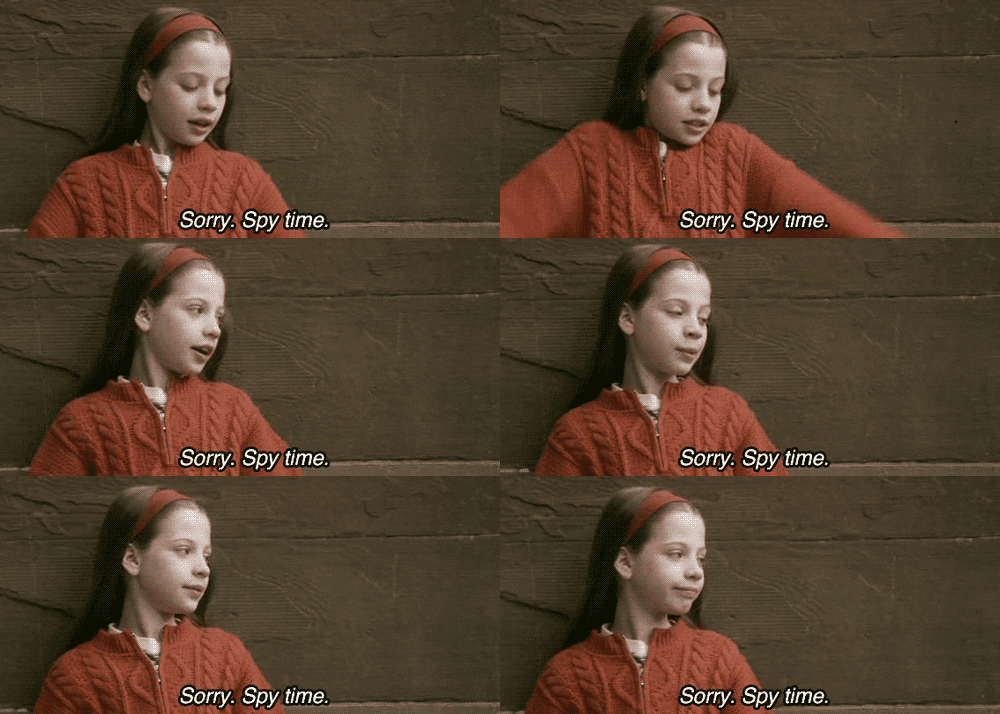
    8. Harriet the Spy was your hero.

    Hey, if people are talking in a public place, it’s fair game for your notebook. 

    9. Though sometimes you pretend to be Nancy Drew, solving mysteries in your neighborhood.

    You may or may not have “borrowed” your mother’s vintage dress and scrounged up an old magnifying glass to complete the look.

    10. The second you finished watching a movie, you immediately wrote dialogue for its sequel.

    As soon as the movie was over you were frantically continuing the story in your own words. It usually involved you becoming best friends with the main character.

    11. You were convinced your script was better than the original.

    Come on, Ninja Turtles: Revenge of Mom was a masterpiece.

    12. You were always imagining your friends as characters in your latest story.

    Your real-life BFF was the spitting image of the superhero sidekick in your latest comic adventure. Coincidence? I think not.

    13. During vacation, you’d force them all to reenact your stories.

    “No, no, no, Johnny! Do it again. And this time? This time do it with feeling!”

    14. Your parents asked if, maybe today, you should “get some fresh air.”

    You know you have a problem when your parents think you read too much.

    15. So you created your own reading fort.

    Which, on top of being cozy, had the added benefit of not being able to accommodate adult-sized humans.

    16. You’re seriously considering making a one now.

    I mean, you don’t really need that walk-in closet, right?

    17. Someday, you’ll build an entire room with wall-to-wall books.

    Bonus points if you can snag one of those rolling ladders.

    18. For now, though, you’ll just shamelessly shove your face between the pages of a real, live book and inhale the scent of your childhood.

    And because, who are we kidding, the smell of books is fantastic.


    18signs

  • 7 Productivity Tools to Help You Manage Your Freelance Writing Time

    7 Productivity Tools to Help You Manage Your Freelance Writing Time

    Where does your time go?

    The question might fill you with anxiety as you try not to add up the minutes you spend on Facebook and Twitter.

    How can you make the most of your time when you sit down to work?

    Many freelancers get paid for their work on a project basis, regardless of how long it takes to complete tasks. But many must keep track of billable hours in order to be paid. And still others want to keep track of their time for personal accountability.

    No matter how you slice it, time is money, and the two are intertwined for every freelancer.

    Whether you rely on your desktop computer or like to take your work on the road with your tablet or phone, there are tons of tools available to help you track your time.

    Are you ready to learn about some of our favorites — and pick out one or two to try? Here we go.

    1. Freshbooks

    A favorite of creative entrepreneur podcast Being Boss, Freshbooks boasts a time-tracking cloud-based tool that’s accessible across multiple devices.

    If a client calls, you can open the app on your phone and start the timer to make sure you don’t lose any billable minutes on your project. Freshbooks then pulls all unbilled hours into an invoice for you.

    In addition, multiple team members can access the same account, and you can even invite your accountant or bookkeeper to check in on your progress.

    Bonus: The intro video for the app version features a delightful animated singing squirrel.

    Cost: You can get a free 30-day trial. Paid memberships range from $9.95 to $39.95 per month for four different tiers of service.

    2. Harvest

    Harvest might just win in terms of accessibility. Per their website, “Your team will get up to speed fast and can track their time however (and wherever) they want — on their laptop, iPhone, Android, or even on the Apple Watch. Simple and quick time entry means there’s no excuse not to track, and you’ll have the data you need to bill accurately and budget wisely.”

    Harvest generates reports to help you keep projects on time and within a budget you’ve set.

    Writer and editor Sara Kaplow used to use Harvest at her company and appreciated the way it lets users switch back to a client or task.

    “The main thing I miss is being able to resume a task [with Harvest],” said Kaplow. “I have about 15 clients at a time, and while I try to be disciplined, if I get an email that a site is down, for example, I obviously have to address that. Harvest allowed me to pick back up. With Toggl, I ended up with 15 five-minute tasks I had to add up manually at the end of the day.”

    Cost: A free version allows one user to have up to four projects for two clients. Paid versions range from $12 to $99 per month, with three levels of service available.

    3. RescueTime

    This tool even gets the endorsement of Alexis Ohanian, founder of Reddit.

    RescueTime lets users create goals, such as spending one less hour each day on email, or it can alert you when you’ve been on Facebook for more than an hour in a day. It generates reports showing which applications and sites you use most, and for how long.

    If it sounds like a depressing revelation awaits you, know that you can also block distracting sites and log highlights and achievements as they occur throughout the day. Gamify your productivity!

    One downside, writes tech and design writer Shawn Blanc, is that RescueTime doesn’t necessarily care about the difference between productive social media use and unproductive distractions.

    “The slight conundrum about Rescue Time’s Get Focused tab is that things like checking Twitter and email are a mixed bag,” Blanc wrote in a review. “I often use Twitter for productive work, but also it can be a time sink. So it’s not this one-to-one direct ratio where Twitter equals unproductive every time.“

    Cost: RescueTime Lite allows users to set goals, get a weekly email report and analyze on three months of history. The Premium version adds on other services, like website blocking, daily accomplishment logs, more robust reports and filters, and unlimited reporting history for $9 per month (or $72 per year).

    4. Toggl

    Toggl brands itself as being so easy to learn, no training is necessary.

    “Start out simple, and drill deeper with user rights and project setup later on,” it claims. The tool allows for an overview of billable time, team progress and live time entries.

    The mobile app lets users hit a button to begin timing work, and Toggle is compatible with productivity tools such as Trello and Asana. An offline option allows you to keep tracking time without WiFi.

    Toggl also has a Chrome extension for easier access and use.

    “Their Chrome extension…will add a start timer Toggl button at places like Gmail threads, Trello cards, and more,” wrote Khamosh Pathak for Guiding Tech. “When you click the button, the title will automatically be imported and time tracking will begin.”

    Cost: A free version allows teams of up to five to track unlimited projects. A $59-per-month business version runs time audits, locks timesheets and sends team reminders. The pro level, at $10 each month per user, doesn’t limit team sizes, and offers report sharing and sub-project capabilities.

    5. Fanurio

    Fanurio tracks time and sends bills to your clients. It’s a desktop-based software program, so the plus side is, you don’t pay a monthly subscription fee.

    The downside: It  doesn’t seem to have an app to go along with its desktop-based program, which could be a major detractor for freelancers on the go.

    Cost: A single-user license costs a flat fee of $59.

    6. Hubstaff

    Hubstaff is geared more toward teams instead of individuals.The user interface looks nice and easily lets you check visual data, like time spent, screenshots of worker activity, app and URL tracking to see where your employees are going online, and more.

    It’s good for remote teams, as you can manage people from all over with the same account.

    Cost: A free version allows one user to track time, save screenshots and view activity levels. For $5 per month, one user can track keyboard and mouse activity and manage employee payments.

    For $9 per month, a user can do these things as well as track URLs, do automatic payroll, track a weekly budget, and integrate other tools like Basecamp, Github and Quickbooks.

    7. TimeCamp

    TimeCamp seems to have the most options for integration with other productivity tools.

    Its major claim to fame is letting your employees trust themselves to get their work done: “TimeCamp allows employees to self-monitor their own productivity, especially how much time they’re losing to various distractions.”

    If it’s just you, maybe you need to ask yourself how much you trust your ability to get things done.

    Cost: A free version allows a single user to track time and computer usage using desktop and mobile versions for unlimited tasks and projects. A $6-per-month basic version adds on the ability to add unlimited users, export, integrate with other tools and track billable time and budgeting.

    The pro version at $9 per month includes all this and more: invoicing; priority support; scheduled reports; timesheet approvals; and projects costs and billing rates.

    Even if you don’t currently work billable hours, it might be an interesting experiment to see how you’re spending your freelance writing time.

    Maybe writing articles and transcribing interviews is taking longer than you think, and it might be time to increase your rates. Alternately, maybe you’ll realize you’re spending a lot more time on social networking than you need to.

    Either way, trying one of these tools might be worth your time.

    What’s your favorite tool for tracking and managing your freelance writing time?

    This post contains affiliate links. That means if you purchase through our links, you’re supporting The Write Life — and we thank you for that!

  • Is Backstory Killing Your Book’s Plot? Here’s How to Fix It

    Is Backstory Killing Your Book’s Plot? Here’s How to Fix It

    The following is an excerpt from 5 Editors Tackle the 12 Fatal Flaws of Fiction Writing, available now.

    So many new writers start their books with pages — even chapters — of backstory.

    They want to tell the reader all about the creation of their fantasy world. Or they want to make sure readers understand every nuance of Mexican politics in 1956 because it will be critical to the plot on page 103. Or they want to make sure the reader understands every feature of time travel or cloning in the year 2133.

    Then their writing coaches or editors suggest that instead of including all this material in the opening chapters of their book, they should just reveal the backstory through dialogue.

    Aha, the author thinks. Dialogue — of course! But instead of jettisoning their precious descriptions and explanations, they essentially put quotation marks around the same ponderous material.

    Problem solved, right? Wrong.

    Your backstory can slow down the plot

    None of your characters should talk like the narrator. And readers still don’t want a backstory dump, even in dialogue. Your attempt to stuff backstory into dialogue results in long, tedious monologues instead of more believable two-way conversation.

    Let’s take a look at a before-and-after example passage:

    Before:

    Debby started panicking. “You know, John, that we can’t send people back in time without the right amount of energy, and even though we’ve done an excellent job in extracting energy from dark matter, as our last two experiments attest, I fear that there isn’t enough to get Colleen into the past and out of danger. Just look at the flux capacitor levels — the microcosm indicator is off as well, and it needs to be at 90 percent for a guaranteed trip. The flux capacitor is crucial for making a time jump, and needs to be at about 92 percent efficiency to work well. Also you need to contact Clare and Silas and make sure they can divert another 38 gigawatts of energy to the main frame so in one hundred hours she can make her jump back to the present. The main frame can handle up to 50 gigawatts, so that shouldn’t be a problem.”

    Whew, did you find that tedious to read? It was pretty tedious to write, too.

    To make matters worse, these types of monologues often take place in the middle of important action. Readers aren’t going to believe a character will stop and give a lecture when bullets are flying or buildings are blowing up around her. Backstory, even in “active” dialogue, stops the present action.

    After:

    Debby frowned at the bank of blinking lights. “We don’t have enough energy here for Colleen to make the jump.”

    “Is there anything we can do?” John asked.

    An alarm sounded, and Debby hit the panel to the left to silence it. “Don’t know.” She glanced at the flux capacitor level and gritted her teeth. It was nowhere near the 90 percent she needed. “I think you need to contact Clare and Silas. Maybe they can divert more energy.”

    “Sure, but how much?” John asked.

    Debby thought for a moment. “I need another 89 gigawatts of energy.”

    “All right,” John said, jumping up out of his chair. “I’ll contact them — if I can find them.

    In this example, we assume that John and Debby already know a great deal of the backstory and pertinent information because they are in the story. Even if I wanted to make sure that the reader (as well as John) was clear about time travel, a cumbersome description only slows the action and raises more questions than it answers.

    Readers don’t really need to know it all

    Have faith in your characters, and have even more faith in your readers. Allow the reader to enjoy the journey. It can be more fun for them to discover the world and plot along with the heroine.

    Sometimes dense description given through dialogue sums everything up, causing the reader to wonder why they should bother to read on.

    Use a limited amount of shorthand that your readers will understand to convey what’s going on. Use the characters to convey their expertise in their own proprietary language, which can add depth to a character and give a better sense of what’s going on.

    Become the expert in your field of study, and of the world you are developing. But don’t build a time machine piece by piece through your dialogue.

    Backstory keys to success

    Next time you’re weaving backstory into your project, remember:

    • Jettison the dense backstory paragraphs at the beginning of your novel’s scenes.
    • Explain in common, character-driven language some finer points of the plot via dialogue.
    • Trust your reader to pick up on gestures, expressions, and atmosphere as substitutes for direct (and long) explanations.
    • Don’t explain everything. Only include bits that are essential and interesting, and that advance the plot.
    • Don’t build a time machine all in one monologue.
    • No one wants a truckload of information dumped at the start of a story. Readers want to be swept away, transported — not buried under a ton of rock.

    Readers don’t spend as much time as they used to “getting into” a novel or story. It’s your job to put the reader into the action and intimacy with your characters as quickly as possible. The rest will follow.

    How have you introduced backstory in your own writing?