Blog

  • 5 Ways to Add Personality and Voice to Every Blog Post You Write

    5 Ways to Add Personality and Voice to Every Blog Post You Write

    “How do you do that? Your posts always make me smile. I look forward to them each week and actually search them out when I have a few spare minutes in my day.”

    You can’t write boring blog posts and get comments like that one. But how do you do it? How do you develop a voice that shines through every post you write?

    Here are a few tricks to help your posts sound more human and personable. You’ll soon convince your audience to read more of them!

    1. Speak to one person

    You sit down, ready to write, yet after minutes of staring at the screen, nothing comes to mind. You search through your favorite sites, check in with your RSS reader, and pull up your social media accounts to look for ideas.

    Suddenly you find a title that interests you, so you grab it, modify it and start writing. Yet when you’re finished, something is wrong: it’s just another boring post that doesn’t say anything new.

    The problem with this “grab and write” approach is you are writing for concept and keywords, not to develop personality. Personality comes when you’re committed to an idea and have something to say that will deeply impact a person’s life.

    Instead, think of one great customer you loved working with. Or if you’re still starting out, imagine a customer who would fall in love with what you do. Have them in mind? Now, write a post specifically for that ideal customer. Narrow it down as much as possible, and write as if they are sitting right across from you learning from you along the way. You’ll find you write differently, showcasing what this person needs to hear to become a paying client.

    2. Start with a story

    Stories sell. They connect us. They hold us riveted to our seats. They make us laugh and make us cry.

    Imagine yourself in a lush, green forest. It’s filled with the beautiful colors and smells of bright flowers, and has a small breeze that makes a walk down a trail the perfect way to spend a day.

    Can you see yourself on that trail? You can use this tactic in your posts by using words that evoke images:

    • Imagine

    • Visualize

    • Picture this

    • See this

    • Focus in on this idea

    When you start a post with these words, you automatically pull your reader in – and you can lead them down any trail you choose.

    3. Get personal

    Many of today’s most popular and well-loved blogs originated with one person, one voice. If your blog is all about you, let your personality shine through!

    Talk about what you believe in. Share what you do, what makes you vulnerable and why people should trust you above all others. It’s important for people to understand why you do what you do.

    • Where did you get your experience?

    • How do you give back to your community?

    • What are your beliefs?

    • What made you choose this idea to move forward with?

    While you may think of it as bragging or showcasing too much about you, your audience will beg to differ. They’ll see it as your story, and in order to build a relationship with you, they want to get to know you. Your story gives them all they need to know.

    4. Go into detail

    Every post you write should be a complete thought. It should have a beginning, a middle and an end. It should be able to stand alone, as it may be the only post someone ever reads.

    What concept do you want to share? Can you decrease it even further and make two, three or four posts from your concept? Can you make it more complete by narrowing your focus in further?

    Details matter, especially when you’re creating an entire blog theme around one concept. The more you can separate it out into truly unique concepts, the more you will touch the people reading your blog and looking to you for advice.

    5. Experiment

    Every day you sit down to write, there will be new ideas that are important to you. Don’t be afraid to try something new.

    Video is an ever-growing medium. Why not give it a try and show your personality in a new manner? Not only will video give you a new way of connecting with your audience, it will also allow you to build your brand vertically as well. You can host it on YouTube, post it to your blog, share it on Twitter and Facebook, and send it out in an email.

    Every day something new comes along. If you embrace technology, look for new ways to get your message across, you’ll be rewarded with an entirely new group of followers ready to build a deeper relationship with you.

    How do you develop your voice and show your personality in your posts?

  • Featured Writer’s Residency: The Mesa Refuge, A Writer’s Retreat on the Bluffs of Tomales Bay

    Featured Writer’s Residency: The Mesa Refuge, A Writer’s Retreat on the Bluffs of Tomales Bay

    This is part of our series on writer’s residencies, co-produced with the Alliance of Artists Communities. We feature residencies around the world, so you can learn about opportunities that might be a good fit for you! To search, compare and read about hundreds of residency opportunities, use the Alliance’s free online Residency Directory

    On the misty bluffs of Tomales Bay sits a residency unlike any other. The Mesa Refuge is a place for “writing at the edge,” one of few retreats in the world that focuses on writing about nature, economics and social equity. The breathtaking scenery, inspired spaces and supportive staff create an ideal setting for creative breakthroughs and productive work.

    Three writers are awarded no-cost residencies for each two-week session during the fall and summer. Writers are given private rooms, as well as the use of a shared kitchen, a library and a deck overlooking the bay. Since 1998, Mesa Refuge has hosted over 500 writers including Michael Pollan, Terry Tempest Williams, Frances Moore Lappé and Rebecca Solnit.

    Image: The Mesa Refuge

    Details

    Where: Point Reyes Station, California; overlooking Tomales Bay about one hour north of San Francisco.

    Who: The Refuge invites writers across disciplines to apply: essayists, journalists, economists, naturalists, screenwriters and authors of memoirs. Nonfiction projects are generally preferred.

    Size: Three writers are invited each session.

    Facilities: Each resident enjoys a private bedroom in a spacious shared house. There’s a shared printer but residents must bring their own computers and writing supplies. Dial-up internet access is available for a fee.

    Image: The Mesa Refuge

    Time frame: Two week sessions offered in the fall and spring.

    Cost: There is no cost to residents, though donations are accepted.

    Food: Most dinners are provided and residents can access the shared kitchen.

    Application deadline: June 2, 2014 for September to November residencies.

    Application requirements: Project statement, bio, resume, references and work samples, plus a $25 application fee. Here’s where to apply.

    Image: The Mesa Refuge

    What residents have said: “The landscape of sky, marsh, and bay flowing to the sea helped concentrate my mind. I loved the quiet. I loved the wild garden overlooking the wetlands below and the hundreds of birds circling above. It is rare and wonderful to feel so quietly cared for — so completely supported and encouraged.”

    Plus: Residents can take advantage of the spectacular setting with opportunities for hiking, kayaking, beachcombing, bicycling, bird watching, yoga, gardening, tennis and table tennis.

    Would you consider applying to The Mesa Refuge?

    All photos are courtesy of The Mesa Refuge and were taken by Sarah Hadley.

  • The Weird Strategy Dr. Seuss Used to Create His Greatest Work (And Why You Should Use It Too)

    The Weird Strategy Dr. Seuss Used to Create His Greatest Work (And Why You Should Use It Too)

    In 1960, two men made a bet.

    There was only $50 on the line, but millions of people would feel the impact of this little wager.

    The first man, Bennett Cerf, was the founder of the publishing firm, Random House. The second man was named Theo Geisel, but you probably know him as Dr. Seuss. Cerf proposed the bet and challenged that Dr. Seuss would not be able to write an entertaining children’s book using only 50 different words.

    Dr. Seuss took the bet and won. The result was a little book called Green Eggs and Ham. Since publication, Green Eggs and Ham has sold more than 200 million copies, making it the most popular of Seuss’s works and one of the best-selling children’s books in history.

    At first glance, you might think this was a lucky fluke. A talented author plays a fun game with 50 words and ends up producing a hit. But there is actually more to this story and the lessons in it can help us become more creative and stick to better habits over the long-run.

    Here’s what we can learn from Dr. Seuss…

    The power of constraints

    What Dr. Seuss discovered through this little bet was the power of setting constraints.

    Setting limits for yourself — whether that involves the time you have to work out, the money you have to start a business, or the number of words you can use in a book — often delivers better results than “keeping your options open.”

    In fact, Dr. Seuss found that setting some limits to work within was so useful that he employed this strategy for other books as well. For example, The Cat in the Hat was written using only a first-grade vocabulary list.

    In my experience, I’ve seen that constraints can also provide benefits in health, business, and life in general. I’ve noticed two reasons why this occurs.

    1. Constraints inspire your creativity

    If you’re five foot five inches tall and you’re playing basketball, you figure out more creative ways to score than the six foot five inch guy.

    If you have a one-year-old child that takes up almost every minute of your day, you figure out more creative ways to get some exercise.

    If you’re a photographer and you show up to a shoot with just one lens, then you figure out more creative ways to capture the beauty of your subject than you would with all of your gear available.

    Limitations drive you to figure out solutions. Your constraints inspire your creativity.

    2. Constraints force you to get something done

    Time constraints have forced me to produce some of my best work. This is especially true with my writing. Every Monday and Thursday, I write a new article — even if it’s inconvenient.

    This constraint has led me to produce some of my most popular work in unlikely places. When I was sitting in the passenger seat on a road trip through West Virginia, I wrote an article. When I was visiting family for the 4th of July, I wrote an article. When I spent all day flying in and out of airports, I wrote an article.

    Without my schedule (the constraint), I would have pushed those articles to a different day. Or never got around to them at all. Constraints force you to get something done and don’t allow you to procrastinate. This is why I believe that professionals set a schedule for their production while amateurs wait until they feel motivated.

    What constraints are you setting for yourself? What type of schedule do you have for your goals?

    Related note: Sticking to your schedule doesn’t have to be grand or impressive. Just commit to a process you can sustain. And if you have to, reduce the scope.

    Constraints are not the enemy

    So often we spend time complaining about the things that are withheld from us.

    • “I don’t have enough time to work out.”

    • “I don’t have enough money to start a business.”

    • “I can’t eat this food on my diet.”

    But constraints are not the enemy. Every artist has a limited set of tools to work with. Every athlete has a limited set of skills to train with. Every entrepreneur has a limited amount of resources to build with. Once you know your constraints, you can start figuring out how to work with them. (Click to tweet this idea.)

    The size of your canvas

    Dr. Seuss was given 50 words. That was the size of his canvas. His job was to see what kind of picture he could paint with those words.

    You and I are given similar constraints in our lives.

    You only have 30 minutes to fit a workout into your day? So be it. That’s the size of your canvas. Your job is to see if you can make those 30 minutes a work of art.

    You can only spare 15 minutes each day to write? That’s the size of your canvas. Your job is to make each paragraph a work of art.

    You only have $100 to start your business? Great. That’s the size of your canvas. Your job is to make each sales call a work of art.

    You can only eat whole foods on your diet? That’s the size of your canvas. Your job is to take those ingredients and make each meal a work of art.

    There are a lot of authors who would complain about writing a book with only 50 words. But there was one author who decided to take the tools he had available and make a work of art instead.

    We all have constraints in our lives. The limitations just determine the size of the canvas you have to work with. What you paint on it is up to you.

    Have you tried adding constraints to your writing process?

    This article was originally published on JamesClear.com.

  • 4 Strategies for Better Time Management (and Bigger Paychecks) as a Freelance Writer

    4 Strategies for Better Time Management (and Bigger Paychecks) as a Freelance Writer

    Making money as a freelance writer has just as much to do with your time as it does with how good of a writer you are or how many clients you have.

    The most successful freelance writers are not those who can write the best copy or even write the fastest. The most successful freelance writers are those who know how to manage their time to get the most quality work done. (Agree? Click to tweet this idea.)

    As a freelance writer who works on the side of a full-time job, I know there are only so many hours in my day. If I can’t make my mornings, nights and weekends the most productive they can be, I’m not just wasting my precious free time — I’m also not getting paid.

    Below are four lessons I’ve learned the hard way that have ultimately helped me make the most of my time and be more productive in my freelance writing business.

    1. Accept that you are not a writing machine

    Just because there are 24 hours a day doesn’t mean you can use every single one of them to focus on writing for clients. As a human, you need time to sleep. And eat. And occasionally watch trashy TV. (“Occasionally” being the key word.)

    Since I’m a driven and motivated person, sometimes it’s hard for me to accept that I do not operate like a machine. But I’ve learned when I’m mentally exhausted, my resistance to distractions weakens. Pinterest beckons. The dishwasher needs to be unloaded. I wonder what snacks are in the fridge. Three hours later, I’m frustrated because I thought this blog post would only take me an hour.

    Through experiences like these, I’ve accepted that I am not a writing machine.

    I am a human who writes, and I need to be fully energized and focused to do my best work. That means it’s okay to close my laptop for an hour or two while I go for a run or cook dinner. Oftentimes, I will finish my assignment faster on my return because by turning off my brain from writing for a bit, I regain my focus.

    2. Log your time right this very minute

    Some clients pay a flat fee per project. But if you’re getting paid hourly, it’s up to you to keep track of how much time something takes.

    Keeping track of exactly how much time you spend on a particular client can be tough, especially if you’re jumping between projects. But it’s absolutely necessary to track your time to ensure you’re properly compensated for your work. If you try to rely on your memory at month’s end, it’s likely you could under report your time — and undercut your own paycheck.

    I save myself a lot of time and stress if I log my time right after I complete a task. Even if it’s only 30 minutes, those minutes add up! I find that if I stay on top of my time sheets, I report my time more accurately — and ultimately get paid more — than if I try to guestimate at the end of the month when invoices are due.

    3. Save the best assignments for last

    Even though writing may be your passion, it’s still work. And like with any job, some projects are more exciting than others.

    Even if you love all your clients, you’ll always have a favorite. When you have two projects to complete, it’s tempting to start on the one you like more first. But at the end of the day, you need to finish both.

    I’ve found I’m more efficient in completing all my freelance work if I start with the task I want to work on the least. I’m then more motivated to complete that less-fun task so I can get to the fun stuff faster.

    If your time is mostly dedicated to writing for one client, there might be certain tasks that are more enjoyable than others. For example, I like writing blog posts much more than I enjoy finding the right images for them. If I find an image at the end, it seems like even more of a drag because I already did the fun part. But if I find the image first, the writing is more enjoyable because a task I don’t particularly enjoy is already done.

    4. When the going gets tough, envision your best self

    While being your own freelance boss can be rewarding, it’s hard to be your own boss AND employee.

    You have to self-delegate — and self-motivate — to get your work done. If you spend too much time online window shopping this week, you don’t get paid. Of course, you strive for efficiency, but a blank page can be daunting. It’s so much easier to spend just 10 more minutes on Facebook before you get started.

    When my motivation is lacking, I try to think about who my best self is and what that person wants to accomplish. Often this is just the kick in the butt I need to stop procrastinating and get back to work. Do I want to be the freelance writer who is great at pinning delicious recipes I will likely never even try? Or do I want to be the freelancer whose writing brings new customers to a product and client I believe in?

    By refocusing on my goals and how my best self wants to run my business, I am more motivated to sit my butt in the chair and get back to writing. I know I can always shop later.

    It takes practice, trial and error to figure out how to best manage your own time as a freelance writer. You may find you’re more productive at certain times than at others. The good news is that you’re in complete control. Whether you’re a morning person, afternoon person or middle-of-the-night person, you have a freedom most employees do not: control of your own working hours.

    So just as you take control of how much you charge and what clients you accept, take control of how you manage your time. Your productivity — and your bank account — will thank you.

    What tricks do you use to manage your time?

  • How to Become a Location Independent Freelance Writer

    How to Become a Location Independent Freelance Writer

    Have you ever imagined moving with the (nice) weather? Winter in Bali, summer in the States, with a quick sojourn to Europe in between.

    Do you want to see the world and run a successful business simultaneously?

    If so, think about taking your freelance writing business on the road.

    You can work from anywhere

    Perhaps the biggest benefit of freelance writing is location independence. Escaping the drudgery of a morning commute and working from home is a privilege many freelance writers hold dear.

    But, why stop there? As a freelance writer there are no physical limitations on where you do your job.

    Seeing the world while simultaneously running a business may seem like a dream existence for many, but for freelance writers, it can become a reality.

    Imagine relaxing on the beach with a margarita, laptop in hand, or going for an early morning scuba dive before starting work. While it may not always be quite that ideal, running your freelance writing business from a tropical island is a real possibility. Some of the most remote places on Earth enable you to run a business just as effectively as if you were sitting in your living room.

    Global internet coverage and unremitting connectivity make it insanely easy to connect with editors and publish blog posts from the other side of the world.

    You don’t need a Starbucks with lightning-quick broadband; you can write from literally anywhere. When I lived in the Bolivian jungle, I went old school with pen and paper, before hitchhiking to the nearest village to publish my work on the web.

    So, why live abroad?

    At one time, running a business and moving around the world may have been considered lunacy, but in today’s economic climate, it’s fast becoming a sensible option. As more companies look to streamline their businesses, there are enormous opportunities for astute freelancers. Sean Ogle created a business, Location 180, that helps people make this dream a reality, and the guys behind 37signals published a book on the rise of the remote work phenomenon.

    Financial savings are still perhaps the foremost incentive to live abroad as a freelance writer. Imagine paying $100 a month in rent instead of $1000, or spending $3 for lunch instead of $30. Reducing overheads is a major goal for any business, and writing is no different. The economic benefit of living in a developing country as a freelancer can be drastic.

    Quality of life is also an important factor. Living on a sunny island next to the ocean or close to your favourite outdoor activities can be the ultimate reward for taking your business abroad. Imagine hiking in the mountains or doing yoga on the beach to unwind from a busy day of work.

    I’ve lived in Argentina, Colombia, Vietnam and China, with a healthy amount of travelling in between. I’ve had experiences I could never have imagined. All of the quirky, downright crazy moments are stories that one day, I’ll be proud to tell my grandchildren. All because I took a leap of faith and blazed my own trail.

    Leverage the fact that as a freelance writer, you’re completely mobile and free to enjoy the world. As a travelling scribe, you have the autonomy to choose how, and where, you work. (Like this idea? Click to tweet it.)

    Taking the leap

    Ok, so now you’re motivated. How do you manage the logistics?

    First, pick your paradise. Look at a map of the world and decide where you want to go. The only consideration that will make your life considerably easier is to choose somewhere with reasonable internet access — though as you can see from my experience in the jungle, it’s not a deal breaker.

    Next, buy your ticket. Many people say they’ll move “when the time is right.” Unfortunately, the time for such a lifestyle change is never perfect. Give yourself a deadline to avoid procrastination or paralysis, but allow a reasonable window before departing to save money. Moving to a new country is stressful enough without the worry that a lack of funds could cut short your expedition! Don’t treat the move as a short holiday; view it as a lifestyle investment.

    Consider completing a TEFL course before you leave, which will qualify you to teach English as a foreign language. Even if you already have a successful freelance business, it’s good to have a fallback option. I’ve found teaching English one of the best ways to supplement my income when required. Also, you can generally choose flexible hours, which provides enough time to run a freelance writing business on the side.

    What happens once you’re there?

    When you arrive in your dream location, seek out any local English language publications and ask them if they could use any help. If you’re new to freelance writing, consider asking for an internship, which would let you to hone your skills in a collaborative writing environment. Additionally, contact your country’s embassy or the local tourism board to inquire about any writing opportunities in the area.

    Get out and explore. Go on trips to remote places, sample regional foods, and talk to local people. Use your experiences as material for extraordinary articles and blog posts. Editors are often looking for contributions from exotic locations.

    Be social and make connections. The expatriate community is notoriously friendly, making it easy to form profitable relationships with those in high places. One day you may be chatting to a CEO or ambassador, and the next you could be having a beer with an English teacher. Use this tight network to your advantage in building your freelance writing business.

    Go forth and conquer

    It takes bravery to say goodbye to loved ones, relocate a business and move overseas. Working remotely is not for everyone, but if you choose this path, the rewards can be great. As a business, freelance writing is well-suited to this adventure. Will you give it a try?

    What do you think of location independence? Have you taken your writing on the road?

  • Want to Join a Writing Group? 8 Places to Look

    Want to Join a Writing Group? 8 Places to Look

    Finding a helpful writing group can sometimes feel as difficult as navigating the messy middle of your writing project. But the rewards for finding a group are numerous.

    A writing group can help point out inconsistencies in your work, provide encouragement, ask questions and hold you accountable to your writing goals. When we belong to a supportive community, we are able to accomplish more.

    How to find a writing group that’s right for you

    So where do you find these people?

    Here are a few ideas for where to look for a writing group.

    1. Local writing centers and communities

    Usually a quick Internet search with your city and “writing groups” will yield some results. Attend the group, meeting, or class and see if the group feels like a good fit.

    2. Conferences

    Sharing your contact information with other writing conference attendees is a great way to expand your writing community. I was invited to join my current writing group after meeting a member at a writing retreat.

    3. Bulletin boards

    There is still a lot to be said for this old school method of finding people! Post a sign at your favorite coffee shop, outside the writing department at your local college, or even on Craigslist. Create a process for vetting individuals or groups to determine if they are a good fit for your writing style – or not.

    4. Writing associations

    Professional associations such as Romance Writers of America and Mystery Writers of America have chapters throughout the country. Check their sites for directories to find other members in your local area.

    5. People you already know

    Many people want to write a book. Eowyn Ivey, shortlisted for the 2013 Pulitzer Prize with her first novel, The Snow Child, exchanged work on a weekly basis with her mother, Julie Hungiville Lemay, an accomplished poet.

    Most of us don’t come from writer families, but this doesn’t matter; the key is establishing a routine for a regular exchange of work. It can often be easier with someone with whom you have weak ties. Consider coworkers, neighbors, or acquaintances.

    6. Meetup.com

    This online service connects local people with similar interests ranging from Spanish literature to Scrabble. If there isn’t a writing group in your city, start your own – or hold virtual meetings and exchange work via email.

    7. Online critique groups

    Multiple online services are available and are often set up as an exchange: you must critique others’ work to have your own critiqued. Though they are often free, you may need to pay for for full access or an unlimited number of critiques. Some groups to check out: Critique Circle, Review Fuse, Scribophile and Ladies Who Critique.

    One thing to keep in mind is that the readers in each group may or may not be your target audience. While I was pleased with my experience on Scribophile, there was a higher proportion of men than women and a higher ratio of fantasy writers compared to other genres.

    8. Social media

    Social media is a great way to connect with like-minded individuals and find potential writing group members. Try these: LinkedIn Groups for Writers, Facebook Groups for Writers, Goodreads Writing Groups and Twitter Lists for Writers.

    Or you can just put out a call on your own social networks that you’re starting a writing group. You might be surprised who responds!

    9. Create your own

    If none of these ideas work for you, consider creating your own group! Here’s how to start a writing group.

    Finding a writing group takes time but it is well worth it to have the support, feedback and encouragement a group provides. Once you find your people, consider these guidelines to make sure the group is effective for all of you.

    Do you belong to a writing group? If you’re looking for a writing partner, leave a comment to connect with other readers!

  • Self-Publishing Secrets: 5 Free Amazon Services That Will Help You Sell More Books

    Self-Publishing Secrets: 5 Free Amazon Services That Will Help You Sell More Books

    While nearly everyone has heard of Amazon, fewer people know about all of its free services that benefit independent authors. If you self-publish your work, make sure you’re aware of these programs and tools that can maximize your book’s impact.

    Selling through Amazon is common among independent authors. Amazon is the largest online book retailer, and people trust it: millions of buyers have their credit card and shipping information already saved on their accounts (hello, one-click-to-buy!).

    The downside of selling on Amazon is authors don’t get access to customer information (like name and email addresses) and the royalties are lower than selling directly through an author website using services such as Gumroad, Sellfy or PayPal.

    If you’re willing to give up the above for a potentially higher sales volume, then here are the five main services at your disposal, for free, to get your book onto Amazon.com as an ebook or paperback.

    KDP

    KDP (Kindle Direct Publishing) is a way for any indie author to sell their ebooks on Amazon.com (or other Amazon country websites). Authors get 35% or 70% royalties, depending on the ebook’s list price and where it’s sold.

    KDP uses the mobi digital format, which is different from most other digital retailers, which use ePub. Your ebook needs to be formatted specifically for their platform, but they accept and convert Doc, ePub, RTF and a few other formats. If you’d prefer to convert the file yourself, free apps like Calibre or Amazon’s KindleGen convert from Doc, HTML and ePub to mobi. Scrivener users can convert directly into mobi using the “Compile” function.

    Formatting your ebook perfectly can be a headache, but here’s a good resource.

    After uploading, use Kindle Previewer to see the final version of your ebook before it’s published, so you can go back, make changes and re-upload. For more advice and resources, check out this post or the massive KDP community forum.

    A lot of authors and readers aren’t aware that you don’t need a Kindle device to read a Kindle ebook. They work and read well on any tablet (like iPads) or smartphone with the Kindle app. My personal favourite way of reading ebooks is from any web browser on my computer, using Amazon’s Cloud Reader.

    KDP Select

    While authors can upload ebooks to KDP and still sell the same ebook anywhere else on the Internet, Amazon also offers KDP Select for authors who agree to 90 days of digital exclusivity. In return KDP Select pays higher royalties for sales in certain countries, adds your ebook to the lending library for Prime Members, and gives you promotional options to make your ebook free for up to five days or discounted for up to seven.

    The promotional options are the best reason to use KDP Select, and why I use it. When your ebook is free or discounted, it appears on sales pages on Amazon.com — which drives more people to buy it.

    Other websites also promote free or discounted Kindle ebooks to massive audiences; Bookbub is the largest, with over two million subscribers. While Bookbub and other larger promotion websites aren’t free, it can often be worth the price to put your book in front of a much larger audience. There are also lots of smaller, free Kindle discount promotion websites; here’s a good list.

    Most indie authors see huge sales days when their ebooks are discounted and massive download days when those ebooks are free. These results often lead to higher-than-usual sales on the days right after promotions (when it’s back to regular price), as well as a bigger audience for future ebooks.

    CreateSpace

    CreateSpace is Amazon’s print-on-demand service for indie authors. It lets you sell a paperback copy of your book either on CreateSpace.com website or directly from Amazon.com. All you have to do is upload and set the book; they’ll take care of printing and shipping. You don’t even pay  for your book to be printed — you simply collect a commission whenever it sells.

    You design a cover (or have CreateSpace design one for an extra fee) and upload your content in PDF format. Once it’s uploaded, you can download a “proof” copy, view it directly on the website, or even order a physical copy. That way, you can make any necessary changes before it’s published.

    CreateSpace also lets you link a digital or Kindle version of your book to the paperback, which allows purchasers to choose their format on the same sales page. It takes a bit of work to set this up, but it’s free and easier after you’ve done it once. I didn’t think print was worth it for years, but as soon as I started offering paperback copies of my ebooks through CreateSpace, I noticed that they made up 10% of my sales.

    Amazon Associates

    If you’re not familiar, Amazon Associates is a service that pays you for linking to products on Amazon.com. It uses a tracking ID in each URL to identify who directed the buyer to the site.

    Use this link when promoting your own books and make an extra four to eight percent on each sale – it’s not against the rules. That’s money Amazon would have kept otherwise! You also get commissions from anything someone buys on Amazon.com if they got there from your initial link.

    On average, I make a few hundred dollars each month from my affiliate account, because every time I link to my books from my website, newsletter or social media, I use Amazon Associates URLs.

    Amazon Author Central

    Even as an indie author, Amazon lets you create an author biography page that attaches to your ebook’s sales page. You can share your background, your blog’s RSS feed (so it grabs new posts), upcoming speaking or book-signing events, and even your latest tweets.

    Your Author Central page appears on every book sales page on Amazon, so it cross-links other books you’ve published. If someone clicks over to your author page, they can even subscribe to you and get emails when you release new books.

    Have you used any of these services as an independent author?

  • How the Ups and Downs of Writing Can Improve Your Craft

    How the Ups and Downs of Writing Can Improve Your Craft

    “There is no rule on how to write. Sometimes it comes easily and perfectly; sometimes it’s like drilling rock and then blasting it out with charges.”  

    – Ernest Hemingway

    As a writer, you know all about the highs and lows.

    When the words spill off your fingertips as quickly as you can type them, when you’re full of confidence and certain of impending success – it’s probably safe to say you’re experiencing a high. These highs can last weeks, months or, sadly, minutes.

    They’re often followed by days clouded in panic and uncertainty. Suddenly, the challenge is too overwhelming. You doubt the same scenes you wrote so proudly only yesterday. Your word flow slows or dries up altogether, and you begin to question what the point of it all is.

    Writers experience both highs and lows

    Author Jodi Hedlund describes her descent into a low in a guest post on literary agent Rachelle Gardner’s blog:

    “In a matter of a few seconds, I plummeted off the high peak I’d been standing upon. And I crash-landed into a deep cavern. Darkness swept away the bright joy I’d felt only moments earlier… My experience is fairly typical, isn’t it? We’ve all had those really high moments where we’re feeling on top of the world. Then something happens that topples us into the pit.”

    I empathize with Jodi; a positive review or an acceptance letter can catapult me into the euphoric state of a high. The future is positive! My writing makes perfect sense! I believe! Yet a rejection letter can just as quickly strip away that confidence, plunging me into a dark state of doubt and instability.

    This is a natural part of any writer’s life… and here’s the secret: The lows are just as important as the highs. The two moods complement one another, and you can exploit each of them to improve your writing and further your career. (Like this idea? Click to tweet it.)Here’s how.

    Your highs are…

    • Productive: they enable you to increase your word count and make progress on your project. This is a time to write freely and without judgment.

    • Social: Use this confident period to make connections. Submit articles for publication or propose a guest post to a well-known blog site. You’ll represent yourself best when you believe in your writing.

    • Fun: Enjoy the process of writing and your positive state of mind. Allow yourself to dream. Dreams encourage ambition.

    Your lows…

    • Bring you down to earth: Don’t panic – the lows are your leveler, your dose of reality. Question what you’ve written: how can you improve it? Be your best critic.

    • Enable you to be realistic: Use these periods to identify your challenges. How can you overcome them? Set some goals and make a plan.

    • Make you determined: When you’re at rock bottom, there’s only one direction available to you – upward. Identify what’s making you feel down and do something about it.

    Use your highs and lows to your advantage

    If you understand the two moods, you have no reason to fear them. Instead, recognize their importance in furthering your career and improving your craft.

    If you’re on a constant high, you may have an overinflated opinion of your work. On the other hand, if all you experience are the lows, where’s the pleasure? The secret is to have a healthy mix of both and to adjust your strategy accordingly.

    How do you use your highs and lows in your writing?

  • Looking for Writing Jobs on oDesk or Elance? Avoid These 6 Common Mistakes

    Looking for Writing Jobs on oDesk or Elance? Avoid These 6 Common Mistakes

    When you first start freelance writing, you will be hyper-focused on finding paying gigs that allow you to write about your passions and showcase your amazing talents. A common mistake when looking for writing jobs is expecting to find these great paying assignments and awesome clients right away on outsourcing sites like oDesk, Elance or Freelancer.

    This mistaken belief can prove to be costly — especially when it leads to new freelance writers throwing in the towel. Outsourcing sites, if not approached correctly, can leave you feeling like it’s the morning after a one night stand: confused, embarrassed and looking for a quick escape!

    There is nothing wrong with using outsourcing sites to get jobs — it’s how I got started as a freelance writer myself, and it’s still where 90 percent of my clients first find my services. However, my first experiences on oDesk included some costly mistakes; one in particular cost me $1,000!

    As a bright-eyed and bushy-tailed new freelance writer, you need to know and understand the lay of the outsourcing land. Here’s how to avoid six common mistakes when working on outsourcing sites.

    Writing jobs on The Write Life

    Mistake 1: Charging too little for your work

    It’s easy to make this mistake, particularly when you’re just starting out and not sure what to charge.

    If you’re just breaking into the freelance writing scene, it’s a good strategy to start with a low rate — but only for the first month. After that, you’ll want to increase your rate, because you’ve developed your skills during that month, right?

    Figure out what you feel is a good hourly rate to start, and go from there. I aimed to make the same amount I was earning in my full-time day job, which was $35/hour. Don’t sell yourself short, or you could find yourself stuck with clients who are underpaying you for what you’re providing. I found it extremely challenging to increase my rates on existing clients, but when a client knows your rate from the start, they’ll value your work.

    Mistake 2: Picking the wrong clients

    Not all clients are created equal, and you want to keep an eye out for red flags, particularly on outsourcing sites. Check for these signs of a solid prospect:

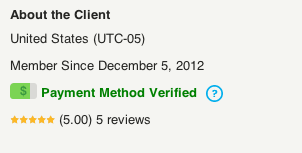
    Image: oDesk Client that is Payment Verified

    1. Is the client payment verified? On oDesk, look in the right sidebar under “About the Client.” You’ll see “Payment Method Verified” in green text. On Elance, you’ll see four small circles next to the client’s name. If they’re verified, you’ll see $ in the first circle, and the more green circles you see, the more projects a client has filled on the site.

    1. Does the client have positive feedback? On Elance, clicking on “Client Info” takes you to a profile page with the client’s projects, including feedback from previous contractors. On oDesk, you’ll see a star rating under “About the Client” on each job page.

      Image: Elance Client Payment Verified

    1. Does the client include company information? Have they shared a description of their company, location and work? Can you find them in a Google search?

    Ensuring these three criteria are met makes it more likely that you’re choosing a legitimate client and protects you from falling for a scam. Learning this lesson the hard way cost me $1,000 in unpaid work.

    Mistake 3: Not asking enough questions

    Communication is key in any relationship — and even more so in a business relationship where you may never meet your clients.

    Make sure you understand each project fully before commencing. It’s crucial to ask as many questions as you can up front so that you understand exactly what the client is looking for.

    If you don’t ask these questions initially, you run the risk of delivering something completely different from the client’s needs. You might also find that the client doesn’t know exactly what they want — which can be a red flag — and you need to know that before you start working.

    Mistake 4: Not providing follow-up ideas

    As a new freelancer, it’s important to build your client base. This is where outsourcing sites are great: you can use them as a place to find leads and convert one-time projects into an ongoing relationship with a client.

    Overdeliver on your work for each client: finish before the agreed-upon deadline, introduce them to a new tool that makes their life easier, or wow them with a perfectly-finished project. Then suggest ways you could help them further, or simply let them know you’re available for ongoing work. (Click to tweet this idea.)

    This one strategy has helped me build my client base by 80%, because once clients know that I do great work, they’re willing to hire me for additional projects. Many of my current clients originally found me on oDesk and now work with me outside of the site.

    Mistake 5: Keeping all your eggs in one basket

    Especially when you’re just starting out, you don’t want to rely on one or two clients for all your income. You need to diversify to protect yourself in case that work dries up.

    Early in my freelance career, I fell into a false sense of security with one client who was providing me with 90% of my earnings. When that work suddenly fell through, I was left trying to figure out how I was going to make ends meet!

    You may even want to take it one step further and also diversify your skill set so you have multiple income streams. Could you focus on an additional niche or writing style? If you need inspiration, browse the list of jobs offered on your favorite outsourcing site to find opportunities that may be a good fit.

    Mistake 6: Doing work you don’t like

    When you’re new to the freelance writing game, you tend to say yes to everything. Even if it’s work that you don’t particularly like, you accept the project just because you can do it and it’s available.

    Don’t do this. No matter how much you’re being paid, you will quickly lose motivation and run the risk of damaging your ratings and client feedback.

    Only take on work that makes sense to your business and that you actually enjoy doing. There are so many projects available on outsourcing sites; you’re sure to find more than enough that engage, interest and challenge you. Find a balance: sometimes you may have to do projects that aren’t your favorite, but make sure most of your work fits with your interests and business.

    What mistakes have you made on outsourcing sites?
    no
    1
    links

  • How Passion Can Make or Break Your Writing Career

    How Passion Can Make or Break Your Writing Career

    If you’re a regular reader of this blog, you likely fall into one of these two categories:

    1. You’re passionate about writing and want to learn as much as you can about the industry

    2. You think writing sounds like a great way to make easy money from home, and you want in on the riches

    People from one of these groups are likely to build solid writing careers, while those from the other group are inevitably going to crash and burn. Pretty obvious, isn’t it?

    Using passion is crucial to fuel your writing career. If you’re 100 percent committed to writing for a living, you stand a better chance of succeeding than if you’re just in it for the money.

    If you’re not sure whether you love writing enough to make a serious go at it, it’s time for a gut check.

    Why passion is important

    Passion is the driving force to success.

    In a technology forum at BYU, Mark Zuckerberg said:

    “I think it’s important if you’re going to take on any big challenge, that you just love and really have faith in what you’re doing. That I think is the most important advice I would say, more than any specific technical thing about how to build a company.”

    Billionaire Warren Buffett also said, “You have to love something to do well at it.”

    And what about Steve Jobs? He said, “People with passion can change the world for the better.”

    These insanely successful people have one thing in common: they all believed in themselves and had a passion for what they did.

    Here’s why passion will help you succeed:

    • You’ll put in the hours to learn the craft.

    • You’ll be energized to work towards your big writing dreams.

    • You’ll keep writing even when you don’t see results.

    To use your passion to your biggest advantage, make sure you do these two things:

    Continue learning. No writer’s talents ever peak. Keep learning and keep improving.

    Share your passion with the world. Publish a blog post. Self-publish a poetry collection. Submit your novel to publishers. Whatever project it is, share it with others.

    How to find your writing passion

    Simply being passionate about writing doesn’t always guarantee success; you also have to have a passion for what you’re writing about.

    Explore your passions and you’ll be driving yourself toward success:

    • Look at your current passions and hobbies. Can you write about those?

    • Test drive different subjects and decide which ones you enjoy writing about.

    • Create meaningful goals to help you on your journey.

    • Try different types of writing (poetry, fiction, blogging, etc.) to get a better idea of what type of writing you enjoy.

    • Write for 15 minutes a day about anything. You’ll begin gravitating toward the things you love most.

    • Step away from your computer and start trying new things.

    For a more in-depth exploration of your writing passion, check out Barrie Davenport’s post on “6 Key Steps to Finding Your Passion as a Writer” at Write to Done.

    How has passion helped you succeed as a writer?