Tag: blogging

  • How To Write About NFTs and Art: 4 Easy Ways to Start

    How To Write About NFTs and Art: 4 Easy Ways to Start

    If you’ve been on the internet in the past few years, you’ve most likely heard about NFT’s. You might be wondering how to write about NFTs and art and how to write about this growing industry.

    You have probably seen NFTs as icons on people’s Twitter profiles, since it’s a popular way to show off what NFTs someone owns. If you haven’t, you might have heard of them through the internet.

    If you’ve wanted to dip your toes into writing about NFTs, we’re going go cover everything you’ll need to know to get started.

    Introduction to NFTs

    NFTs stand for non-fungible tokens. They’re a part of the Ethereum blockchain, which falls under the umbrella of cryptocurrency.

    If that sounds complicated, to make it clearer, you’re essentially buying digital art.

    NFTs are digital collectibles, similar to buying art or trading cards in the real world. Once you own it, it’s your property. Most of the current conversation online around NFTs is through digital art, but people can also use it for other artistic endeavors as well, such as music and videos.

    According to The Verge, “NFTs are designed to give you something that can’t be copied: ownership of the work (though the artist can still retain the copyright and reproduction rights, just like with physical artwork). To put it in terms of physical art collecting: anyone can buy a Monet print. But only one person can own the original.”

    The main thing you need to know, in the shortest summary, is that it is a new way for artists to sell their work.

    When artists sell an NFT there is a digital footprint to prove the purchase. This helps both authors and buyers prove the purchase and keep track of the financial trail.

    Some businesses are using it as a new level of engagement with their company as well. Lately, big book and magazine publishers have been getting their foot in the door with NFTs, which is something writers should know about.

    Brands are just beginning to get comfortable with this new technology, so it will probably begin to grow even faster as time goes on and they learn it better.

    As they increase in popularity online, you might be interested in writing about this new industry or even start to sell some yourself. We’ll go over some of the basics you need to know if that’s what you want to do.

    how to write about nfts
    https://pixabay.com/illustrations/nft-nfts-cryptocurrency-6795915/

    How To Write About NFTs – Tips and Tricks

    NFTs and cryptocurrencies are only going to increase in popularity with time so if it is an industry you want to write about, there are a few things you’ll need to know.

    Let’s dive into how to write about NFTs and build your portfolio as a writer in this growing industry.

    Know the ins and outs of the NFT lingo

    When it comes to trends and new industries, it’s essential to master the language and lingo people in that community use.

    You will want to take the time to read some of the biggest NFT websites and follow experts on the matter so you know what you’re talking about.

    That way, people will take you seriously and won’t be turned off by your writing right away due to obvious errors in your writing. This will also help publications and people in the industry take you seriously as a writer.

    Make it easy to understand

    While you need to know the language of NFTs, at the same time, you need to make it easy to understand.

    Since it’s a new and slightly complicated industry, you need to make your writing accessible to the average person. You’ll get a lot more readers if you help people understand the basics, even if you’re writing to people deep in the NFT space.

    Know the newest trends

    One essential part to writing about NFTs is to know what trends are on the rise. For example, you’ll need to keep up with the newest NFT marketplaces and know what the options are.

    You’ll need to keep up daily to see which brands are jumping on NFTs and which industries are putting their foot in the game. Almost every day some new news comes out about NFTs since it is a hot industry that is constantly changing and evolving.

    Whether you choose to publish NFT articles and stories on your own website or write for websites, you’ll need to know the current trends to write about. If a huge celebrity or company joins the NFT space, you’ll want to be ahead of the story and publish it as soon as that news goes live.

    Keep up with the laws around NFTs

    Just as cryptocurrency laws and regulations are always changing, you’ll need to keep up with the newest laws around NFTs.

    It’s essential to fully inform your audience of what they need to know. Lots of people want to oversell and overhype NFTs but most people don’t know the basics so they can make correct and informed choices.

    For example, more people should be aware of NFT scams out there or know how to protect their assets. If someone breaks into your NFT account, they can steal the art you have purchased. You’ll want to make sure you cover the basics and keep your audience safe as they explore this new industry.

    Options and sites where you can make money writing about NFTs

    As a writer, if you want to start making money writing about NFTs, we’ll cover the basics of what you need to know to get started. There are a few options you can dive into to get your foot in the door of this exciting industry.

    Publish your own articles

    This is an option if you want to start publishing pieces and get a solid platform under your belt. You can also use this to build a portfolio and pitch bigger companies.

    If you grow it enough, you could also make money with affiliate marketing, advertising, or other income-generating options.

    Keep in mind, running your own site can take up a lot of time, so be clear on if you just want to use it to house your portfolio or you want to turn it into an income-producing website.

    Write for NFT and cryptocurrency sites

    There are two ways you can go about writing for NFT websites: market yourself as an NFT writer and try to get clients to come to you, or you can pitch to NFT sites to write for them.

    One way for writers to find news sites to write for, you’ll want to go to Google and search: NFT website “write for us”.

    Here are some that pop up for example when I do: Cryptofiles, Cryptopositives, and Cryptotimes.

    Depending on what you want to write, you could do articles, website copy, social media posts, emails, or more.

    Otherwise, you might want to use “NFT writer” in your bio on social media, on LinkedIn, your website, and so on, to attract potential clients who are looking for writers in this space.

    Sell your own NFTs

    If you didn’t know, writers also have the possibility of selling their own NFTs.

    Some authors are selling first editions of their digital books. They also have been selling their cover art as NFTs where they create unique or special ones specifically for this.

    This is most likely not the option you’re looking for, but we had to mention it just in case it was something that you didn’t even know was possible as a writer.

    Overall

    Writing about NFTs is a growing industry and it’s something that could be a great option for freelance writers to cover and add to their overall resume.

    TWL. CTA. Book Outline Template
  • How to Be a Successful Blogger: Follow These 2 Major Tips

    How to Be a Successful Blogger: Follow These 2 Major Tips


    You created a blog — now what?

    I teach a lot about the importance of social media and platform and networking.

    I talk about values of self-marketing and using tools such as a blog to meet people and make connections.

    But then sometimes, a conference attendee will raise their hand and stop me, saying, “That’s all well and good, but how do we get people to actually read our blog?”

    The question is so basic that it can be glossed over when I’m teaching, so I want to address it here in this post — and share a few social media tips that will assist you moving forward.

    Although my specialty is publishing and I typically teach writers and novelists, these tips will help you learn how to be a successful blogger. All you need is an active Twitter account and a little creativity.

    Before we begin, if you don’t have a blog already, you can easily check to see if your preferred domain is available:

    1. Offer a clear incentive to click

    So you just hit “publish” on a recent blog post and want to spread the word. A simple thing you can do to promote your post is use your own social media channels — namely Twitter, and also possibly Facebook.

    If your own social media channels are still small or new, then you won’t be spreading the word to too many people, but that’s OK. Your network will grow over time, and your Twitter and Facebook mentions of your own posts will gather more shares over time.

    The goal is to mention to your network that you just created a blog post. They’ll then click through to absorb the material, and maybe even leave a comment or interact.

    If you create a great post that can help people, feel free to share it multiple times — once a week for several weeks, for example. Especially on Twitter, where people tweet a lot, there is no rule or law that says you can’t share good information multiple times.

    Incentives and clarity: that’s what it’s all about. Give people clear incentives to read your blog posts.

    This means 1) Realize that people will not do anything unless they understand what’s in it for them, so give them an incentive to click through; and 2) Make it perfectly clear what waits for them on the other side of that hyperlink, so they don’t pass up a click-through simply because they’re puzzled about what you’ve posted.

    [twl_reusable_block post_id=41455]

    Examples

    Let’s examine examples from my own life.

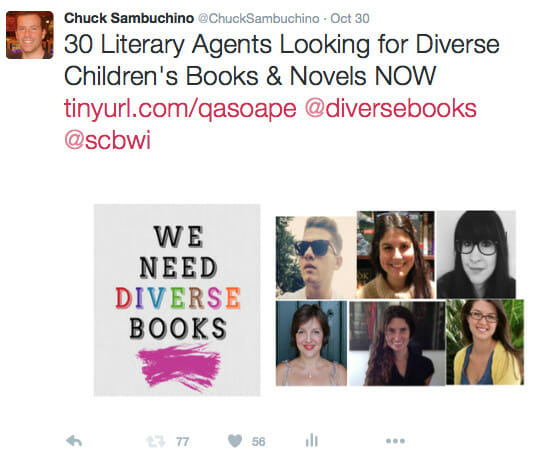
    Recently, I spent a lot of time researching literary agents who were actively seeking children’s books and novels with diverse characters. Compiling the post took me days of work and a lot of emails. It was a special post that I wanted to share. 

    Let’s examine three different ways I could share it through my own social media networks:

    Examine tweet possibility 1:

    1

    In my opinion, status updates like “Check out my latest blog post” or “New blog post is up” are the worst. They’re lazy, and don’t offer a new connection any reason to click. They’re lazy, and show someone who wants to exert no effort in gaining new followers.

    Grade: F


    Let’s try again with tweet possibility 2:

    2

    At least with this second tweet, you understand a little about what the blog post covers. But still, the tweet is scant and doesn’t provide absolute clarity on what lies on the other side of the click.

    And did you notice the grammatical mistake? Those extra words are a sign I was rushing through the composition of the tweet, and not sculpting it carefully. Poor proofreading reeks of unprofessionalism, and will turn off prospective followers.

    Grade: C


    Let’s try again with tweet possibility 3:

    3

    The tweet is optimized from top to bottom to gain the most shares and attention. Look at what it does well:

    • It provides absolute clarity by explaining exactly what the blog article is about.
    • It includes simple tricks to add sexiness, like a numbered list in the title and a capitalized “NOW” to show the post is important and timely.
    • I added Twitter handles for users who may enjoy spreading this information. You can also use hashtags to loop in new groups of people.
    • I added images. People love images with blog posts and social media status updates. Images bring a post to life.

    Seventy-seven retweets for this tweet is great, especially considering I had already mentioned this post several times before on social media

    Grade: A


    More Examples

    Let’s look at another example. Notice the evolution in incentivizing, and how each version is superior to the last.  

    Tweet possibility 1:

    4

    Tweet possibility 2:

    5

    Tweet possibility 3:

    6

    The third tweet works so well because it doesn’t just reach out to writers. It specifically reaches out to the types of writers this agent wants to meet.

    The specifics here help the tweet, and if you happen to be a writer who is composing one of the types of book I mentioned, then this post is like a lightning bolt that says, “Click me, I have value, click me, I have value.”

    [twl_reusable_block post_id=41455]

    Advanced strategy: Form a Twitter power crew

    When you mention your blog posts on social media, what you really seek is reach and amplification through sharing.

    If 2,000 people share your post and it goes viral, it reaches many readers and thus its amplification is great. Meanwhile, if you only have 50 followers on Twitter, and you tweet out news of your post, it may not get very far.

    So why not work with others? Find other people and groups and form a Twitter power crew. You can all tweet each others’ posts and everyone’s amplification rises together.

    You scratch the backs of others, and they return the favor.

    2. Create valuable posts that will naturally get shared

    Promoting your own work isn’t enough — you need others to share it, too. When a blog post gets shared on social media, you get more people to read the post, and turn some of those new readers into consistent followers who get to know you and your brand.

    Ideally, your columns will spread organically from people you don’t know sharing your post. The best way to do this is to create a post that has value.

    Most blogs never achieve success because the blogs provide no true value. A good blog post can make your life easier, inform you, entertain you, make you laugh, show you things or places you want to see, or cull information into a single source.

    Creating a valuable blog is difficult. It takes a plan, time, and hard work. But if you spend the time to create something unique and valuable, then people will share it. Make posts for others, not for you. The example I use commonly is this:

    If I took my three-year-old daughter to the park, would you care? In other words, would you read a blog post about how I took her to the park? No.

    But what if I spent a month taking my daughter to some small, out-of-the-way parks, then composed a blog post called “The 5 Best Family-Friendly Parks in Cincinnati You Didn’t Know Exist (and Where to Park the Car).”

    If you live by me and have kids you would take note of it — and it’s because all of a sudden the post has value for you, not me. The post took me time and energy to create, but it pays off when parents share the post with their friends.

    It’s very simple. If you create something that’s just plain good, people will share it.

    What tips would you add for connecting with potential blog readers through social media? How have you become a successful blogger?

    This post has been updated. We regularly update our posts to make sure you have the best content. Also, this post contains affiliate links. That means if you purchase through our links, you’re supporting The Write Life — and we thank you for that!

    Ready to Learn How to Gain More Followers Thru Social Media?

    in partnership with Self-Publishing School

  • How to Publish on Medium… and Make Money from It

    How to Publish on Medium… and Make Money from It

    When it comes to writing online, there are endless options for publishing your work.

    However, for the most part you have two main options: to create your own website to publish your content, or to use a site that will host your writing for you.

    If you don’t want to do the extra work of setting up your own website, you can use Medium to get publishing right away.

    If you have been writing online for any length of time, you have probably stumbled across Medium.com as a publishing platform.

    [sps_reusable_block post_id=43047]

    If you’re a writer, you might want to know how to publish on Medium and how to get set up with an account. We will go over what Medium is, how it works, how to publish on their site, and how to monetize your writing on Medium.

    how to publish on medium

    What is Medium

    According to their website, Medium is “A place to write, read, and connect.” If you haven’t used it before, it is essentially a publishing platform with a social networking aspect built-in.

    As you publish, Medium helps send your articles out to people who are interested in the topics you write about. It also has a clean interface so you can publish easily without all of the complications of publishing on your own site.

    Just to note, Medium is not the first website to offer an easy-to-use blog. Before Medium there were sites like WordPress.com, Blogger, and Tumblr. However, Medium has a different overall look and different monetization features.

    Why publish on Medium

    A lot of people choose to start writing on Medium because it’s free and already has a lot of built-in traffic. With a traditional website, you often have to work hard to send people to your website. On Medium, when you publish with certain keywords or categories, people who are already on the site will naturally find your writing. 

    That can save you a lot of time from worrying about growth, SEO, or any of the other stresses that come with owning your own website.

    There is a built-in algorithm, similar to what you would find on social media sites, that tailors content to you so you can find interesting writers and posts to read. As you can imagine, when you publish on this site, it gives the same benefits to your content as well by showing it to people who would be interested in your work.

    It’s not easy to do, but there is also a chance for your articles to go viral across Medium. If they hit a certain number of readers, likes, and comments, there’s a chance for them to appear in front of more people or to be sent out in their newsletter.

    Medium also connects to your social media profiles, so you can automatically send out your articles through them. This also means you can connect with people who already follow you on social media. If you’ve done the hard work to build connections and get to know other people, they will have the chance to follow you on Medium as well.

    Keep in mind, you do not have to exclusively only post your content on Medium or on your own website, you can share it in both places if it makes sense for your publishing strategy. 

    How to get started with Medium

    To start writing on Medium, you will need to sign up for an account on their site. As mentioned before, it’s free to sign up but they do have a membership option. The membership allows you unlimited access to every story with a portion of your membership going to the writers you read the most. It starts at $5 per month or $50 for the year.

    Once you sign up, you’re ready to start writing. Signing up for an account also gives you the ability to comment on other people’s blogs, follow certain authors or publications, and generally network with other writers.

    The basics of publishing on Medium

    To publish on Medium, you simply need to add in a new post, write your text, and format it to look how you want it to – which is easy with their editing tools. It’s helpful to have a tool that is easy to edit and manage if you don’t have a lot of technology or coding skills.

    After you write your post, you can add in some tags or add it into certain publications. Then you simply need to publish the post and if you link your social media profiles, it will automatically send out to them as well.

    You can learn more about publishing on Medium and formatting your article in this article.

    Inside of Medium, you have the option to set up what they call a publication on top of writing your regular articles. Publications are often written by multiple authors around one particular topic. You can create your own publication or join one that already has readers (with permission from the publications’ editors).

    Publications allow writers to send out newsletters and they also receive their own stats page, so all the writers involved can keep track of how the publication is doing or where readers are coming from.

    Plan what to write about

    Ideally, before you start publishing on Medium, you should outline what you’re going to cover and make a basic content calendar.

    Once you decide what to write about, you’ll want to set up a publishing schedule. What can you fit inside your schedule and how often can you publish a post? Answering those questions will give you an idea of how often you should be publishing. You don’t want to set up a blog to only publish in it once every few months.

    Medium keeps track of your engagement and your overall metrics, so you can see which posts are gaining traction. That way, you can tailor your future content around what your audience already loves to read. Even with the best planning, it can be hard to figure out what readers will love to read from you, so analytics can help.

    How to make money on Medium

    Now let’s get to the real question that most people want to know: how can you make money on Medium? If you’re going to be putting in the hard work to come up with a niche, publish regularly, and stay on top of your content, you might as well make some cold hard cash while you do so.

    They have a whole page that breaks down the specifics, but we’ll give you a quick overview to get started.

    First, you’ll need to apply for the program and meet its eligibility requirements. As of the time of writing this article, to meet their criteria you need to publish a story, gain at least a hundred followers, and publish one every six months.

    One of the first ways you can get paid is by keeping and attracting readers to your work. The more people read and stay on your stories, the more you will get paid.

    From there, you can also make money based on how many people you can convince to join the Medium membership. As of the time of writing this, you earn half of their membership fee (after payment processing fees) for as long as they remain a member. That’s a good deal for a lot of creators out there to start making an income from their writing.

    Overall, Medium is a great site for writers to publish their content and reach a whole new audience.

    [sps_reusable_block post_id=43047]

  • How to Start a Blog in 2024: A Simple, Step-by-Step Guide

    How to Start a Blog in 2024: A Simple, Step-by-Step Guide

    Have you always wanted to start a blog?

    If you’re a writer, it makes perfect sense: You can use a blog to serve as your author platform, market your work or find new freelance writing clients. Blogging is also a great way to experiment with your writing style.

    This is the age of content — people are always looking for more to absorb, and your unique voice has a place on the vast, limitless interwebs, too. 

    How to start a blog

    Starting a blog can feel overwhelming. But the truth is, it’s doable for anyone with the right guidance.

    We’re here to help you navigate every step so you can start a blog stress-free — from choosing your domain name to publishing your first post.

    This is a long post, so here’s a quick summary of what we’ll cover:

    • Pick a domain name (URL) and see if it’s available (to cut to the chase, check URL availability here)
    • Purchase a hosting package and install WordPress
    • Choose a theme and blog header
    • Write your blog pages
    • Install plugins and widgets
    • Promotion, including building an email list

    Ready to dig in?

    Here’s how to start a blog.

    [sps_reusable_block post_id=43047]

    1. Pick a domain name (and get it for free)

    First things first when you start a blog: choosing a domain name. Where are people going to find you online?

    This can be one of the most enjoyable parts of getting started with a blog; it’s such a rush when the URL you want is available and you can buy it right away.

    But if your first choice isn’t available, if someone else is already using that URL, it can be stressful to come up with another domain that feels right. After all, this is a permanent home on the Internet you’re creating!

    The truth though, is that you can always change this down the line if you decide to go in a different direction with your URL. The most important part isn’t choosing the perfect domain, it’s choosing one and getting started.

    One of the best places to start is using a variation of your name. Especially as a writer, because you are your brand. Your name will never go out of style no matter how your interests change over time.

    To check availability, search this handy domain-name checker:

    If you’re feeling good about your choice, you can also visit Bluehost directly and purchase your domain there. The company offers a $2.95/month plan for The Write Life readers.

    Even if yourname.com isn’t available, you might find it with a different ending, such as yourname.co or yourname.io. If you’re super committed to this whole writing thing, you can also try tacking a “writer” onto the end of your name, as in susanshainwriter.com.

    Alternatively, you could opt for a creative blog name — but remember your interests and target audience may change as the years go by. When I started blogging in 2012, I focused solely on adventure travel and named my blog Travel Junkette. After expanding my niche and services, I switched to susanshain.com because my name won’t change, no matter what I’m blogging about.

    Although it wasn’t a huge deal, I wish I’d started out using my name as the domain, and would advise you not to make the same mistake I did.

    Once you’ve settled on your domain (or domains, if you’re like many of us writerpreneurs!), don’t wait to buy it. Even if you’re not ready to start a blog right now, domains are cheap — and you don’t want to risk losing the one you want.

    If you’re really having a hard time picking a URL, review our more detailed post on how to choose a domain name.

    Before you actually click “purchase,” though, you might want to read the next step; we’re going to tell you how to get a domain name for free.

    2. Purchase a hosting package

    Now it’s time to choose a web host.

    What’s a web host? Your hosting company does all the technical magic to make sure your site actually appears when people type your domain name into their browser. In other words, it’s pretty important.

    While we use MediaTemple to host The Write Life, it’s typically better for blogs with lots of traffic. You probably don’t need that if you’re just starting out, so go with a cheaper option instead.

    For a new blog, try Bluehost. It’s used by top bloggers around the world and is known for its customer service and reliability.

    The Write Life has a partnership with Bluehost whereby they allow our readers to purchase hosting for $2.95/month. The cool part is that INCLUDES your domain.

    Oh, and pro freelancer money tip: Put your purchase (and all the purchases listed in this post) on a business credit card and keep the receipts; as investments in your business, they’re tax-deductible.

    3. Install WordPress

    We’re almost through with the techy stuff, we promise!

    You have several different choices for blogging platforms, but we like WordPress best. Not only is it totally free, but it’s easy to learn, offers a wide variety of themes, and has an online community and abundance of plugins that make blogging accessible to everybody.

    You can read comprehensive instructions for installing WordPress on your new blog here. Once you’ve completed that, you can officially log into your blog and start making it look pretty.

    4. Put your site in “maintenance mode”

    While working on your blog’s appearance, you might want to put up an “under construction” sign to greet visitors.

    You don’t want any potential clients or readers to Google your name and find a half-finished site. (You may think you’re going to finish setting up your blog tomorrow, but we all know how writers procrastinate when there are no looming deadlines!)

    To set up maintenance mode, just download this plugin. On your maintenance page, you could even include a link to your email newsletter or social media profiles so visitors have an alternate way of getting in touch with you. When you’re ready to share your blog with the world, simply deactivate and delete the plugin.

    5. Choose a blog theme

    Now we’re getting to the fun stuff! Your theme determines what your blog looks like, and you’ve got a lot of options to choose from. Yes, there’s a wide range of free themes, but if you’re serious about blogging, the customization and support offered by paid themes can’t be beaten.

    Here at The Write Life, we use Genesis, which is one of the most popular premium themes available. Another popular and flexible theme is Thesis. On my first blog, I used Elegant Themes, which has a wide selection of beautiful themes at a reasonable price. All of these themes come with unlimited support — essential when you’re starting a blog.

    If you want your blog to be a marketing tool for your writing services, you might look for a theme with a static home page (like mine). That way, your site will look professional and appealing to everyone — whether they’re there to read your latest post or hire you for a project.

    Whatever you do, make sure your theme is “responsive,” which means it automatically adjusts to look good on any device. Since more than half of website visits are made on mobile phones, this is crucial for your blog’s aesthetic.

    6. Create a blog header

    I think it’s always worth getting a custom header for a new blog.

    You can ask your favorite graphic designer, create one with Canva, or order one on Fiverr. I’ve had great luck getting headers and other graphics designed in this online marketplace, where thousands of people offer their services for $5 per gig.

    Starting a blog can seem like a lot of work -- but we’ve made it easy with this step-by-step guide just for writers. Here’s how to start a blog from scratch.

    7. Write your blog pages

    Though you’re starting a blog and not a static website, you’ll still want a few pages that don’t change. (“Pages” are different from “posts,” which are the daily/weekly/monthly entries you publish on your blog.)

    Here are some pages you may want to create:

    About

    The about page is frequently touted as one of the most-viewed pages on blogs, so don’t overlook it. Include a professional headshot and brief bio, and explain why you’re blogging and why the reader should care. What makes you an expert? How can you help them?

    Don’t be afraid to let your personality shine through; blogging is a personal affair!

    Contact

    You want your readers to be able to get in touch with you, right? Then you’ll need a contact page.

    It doesn’t have to be anything fancy; just tell your readers how best to reach you. Avoid putting your full email address on here, as spambots could get ahold of it. To work around that, you can use a contact form plugin, which we’ll link to below, or simply write something like “yourname AT yoursite DOT com.”

    Portfolio

    It’s your blog, so flaunt what you’ve got! Show your prospective clients and readers that you deserve their time and attention with examples of your past and present work.

    You can see examples of great writer portfolios here; personally, I love Sara Frandina’s.

    Resources

    Do you have a list of favorite writing tools? Or maybe books that have inspired you? Readers love resources pages, and for bloggers, they can also be a clever way to earn income from affiliate sales.

    Check out The Write Life’s resources page for inspiration.

    Start here

    You probably won’t need this at first, but a “start here” page is smart once you have a decent amount of content. It’s a great opportunity to express your mission and highlight your best work, so your readers can see the value of your blog without wading through months or years worth of posts.

    Joanna Penn does a good job with hers, encouraging readers to download her ebook and then choose a topic that interests them.

    Work with me

    If you’re using your new blog to sell your writing services, this page is essential. Be clear about how you can help people and how they can get in touch with you. You could even list packages of different services, like Lisa Rowan does on her site.

    Once you’ve set up all your pages, make sure they’re easily accessible from the home page. If they’re not showing up, you may have to adjust your menus.

    8. Install plugins

    Plugins are great for everybody, especially those of us who are less comfortable with the technical side of things. Think of them as apps for your blog; they’re free tools you can install to do a variety of things.

    Though having lots of plugins can undermine the functionality and security of your blog, there are several we recommend everyone look into:

    Contact Form 7: If you want to avoid putting your email address on your contact page, use this plugin, which is frequently updated and receives good reviews.

    Hello Bar: Want to get readers to sign up for your free newsletter? Or want to announce the release of your latest book? This plugin allows you to create a banner for the top of your blog.

    Mashshare: These share buttons are similar to the ones you see here on The Write Life. Another minimalist option is Simple Share Buttons Adder. It doesn’t matter which plugin you choose; it’s just important to make social sharing easy for your readers.

    Google Analytics Dashboard: This plugin tracks the visitors to your site so you can see what people are interested in and how they’re finding you.

    Akismet: One of the headaches of blogging is the plethora of spam comments. This plugin will help you reduce the number of spammers that sneak through.

    WP Super Cache: Another plugin that’s not sexy, but is important. Caching allows your blog to load faster, pleasing both your readers and Google.

    Yoast SEO: This all-in-one SEO plugin helps you optimize your posts so you can get organic traffic from search engines.

    9. Install widgets

    If your blog has a sidebar, you might want to spruce it up with a few widgets, aka small boxes with different functions. That said, the minimalist look is in — so skip this step if you want to keep your sidebar simple.

    Here are some ideas:

    About box

    You’ve probably seen this on a lot of blogs; it’s a box in the upper right-hand corner welcoming you to the site. Check out The Write Life managing editor Jessica Lawlor’s blog for a good example.

    Social media icons

    Make it easy for your readers to follow you on social media by including links to your profiles in the sidebar. Your theme will probably include this feature, but if not, here’s a basic tutorial.

    Popular posts

    Once you’ve been blogging for a while, you might want to highlight your most popular posts in the sidebar, which you can do with a basic text widget. We do this here on The Write Life so you can find our most popular content quickly and easily.

    10. Purchase backup software

    Don’t overlook this important step just because you don’t have content yet! It’s better to install this software early than to start blogging and forget until it’s too late.

    Free options exist, but I’ve never had good luck with them — and for something as important as my entire blog, I don’t mind paying a little extra. (It’s a business write-off, remember?!) Popular backup options include VaultPress, BackupBuddy, and blogVault.

    11. Start your email list

    I know, I know, you haven’t even started blogging and I already want you to build an email list. Trust me; you’ll be so glad you did.

    Alexis Grant, founder of The Write Life, agrees with me. “If I could go back and do one thing differently for my business, it would be starting a newsletter earlier,” she writes. “My email list is THAT important for my business, bringing traffic to my website, buys of my products and opportunities I never could’ve expected.”

    Even if you don’t have anything to send, just start collecting email addresses. The best way to entice people to sign up is by offering a free ebook or resource. For a great example, check out The Write Life’s Freelance Writer Pitch Checklist.

    My favorite email newsletter platform is Mailchimp. It’s intuitive, fun, and free for up to 2,000 subscribers.

    A lot of creatives also use ConvertKit. It also offers a free plan, and some people say it’s easier to use than MailChimp. If you want more options, browse our list of news of tools for building your email list.

    Once you’ve created your list, encourage your readers to sign up by adding a subscription box to your sidebar, and maybe even install a plugin like PopupAlly. Or, if you use ConvertKit, they have pop-up options built-in.

    12. Write!

    If you really want to start a blog, you’re going to need to…start writing your posts.

    We recommend creating an editorial calendar, even if you are coordinating with no one other than yourself. It doesn’t have to be fancy; it can even be scribbled out in a notebook.

    What’s important is that you plan your posts in advance, so you can keep track of your ideas and stick to a schedule. It’s also a chance to assess and tweak your content strategy. What do you want to write about? How will you draw readers in?

    Don’t forget you’re writing for the web, so your style should be different than if you were writing for print. Keep your tone conversational, use “you” phrases to speak to the reader, and break up text with bullet points and sub-headers.

    Images are important for grabbing attention and breaking up the text, so find a feature photo on Unsplash or Pexels to make each post shine.

    13. Promote, promote, promote

    You’re almost there! Now that you’ve started writing, it’s time to get readers. And I hate to be the bearer of bad news, but for many writers, this is the most surprisingly time-consuming aspect of blogging. Though it’d be nice if we could just write (that’s what we love to do, right?), it’s nicer to have people actually read your work.

    You can try guest posting on other blogs, reposting on sites like Medium and LinkedIn, or including links when writing responses in forums, Facebook groups, or on Quora. Just make sure you’re adding value — and not spamming people with your URL.

    Social media is another great way to get more traffic and grow your author following. Instead of merely tooting your own horn, be sure to interact with editors, writers and bloggers, too.Share their content with your community, comment on their posts and support them when and where you can. Hopefully, they’ll return the favor!

    [sps_reusable_block post_id=43047]

    In the end, creating a successful blog is about hard work and consistency. Keep posting helpful and engaging content, optimizing it for SEO, and sharing it with your networks — and you’ll soon see your new blog start to blossom.

    Congratulations, you’ve now officially started a blog as a writer.  Maybe one day it can become a full book? Time to get writing!

    This post contains affiliate links. That means if you purchase through our links, you’re supporting The Write Life and we thank you for that!

    This is an updated version of a story that was previously published. We update our posts as often as possible to ensure they’re useful for our readers.

  • 5 Nonfiction Writing Techniques That Will Captivate Readers

    5 Nonfiction Writing Techniques That Will Captivate Readers

    Do fiction and nonfiction writing have anything in common?

    After all, their goals are fundamentally different. One wants to entertain, the other one mainly educates.

    But take a look at Hunter S. Thompson’s work and you will know better. Thompson was a master at crafting tight, compelling fiction, and he used these very same fiction techniques to become one of the most highly acclaimed and fascinating nonfiction writers in history.

    [sps_reusable_block post_id=43045]

    How to write a nonfiction book using fiction techniques

    There’s no doubt: If you want to hook your audience, some story techniques come in extremely handy. It’s basic human psychology.

    Take a page from your favorite fiction writer and adopt these five nonfiction writing tips.

    1. Tell a memorable story

    Humans have been fascinated by stories since the dawn of time. At lunch, we tell our newest stories to our co-workers; at night, we tell fanciful tales to our kids and then consume suspense from our flatscreens.

    We remember stories much better than abstract rules, formulas or concepts. Your post or essay will be stronger and more relatable if you include little examples, experiences and comparisons.

    For example, instead of saying “Spinach is healthy,” you could tell a story about a runner who improved his performance by eating a lot of spinach. Just two or three additional sentences is often enough to help your words hit home for the reader.

    2. Bait your audience

    Great fiction grabs you right at the beginning and doesn’t let your attention go until the end. Why not do the same with your nonfiction?

    If your article is online, it’s in direct competition with thousands of other articles; your reader can choose from all of them instantly, and mostly for free. She could also just close her browser and go watch TV. In today’s multimedia world, attention is the number one commodity.

    Does your first sentence make the reader want to read the second? Does your second sentence evoke curiosity for the third? Here are a couple of options for beginnings that I found worked best for my blog:

    One strategy is beginning with a little personal or historical story. Take a look at the storytelling tips above and make sure to always keep the reader wondering what’s next. Before he knows it, he will be halfway through your article.

    You could also ask a question that moves your audience. If you write an article about how to save money, how about a start with “Isn’t it frustrating that at the end of any given month, there is no money left in your wallet?“ That’s how you put yourself in the reader’s shoes, to make her identify with you and your article.

    You could start with an interesting or funny thought, too. When you’re writing about the phases of the moon, why not begin the post like this: “Did you know that on the moon, you would only weigh 16.5 percent of your weight on Earth?”

    By using one of these strategies, you have a better chance of catching your reader’s attention — and keeping it.

    3. Use emotional language

    Bad nonfiction pieces are overly factual and prosaic. (Think of the last academic paper you read. Snooze!) They often employ a certain “code” of complex sentence structures and foreign words to make them seem more credible and expert-like.

    The antidote: use more imagery, more emotion and more personality. Metaphors are also an interesting way to add some spice. Instead of writing “double-digit percent fluctuations,” write, “a rollercoaster ride of ups and downs.”

    The less abstract your nouns, the better. Any noun of something you’re able to touch physically is better than something you can’t touch. Palpable words draw the reader into your text more effectively, so he experiences them instead of simply reading them.

    Certain words like ”confession” or “magic” are emotionally charged power words that hit your audience strongly. They make them feel your content. Power words can evoke vibrant emotions, and emotion will keep the reader’s eyes glued to every single word of yours.

    So read some Hemingway or Dickens, reconnect with the emotional side of your writing, and stir up your audience’s feelings!

    4. Say it simply

    Have you ever given up on an article or instruction manual because its wording frustrated you? If you have great content, don’t encrypt it. Provide even more value for your reader by cutting the content down into easily digestible bites.

    Look at any post on The Write Life: The content is top-notch, but it’s all packed into short sentences and easily understandable vocabulary. Ideas are broken down into detail. You see short paragraphs and a lot of white space. All the components of tight, simple writing are right before your eyes.

    Many great novels are written in a fairly simple style. They impress with story rather than with wording. Take any novel by Charles Bukowski: Do you think his prose would have the same effect if it used long-winded, multi-clause sentences and a jungle of technical terms? Rather than trying to make a sophisticated expression, Bukowski conveys emotion and character.

    Say it as simply as possible, but make sure your idea comes across.

    5. Surprise the reader

    Good fiction is full of surprising twists, but nonfiction often reads predictably, which is to say, dull.

    Do it better and include an unexpected twist or turn when you can. It will keep things interesting and fun for your audience. Why do we watch dramas and why do we like our gifts wrapped up? It’s for the kick of the surprise that awaits us.

    Keep readers on their toes by asking them a question and answering it in a way they wouldn’t have expected. For example, if you are writing an article about robots, you could ask: Which famous person drew early plans for a robot?

    (Answer: Leonardo da Vinci drew up plans for an armored humanoid machine in 1495.)

    You could also make a statement and follow it up with a point that seems like a contradiction. Don’t forget to explain and reconcile your points. A surprising joke or a provocative comparison can keep the reader interested as well, provided it fits your style and the format of your writing. Be imaginative, just like a fiction writer.

    Finally, how can you train yourself in the above techniques?

    One way helps for sure: read a lot of great fiction. The storytellers’ styles and strategies will spill over into your unconscious, and before you know it, you’ll be a master at helping every reader fall in love with your writing.

    What do you do to grab your reader’s interest? Share your secret weapons in the comments!

    This is an updated version of a story that was previously published. We update our posts as often as possible to ensure they’re useful for our readers.

    [sps_reusable_block post_id=43045]

    Photo via Dean Drobot / Shutterstock 

  • How to Choose a Domain Name for Your Blog or Website

    How to Choose a Domain Name for Your Blog or Website

    You’d think choosing a domain name would be easy, but it always feels like there’s so much pressure to get it right.

    This URL is how people will remember you! It represents the work you do! It represents YOU! It’s got to be the perfect internet vanity plate!

    And then, of course, there’s the problem that we’ve all run into. When you finally decide on the perfect domain name, you check to see if the domain is available…and it’s already taken. Back to the drawing board.

    Take a deep breath. We’re here to help you figure out how to name your blog, so you can move onto the fun stuff — actually blogging.

    How to choose a domain name for your blog

    If you take nothing else away from this article, remember this: the best domain names are easy to type and easy to remember.

    We live in a constant state of content overload. With social media feeds that never end, inboxes that don’t stay at zero for long (if ever), and a crazy number of new blog posts published each month, it’s fair to assume that most users of the internet are a bit overwhelmed.

    Your domain name needs to be memorable. This fact is worth fixating on and even repeating. If you want people to come to your blog once and then again after they appreciate the value you bring, they need to be able to remember your URL.

    It also needs to be easy to understand and write out. If you say your domain name out loud to someone, they should be able to turn around and type that URL into their browser. If they can’t do that, they’ll never get to your website.

    Let’s look at my own website, The-Blogsmith.com, as an example. I made this very mistake when I chose this domain, and I learned from it.

    My domain is too complicated, and too easy to get wrong. Acquaintances who try to remember it often end up typing in variations like blogsmith.com or theblogsmith.com, which are pretty close…but not my domain name.

    While I probably wouldn’t change my domain name at this point (unless theblogsmith.com was available!), it’s worth noting the challenges that come with complicating your URL with something as seemingly innocuous as a dash.

    Here are a few solid options when it comes to choosing a domain name.

    Use your own name

    When deciding how to name your blog, choosing a URL that’s your name or reflective or your name is always a smart idea.

    FirstNameLastName.com is the gold standard.

    Want to see if your name is available as a URL?

    Type it into this box and Bluehost will tell you if you can grab it:

    When sharing your blog’s domain name with people you meet in person or even online, it’ll be easier for them to recall this correctly, since your name is pretty straightforward.

    (Unless, of course, it’s not. If you have a name that’s difficult to spell or remember, consider picking a variation of your name instead, or one of the options we’re about to review below.)

    If you have a popular name, your ideal domain name might have already gotten scooped up. In that case, choose one of these options: 

    • A nickname

    Here’s an example of someone who has taken this route: ryrob.com. Ryan Robinson is a blogger who chose this domain name on a whim during a college class because his friends called him “Ry Rob.” It stuck, and he has grown the URL into a popular blog.

    • Your name + middle initial

    Here’s an example of someone who has taken this route: benlcollins.com. Ben Collins is a Google Developer Expert who teaches online courses about Google Sheets. His first and last name are common, so he added his middle initial.

    • Your name + what you do

    Here’s an example of someone who has taken this route: carolinewinnphotograpy.com. Caroline Winn is, you guessed it, a wedding photographer. It’s a bonus that her specialty is clear immediately from her URL.

    • FirstName-LastName.com

    Google won’t penalized you for using a hyphen in your URL. Here’s an example of someone who has taken this route: kimberly-palmer.com. Kim Palmer is a personal finance writer. The hyphen in her URL makes her name easy to read.

    One massive benefit of starting a blog or business with your name is it will remain relevant even if you make a shift in your work. Say you start out as a social media consultant and put “social media” in your name, then pivot to offering a full content marketing package instead. Your new direction would no longer match your URL. This is worth thinking about as you consider how to name your blog!

    Choosing a domain name that’s your name or a variation of your name also helps build your personal brand. Making your URL synonymous with your name makes it that much easier to gain traction and recognition. 

    If you’re not 100% sure where you want your blog to go in the future, picking a domain name based on your name is the smartest option.

    Use your business name

    It’s a good practice to buy your domain name shortly after coming up with a blog or business name, or while deliberating between a few of your favorite ideas.

    Why? Because if you decide to first incorporate your business and the matching domain name is already taken, you’re SOL.

    Or are you? You certainly wouldn’t be the first person to come up with a great business name only to be disappointed by the available domain name results.

    choose a domain name

    Here are some ideas for domain name variations that play on your business or blog name:

    • Incorporate your name into the business name (for example, MaddCopy)
    • Synonyms of the individual words that make up the business name
    • Alliteration to assist in recall
    • A different language (if it’s relevant in some way)
    • Relevant industry jargon so people can instantly understand they’re in the right place and/or something that describes what you do clearly
    • A play on words with a domain extension (ex/ Groupon’s link shortener is gr.pn)
    • Dashes between your first and last name (or words in your business)
    • Adding “the” before your business name
    • Incorporate power words and descriptive adjectives

    What about .org or .net?

    If you absolutely can’t come up with a URL that’s available as a .com, you could consider another extension, such as .org, .co or .net. Bluehost also offers many more obscure extensions.

    There are a number of downsides to this approach, including these two biggies:

    • Most people assume all URLs end in .com

    Say they actually remember your first and last name and type that correctly into their browser…but then they add .com instead of .co, and it takes them to someone else’s website. We talked above about the importance of your domain name being memorable, and using an extension other than .com throws a wrench in that.

    • Dot com domains tend to show up higher in Google’s search rankings 

    This is partly because .com domains tend to be associated with trust. (So do .edu and .gov, but you probably won’t have those choices for your business unless you’re associated with an educational institution or government organization.)

    If you show up high in Google search, someone who’s looking for you might find you more easily, and you could get more general search traffic to your blog.

    Still, if you absolutely can’t find a .com URL that works for you, plenty of professionals and businesses make their online homes at .org, .net or another domain extension.

    How to name your blog: Is your ideal URL available?

    The easiest way to incorporate your chosen domain name is to buy it through the hosting company you’d like to work with. This will save you from the technical headaches that occur if you buy a domain from one company and then have to point it toward a different web host.

    Bluehost is an easy choice for an all-in-one solution; you can purchase your domain there AND use it as a web host.

    (If this is confusing, review our guide on how to start a blog. We explain everything there, including how to install WordPress after you purchase your domain and hosting.)

    The Write Life has a partnership with Bluehost whereby they allow our readers to purchase hosting for $2.95/month. The cool part is that INCLUDES your domain.

    Here’s the domain checker so you can see if your ideal URL is available:

    If you’re still totally at a loss for choosing a domain name, consider some of these domain name generators. They do the creative work for you.

    This post contains affiliate links. That means if you purchase through our links, you’re supporting The Write Life — and we thank you for that!

    This is an updated version of a story that was previously published. We update our posts as often as possible to ensure they’re useful for our readers.

    Photo via GuadiLab / Shutterstock 

  • From Self-Publishing to Blogging: 7 Solid Ways to Make Money Writing

    From Self-Publishing to Blogging: 7 Solid Ways to Make Money Writing

    Jane Friedman is a writing and publishing guru.

    Yes, the guru moniker is used with too much abandon these days, but Friedman’s laudable credentials, practical books and excellent website have earned her the title in my book.

    If you get nothing else from this article other than an introduction to Jane Friedman and her work, I’ve done my job.

    That said, the inspiration for this article stems from Friedman’s most recent release, The Business of Being a Writer, a fantastic primer for any writer looking to take their writing from a personal hobby to a possible business.

    Or maybe you’d just like to earn coffee money. That’s OK too.

    In the book, Friedman presents dozens of options for your consideration as you look at what you write and how you could turn that into some form of income.

    Your art and your commerce can, in fact, commingle.

    Writer, beware

    Before we dive into the major areas of making money from your writing, I have to relay one hard truth. Friedman brings it up, and my professional experience has borne it out.

    As she writes, “Very few people can make a living solely by writing and publishing books.”

    Now, that doesn’t mean you shouldn’t write and sell your books. It means that “this one pursuit should not constitute one’s entire business model.”

    And this is why you should make yourself aware of the many different ways we as writers in the 21st century can turn a buck from turning out words.

    Write your books. Sell hundreds — millions — of copies. But don’t begin your career by banking your future on that collective dream of every first-time author.

    If you want a career in writing, think wide and think long.

    As Friedman encourages us, “It remains possible to make a decent living from writing if you’re willing to pay attention to how the business works, devise a business model tailored to your goals, and adapt as needed.”

    Think wide about your writing

    If you’re at least a year or two into taking your writing seriously, you likely have a type of writing you enjoy. Maybe it’s short stories, or poetry, or freelance writing, or fiction.

    Whatever puts fire to the kindling of your writing life, keep doing that.

    By all means, leverage your writing strengths and experience. Don’t negate your gift in the pursuit of income.

    But.

    If you want to create and maintain a financial foundation for your future as a writer, you will need to think wide. In other words, you need to think beyond what you currently do as a writer. You need to continue honing your craft, but you should open your mind to the possibilities of peripheral writing and writing-related work.

    Ask yourself, “What other writing work could I do that both encourages me to write and provides compensation?”

    If nothing immediately springs to mind, let’s consider seven ways you can monetize your writing, using Business as our guide.

    Note: Business goes into further detail about each of these paths, and Friedman’s website has even more information. I’ve also listed useful articles and books to help you get started along any of these pathways.

    1. Traditional publishing

    For many authors, traditional publishing is the pinnacle achievement, the bucket-list Mt. Everest they need to climb.

    But, as Friedman writes, “Most authors will earn little, or at least nothing close to a living wage, from their books…Industry insiders estimate that 70 percent of authors do not earn out their advance.”

    Maybe don’t try to climb this mountain first.

    But if you must:

    2. Self-publishing

    Rupi Kaur. Andy Weir. E. L. James.

    You may know these names because they have all enjoyed wild success as a result of their self-published books.

    But they are the exceptions, not the rules.

    The brutal numbers of self-publishing report the real story:

    Again, write your books. Publish them yourself through Amazon self-publishing. Work on your platform and your marketing.

    Whatever you do, don’t believe the lie that anyone will “just find” your self-published book once it’s released. You cannot “just write” your book and “just hope” it will do well.

    You must apprentice yourself to the craft of writing first, to the means of self-publishing second, and to the necessity of platform and marketing third.

    Even then, you might just recoup your investment — which is a great start to your business of being a writer.

    To enjoy a sustainable living through self-publishing, you’ll need strategy and purpose, and, honestly, a good amount of luck.

    Do self-publish. Don’t only self-publish.

    Starting points:

    3. Freelance writing

    Heed Friedman’s warning when it comes to freelance writing: “It now takes considerable experience and expertise to land paying work at a traditional print publication, and I don’t recommend it as a first line of attack. New writers will do better to look to online-only publication.”

    However, pitching articles to websites is an excellent way to bolster both your experience and your expertise. In time, you might also augment your income.

    To wit: I first pitched The Write Life in late 2014 for the article that eventually became About to Respond to a Negative Review of Your Book? Read This First. I pitched my next article a few months later. I pitched a column three years later. Now readers contact me about editing because they’ve seen these articles.

    In other words, freelance writing has cross-promotional benefits to all of your other writing.

    And just think about when someone googles you: if you’ve written for dozens of known websites, you just might own the front page for your name — a definite boon for any author.

    Start here:

    4. Blogging

    Friedman writes, “It may take a very long time before you see a direct connection between your blogging and your monthly or annual income.”

    If you’re not consistently and strategically producing quality content, your blogging may not be earning the results you’re hoping for, whether that’s newsletter signups, page views, or affiliate income.

    But, if you think long and ensure there’s a method to your online madness, your blog can become a significant contributor to your bottom line.

    It’s worked for Jane Friedman, as it has for many other known entities you likely follow. After you’re introduced to their work in some way and you see how consistently they produce worthwhile content, you involuntarily begin to expect their regular content.

    In other words, you become a fan.

    And in the writing world, you need fans.

    Start here:

    5. Editing and related writing services

    As a freelance editor, I wanted to place this choice first — but I know that editors are wired differently.

    If you find yourself more engaged in your critique group when discussing what works and what doesn’t about someone else’s story, you might be a developmental editor in waiting.

    If you have a negative physical reaction to an improper your instead of you’re, you might be a copy editor.

    If you’re good at pretending to write in someone else’s voice, you might be a ghostwriter.

    All of these writing-related services are valuable and needed today, but — as seems to be the case with every point on this list — establishing yourself in any of these areas requires patience, education, and, yes, learning how to sell yourself.

    For what it’s worth, a majority of my income as a freelancer has stemmed from copyediting, developmental editing, and ghostwriting.

    Start here:

    6. Teaching

    If you have a few years of experience and the capability to form coherent sentences out loud and in public, your knowledge and insight can help other writers.

    As an introvert, I challenged myself in 2017 to increase my freelance profile by seeking speaking engagements and teaching opportunities. It was one of the best things I did for my job that year.

    Disclosure: my speaking engagements and teaching opportunities did not directly lead to increased income. But the relationships I formed with other area writers were worth far more than income. Plus, they can now refer me to people in their circles, and I can refer them.

    When you overcome your fears, you might be amazed at what kinds of doors open to you, either in the immediate future or years down the road.

    For what it’s worth: speaking and teaching seldom pay well — or at all. This is one area where I would encourage you to pursue them for the benefit of exposure.

    However, in time, as you accrue experience as a speaker or teacher, you will be able to ask for payment. Or you can channel your newfound confidence into an online class or podcast.

    Start here:

    7. Publishing career

    If you really want to go all-in and you live in or near a town or city with a publisher, literary agency, or other writing-related business, apply for a job there.

    What better way to understand the business than to be in the business.

    Jessica Strawser, the erstwhile editorial director of Writer’s Digest, comes to mind. After leaving her full-time post with the magazine after a decade, she released her first novel to critical acclaim. She’s since released two more.

    Which makes me think she probably learned a thing or two during her tenure with the magazine.

    That magazine, by the way, once employed another writer who’s now making her living from everything we’ve just discussed.

    Jane Friedman was once the publisher and editorial director of Writer’s Digest.

    I’d say she’s learned a thing or two as well — and we are all the beneficiaries.  

    This post contains affiliate links. That means if you purchase through our links, you’re supporting The Write Life — and we thank you for that!

    Photo via GaudiLab / Shutterstock
    nolinks
    no
    1

  • The 100 Best Websites for Writers in 2019

    The 100 Best Websites for Writers in 2019

    Editor’s note: Looking for our most updated list of best writing websites? Here’s our list for 2021.

    Endless definitions of “writer” exist in the world. And they’re only growing with the proliferation of blogging and digital publishing.

    Whether you’re a novelist, journalist, Ph.D. candidate, entrepreneurial blogger, self-help guru writing a book or some combination of creativity at the intersection of multiple ambitions, you call yourself “a writer.” Whatever kind of writer you are, a blog or online community probably exists to help you succeed.

    Each year, The Write Life celebrates these vast resources available by releasing a list of the 100 Best Websites for Writers, and we’re excited to do it for the sixth year in a row.

    Curating our list of go-to writing websites

    Thanks to your suggestions over the years, we’ve been able to curate hundreds of websites to bring you the best of the best. Many are tried-and-true favorites featured in our previous lists, and this year we’re thrilled to feature several newcomers you recommended, along with two new categories: writing tools and inspiration.

    Each website featured in this list meets the following criteria:

    • It was recommended by readers of The Write Life. More than 400 of you nominated sites this year — thank you!
    • It publishes content helpful to writers.
    • It has been updated recently and regularly.

    We’ve broken our 2019 list into 10 categories: freelancing, inspiration, writing tools, blogging, creativity and craft, editing, podcasts, marketing and platform building, writing communities and publishing. All sites are listed in alphabetical order within their categories, with numbers for ease of reading (not ranking).

    And if you want to start your own website or blog, here’s our step-by-step guide on how to start a blog. Your website could be next on our list!

    Here’s our list of best writing websites in 2019.

    1. A Selfish Poet

    For poets and creative writers seeking publication, writer Trish Hopkinson shares writing tips and no-fee calls for submissions. Articles from Hopkinson and guest bloggers will help you become a savvier submitter and keep you abreast of the latest opportunities for writing contests, journals and other publications that pay.

    Post you’ll like: Just Keep Writing: 3 Forms to Re-energize Your Poetry

    2. Creative Revolt

    At Creative Revolt, Jorden Roper is leading a revolution to help freelance writers and bloggers make serious money. Don’t miss her free class on how to make your first $1,000 freelance writing in 45 days.

    Post you’ll like: How to Become a Freelance Writer with No Experience, Degree or Money

    3. Elna Cain

    Elna Cain has helped thousands of writers find their first freelance writing job and go on to make a living from writing. On her blog, she shares tips and strategies to help new freelance writers succeed.

    Post you’ll like: How to Write an About Page as a Brand New Freelance Writer

    4. Freelance to Freedom

    You love to write. But to be a successful freelancer, you need to work those business muscles. That’s where Freelance to Freedom comes in. Founder Leah Kalamakis offers articles, newsletters and a free Freelancer’s Toolkit to teach everything from client management to setting up your business website.

    Post you’ll like: How to Build a Side Hustle While Still Working a Full-Time Job

    5. Freelance to Win

    At Freelance to Win, Danny Margulies believes you should get to do work you actually enjoy doing — rather than just working for a paycheck and waiting for the weekend to arrive. Danny is an expert at landing gigs on Upwork, and his blog shares all the latest tips on how to use this platform for ultimate success.

    Post you’ll like: Can Attitude Beat Skills in Freelancing?

    6. Freelancer FAQs

    You have questions, they have answers. Team members and guest contributors at Freelancer FAQs address all the things you’ve ever wanted to know about freelance life, including writing, marketing, running your business, money management and more.

    Post you’ll like: How Can I Find Profitable Niches to Make More Money as a Freelancer?

    7. FundsforWriters

    Where other websites provide guidance on how to write, FundsforWriters offers direction on funding streams, focusing on markets, competitions, awards, grants, publishers, agents, and jobs. Her free weekly newsletter reaches more than 35,000 writers, and includes semi-pro or higher paying markets and contests as well as grants, crowdfunding, contests, publishers, agents and employers.

    Post you’ll like: Beyond The Writer’s Market: Seven Ways to Find New Magazines

    8. LittleZotz Writing

    Lauren Tharp has found a way to write as a freelancer full time and is dedicated to helping other writers do the same. In 2018, she opened the site up to guest submissions, so if you have knowledge to share about writing, you’ll want to send Lauren a pitch!

    Post you’ll like: What to Do When You Lose Your Best Client

    9. Make a Living Writing

    At Make a Living Writing, Carol Tice helps writers move up from low-paying markets and earn more from their work. Whether you’re a new writer, mid-career writer or just thinking about becoming a writer, her blog, ebooks and paid community offer solid advice, support and resources to grow in your career.

    Post you’ll like: How to Become a Freelance Writer: The Ultimate Answer Sheet

    10. Pen & Pro$per

    You’re in the “write” place when you visit Pen & Pro$per where Jennifer Brown Bank shares more than 15 years of professional writing experience to help others reach financial success with their writing. The site is devoted to supporting and advancing its community along their creative journey.

    Post you’ll like: How to Onboard New Clients (And Why You Should)

    11. Sagan Morrow

    Recommended by readers, romance novelist and business-book author Sagan Morrow teaches solopreneurs how to build businesses. Her articles offer practical tips and step-by-step guidance for anyone who wants to make a living as a writer.

    Post you’ll love: Identifying Your Ideal Client: Step-by-Step Guide

    12. The Freelancer’s Year

    In 2016, Lindy Alexander took on the challenge of taking her freelance writing career full time. The Freelancer’s Year documents the lessons she’s learned and features interviews with seasoned freelancers.

    Post you’ll like: Are You Ready to Become a Full-Time Freelance Writer?

    13. Goins, Writer

    Best-selling author of five books, Jeff Goins believes you don’t have to starve to share your best work. He created his site to inspire others to awaken to their creative gifts and develop their true voices. Through his blog posts, podcasts and newsletters you’ll get an inside peek into the life of a successful creative professional, as well as practical advice for pursuing your own art.

    Post you’ll like: Why the Story of the Starving Artist Needs to Die

    14. Positive Writer

    Bryan Hutchinson overcame writer’s doubt, and he knows you can too. In the pursuit of creating work that matters, all writers get stuck from time to time. Positive Writer offers motivating blog posts to help you move beyond writing paralysis and finish the work you set out to create.

    Post you’ll like: Keep Writing Even When You Absolutely Hate It

    15. The Write Practice

    Here’s a little secret about writing: It takes practice! At The Write Practice, Joe Bunting and his team help you develop your writing rhythm and grow into your voice and identity as a writer through prompts, exercises and more.

    Post you’ll like: Writing Deadlines: The Unlikely Secret to Creative Freedom

    16. Write or Die

    Writers can’t do it alone! Community is everything over at Write or Die. Wallace’s blog documents the writing lessons she’s learned and offers practical guides and tools for upgrading your own writing.

    Post you’ll like: So What Exactly Is MBTI? The 5-Minute Breakdown for Writers

    17. Writers Helping Writers

    Authors Angela Ackerman and Becca Puglisi are dedicated to empowering writers everywhere. Their books and blog posts focus on helping writers, editors and teachers become better storytellers.

    Post you’ll like: Beginnings and Backstory

    18. Duotrope

    This resource for writers helps you find agents and publishers for your work. Browse up-to-date market listings, track your submissions and deadlines, and get valuable insight into the publications you’re pitching. Duotrope costs $5 per month or $50 per year, and you’ll start with a seven-day free trial. Users say the cost is worth it.

    “You get pretty amazing statistics,” literary magazine editor Jerrod Schwarz told The Penny Hoarder, “that are as specific as percentage of people they publish, percentage of people they reject, how many people they publish per issue. Sometimes contact information.”

    Try out the tool here

    19. Journalist’s Resource

    Run by the Harvard Kennedy School’s Shorenstein Center, Journalist’s Resource offers write-ups on the latest scholarly studies, reports and data. This is a great place to find reliable research as well as inspiration for your next freelance article.

    Browse the latest research here

    20. One Stop for WritersIt’s here! Did your favorite site make The Write Life’s list of best writing websites?

    One Stop for Writers by Writers Helping Writers is a “storehouse of creative information.” Grab free resources to help you write and plan your story or upgrade to to one of their subscription offerings for even more support.

    Browse the resources here

    21. ProWritingAid

    Tons of our readers recommended this site last year! ProWritingAid offers manuscript editing software to help you analyze and self-edit your writing. You can sign up with an email address to use the free tool to analyze 500 words of text for style, grammar, overused words, readability and more. You can pay for a membership to get desktop software and eliminate the word-count limit.

    Try the editing tool here

    22. Where to Pitch

    Created by freelance writer Susan Shain, this awesome resource helps you decide where to pitch your articles, based on a topic or publication. The free Where to Pitch newsletter offers monthly freelance writing tips and resources.

    Try out the tool here

    23. Who Pays Writers?

    “Who Pays Writers?” is a crowd-sourced list of publications that pay freelance writers and how much they pay. Just search for a publication in the tool, and you’ll see an average pay per word, a list of assignment descriptions and how long writers waited to be paid.

    Try out the tool here

    24. Writers Boon

    A one-stop destination for everything a writer needs, Writers Boon is a book publishing and marketing directory where you can connect with other authors, publishing and marketing experts and resources for authors. Membership is $89/year, but you can follow the Writers Boon Blog for ongoing free advice and news.

    Sign up here

    25. Be a Better Blogger

    Blogger Kevin Duncan created Be a Better Blogger in 2014 to help you — you guessed it — become a better blogger. His articles show bloggers how to get better engagement, increase traffic and choose the best tools to run your blog.

    Post you’ll like: 6 Simple Steps for Creating Remarkable Content

    26. Be a Freelance Blogger

    Sophie Lizard and her team at Be a Freelance Blogger shows you how to increase your income, build an expert reputation, and regain your freedom by blogging for hire. Through her blog posts, job board and Facebook group, you’ll increase your blogging income and become an expert in your niche.

    Post you’ll like: 6 Get-It-Done Tips for a Fairytale Freelance Blogging Career

    27. Copyblogger

    Since 2006, Copyblogger has been teaching people how to create killer online content. They’ve been around the block a time or two! Take your content marketing and copywriting skills to the next level with Copyblogger’s free membership, including an online-marketing e-course, free ebooks, forums and more. It’s a leading resource for professional blogging and digital marketing.

    Post you’ll like: A 10-Minute “Hack” That Makes You a More Confident and Effective Writer

    28. Craft Your Content

    This editorial agency founded by Elisa Doucette offers proofreading, editing and coaching services for entrepreneurial writers. Its free email course and articles motivate and educate writers to create better content.

    The Write Life readers say, “Elisa and Craft Your Content are one of the best kept secrets on the internet.”

    Post you’ll like: Responding to Edits as a Professional Writer

    29. How to Blog a Book

    In 2010, author Nina Amir developed the challenge to “write a blog post a day and a book a year” by blogging your nonfiction book from beginning to end. Now her site shares tips for blogging in general, including “booking blogs” — repurposing your blog content into books.

    Post you’ll like: How to Become a Prolific Author by Blogging Books

    30. ProBlogger

    Founder Darren Rowse and the ProBlogger team bring you the latest news and tips to build a better blog. This site, which has been around since 2004 (!), offers extensive resources on how to monetize your blog, as well as a robust job board constantly updated with new blogging opportunities.

    Post you’ll like: 3 Ways to Give Your Readers a Fresh Take on a Well-Worn Idea

    31. See Jane Write

    A website and community for women who write, See Jane Write, founder Javacia Harris Bowser seeks to empower women to be “authors of their own lives” and “live a life worth writing about.” Consistently recommended by many of our readers, See Jane Write is a great place for women who want to dive into the worlds of writing, blogging and entrepreneurship.

    Post you’ll like: Rediscovering the Joy of Blogging

    32. The Blogsmith

    Sales and marketing pro Maddy Osman shares SEO writing advice and content marketing expertise to help writers get more eyeballs on their sites.

    The Write Life readers say, “I always go to The Blogsmith when I need the most up to date information on industry changes that impacts writers.”

    Post you’ll like: How to Get Backlinks (Without Being Annoying)

    33. Aliventures

    Master the art, craft and business of writing with Ali Luke. Her blog provides practical and motivational advice on writing books, blogging and building a business around your writing. Check out her Writer’s Huddle Self-Study Packs to learn more about time management, self-publishing, freelancing and more.

    Post you’ll like: Three Things to Do Before You Start Freelance Writing… and Three Things Not to Bother With

    34. Almost an Author

    Almost an Author offers a deep archive of useful content focused on helping writers at any level. Blog posts, interviews and resources help writers learn the craft and launch their careers.

    Post you’ll like: Microblogging for Authors and Writers

    35. Ann Kroeker

    Ann Kroeker, an author and writing coach, helps established and emerging writers be more curious, creative and productive so they can overcome hurdles and reach their writing goals.Her website is home to numerous blog posts, podcasts and resources for writers.

    Podcast episode you’ll like: 4 Simple Ways to Put Your Own Writing First

    36. Bang2Write

    Calling all screenwriters (and novelists)! Bang2Write is for you. This site offers tons of advice on how to develop great stories and pitch your scripts, along with best practices for writing research.

    Post you’ll like: 22 Industry Pros Share Their Advice On What They DON’T Want

    37. C.S. Lakin’s Live Write Thrive

    Novelist, copyeditor and writing coach C.S. Lakin loves writing, teaching and helping writers. At Live Write Thrive, she writes about proper scene structure, character development, editing and crafting a fantastic story.

    Post you’ll like: How Writers Can Spot Those Pesky Flaws in Their Fiction

    38. DIY MFA

    According to the folks at DIY MFA, the typical MFA (Master of Fine Arts) boils down to one simple formula: Writing + Reading + Community. And you can do that yourself, accessing the benefits of a Master of Fine Arts degree without having to go the traditional (expensive) route.

    Post you’ll like: Using Fiction Writing Techniques to Enhance Your Creative Nonfiction

    39. Elizabeth Spann Craig

    Mystery author Elizabeth Spann Craig blogs about all things relevant to a writer’s life, including public speaking, productivity, gaining visibility and connecting with the wider author community. Her weekly “Twitterific” roundup of writing articles is a reader favorite.

    Post you’ll like: Pushing Ourselves in 2019

    40. Eva Deverell

    Eva Deverell offers tons of resources for readers, writers, poets and people who just love learning. With worksheets, blog posts, writing prompts and ebooks, this site offers practical ways to deepen your craft. Don’t forget to grab your free novel outline!

    Post you’ll like: How to Write Fast

    41. Fiction University

    There’s no “right” way to write. So instead of giving advice on what writers should do, Janice Hardy explains how to make industry rules work for you. Take your writing to the next level with new articles and guest columns published regularly on Fiction University. You’ll gain valuable insight into the book-writing and publishing process.

    Post you’ll like: An Easy Tip for Tightening Your Novel’s Plot

    42. How to Write a Book Now

    Author Glen C. Strathy shares tips on everything about the writing and book publishing process, from where to start, to story model analysis, to creating compelling characters. At How to Write a Book Now, readers can also submit their questions about writing.

    Post you’ll like: Plotters vs. Pantsers: How to Make Sure Writer’s Block Doesn’t Kill Your Dream

    43. Inky Girl

    Inky Girl is the place for children’s book writers and illustrators. Debbie Ridpath Ohi shares original comics, interviews with industry experts, and advice on telling unique stories.

    Post you’ll like: My Biggest Piece of Creativity Advice for Writers & Illustrators (All Ages): Make Time to PLAY

    44. Lauren Carter

    A writer and creativity coach, Lauren Carter offers one-on-one coaching and online courses to help writers focus and build a writing practice. Her blog posts turn life lessons into writing inspiration and motivation.

    Post you’ll like: Doubt

    45. Nicole Bianchi

    Writer, editor and web designer Nicole Bianchi shares practical and personal advice about writing, copywriting, and marketing strategies Her tips help writers boost their productivity, improve their writing skills and build their online presence.

    Post You’ll Like: Use this Strategy to Craft Captivating Blog Post Introductions

    46. PsychWriter

    Pyschology and writing have a lot in common. Over at PsychWriter, Tamar Sloan explores the intersection of psychology and writing, specifically as it pertains to character development and reader engagement. This blog covers the art of making your characters and story believable.

    Post you’ll like: 5 Free Motivational Posters for Writers

    47. Re:Fiction

    Re:Fiction believes the great writers of tomorrow are out there even now, honing their skills and polishing their yet untold stories. This online magazine, filled with useful resources, is devoted to helping fiction writers thrive.

    Post you’ll like: How to Start Writing When You’re Stuck

    48. The Craft of Writing

    Creative writer Anne Skyvington blogs on the craft of writing and her life as a writer in Sydney, Australia. Her articles distill the research she does for her own creative writing and explore the fundamentals of writing and publishing.

    Post you’ll love: To Plot or Not to Plot?

    49. Tweetspeak Poetry

    The team behind Tweetspeak Poetry are committed to helping people become who they really are. Here, readers and writers alike can indulge in beautiful poetry, writing workshops, book clubs and more. This is also a great place to find resources for teaching poetry.

    Post you’ll like: What Hemingway Can Teach You About Professional Loneliness

    50. Write to Done

    Write to Done is all about learning to write better. Founder and chief editor Mary Jaksch brings the age-old advice to keep writing to a whole new level, noting that it’s not practice that makes you a better writer — it’s practice directed in a positive way.

    The Write Life readers say, “It’s practical and covers all topics.”

    Post you’ll like: How to Create an Easy Habit of Daily Writing Without Willpower

    51. Writer Unboxed

    Writer Unboxed is dedicated to publishing empowering, positive, and provocative ideas about the craft and business of fiction. Founded in 2006 by Kathleen Bolton and current editorial director Therese Walsh, the site featured many guest voices and is well known robust comment section, where the conversation further evolves with the input of community members.

    Post you’ll like: The Different Types of Editing Explained

    52. Writerology

    At Writerology, Faye Kirwin combines her expertise in writing and psychology to help you hone your craft, understand people and write amazing stories. She believes that to write a spellbinding book, you need a handle on more than just storytelling technique. You need to understand something that saturates every part of the writing process: people.

    Post you’ll like: How to Get Into ‘The Zone’ (When The Words Aren’t Flowing)

    53. Writers Write

    The motto at Writers Write is ‘Write to communicate.’ This site offers a vast archive of informational and inspirational articles on creative writing, blogging and business writing.

    Post you’ll like: 7 Really Good Reasons to Write a Memoir
    It’s here! Did your favorite site make The Write Life’s list of best writing websites?

    54. Grammar Girl

    The English language can be quite a mystery. Grammar Girl is the go-to guide for all things “grammar, punctuation, usage and fun developments in the English language.” She has a popular podcast, too.

    Post you’ll like: How ‘Trolloping’ Became a Word

    55. Kathy Steinemann

    If anyone loves words, it’s author Kathy Steinemann. On her blog, she shares master lists of adjectives and offers tips for avoiding overused words and being more descriptive and original in your writing.  

    Post you’ll like: 600+ Ways to Describe Breath & Breathing: A Word List for Writers

    56. Scribendi

    Scribendi is focused on the art of editing and proofreading. Their resources for writers cover everything from grammar to finding inspiration to the mechanics of writing.

    Post you’ll like: How to Use Social Media to Improve Your English

    57. Writership

    Allow your writing to shine. The Writership “Captain’s Blog” is run by a team of editors with Executive Editor Leslie Watts at the helm. Through the blog and podcast of the same name, they offer self-editing tips for fiction writers.

    Post you’ll like: Figuring Out Why Your Scene Doesn’t Work: Scene Values

    58. Create If Writing

    Want to build an online platform without feeling smarmy? That’s where the Create If Writing podcast comes in. Host Kirsten Oliphant shares tips and tools on how to build an authentic platform for your creative brand.

    Episode you’ll like: How to Brand Your Writing Voice

    59. Self Publishing Formula

    Featuring interviews with million-selling indie authors, breakout stars from traditional publishing, industry insiders and tech geniuses, author Mark Dawson and James Blatch hosts this weekly podcast. Listen for tips on writing, publishing, marketing and more.

    Episode you’ll like: Hitting the Right Notes With Non-Fiction

    60. Story Grid

    On the Story Grid podcast, author Shawn Coyne and “struggling” writer Tim Grahl discuss the ins and outs of what makes a story great. There’s a blueprint for great novels — and these co-hosts seek to crack the code.

    Episode you’ll like: How to Spreadsheet Your Novel

    61. Writing Class Radio

    It’s all about stories on Writing Class Radio. Writing Class Radio is for people who love stories, who get inspired by hearing other people tell their stories and who wants to learn a little bit about how to write their own stories.

    Episode you’ll like: From Writing Prompt to Published Story

    62. Writing Excuses

    Writing Excuses is a fast-paced, educational podcast for writers, by writers. With weekly episodes, usually less than 20 minutes long, get quick tips and advice from experts who want to help you write better.

    Episode you’ll like: What Writers Get Wrong

    63. Bakerview Consulting

    Helping authors, one at at a time. That’s consultant and book blogger Barb Drozdowich’s motto! On her blog, she tutors authors in the technology they need to build a platform through social media.

    Post you’ll like: The Perfect Guide for Effective Social Media Automation

    64. Enchanting Marketing

    Want to become a more confident business writer? You’re in the right place. In 2012, writer Henneke left the corporate world and grew a freelance copywriting business. Don’t miss her free 16-part writing course!

    Post you’ll like: How to Start (and Finish) Your Dream Writing Project: 5 Battle-Tested Tips

    65. Kikolani

    If it’s something the modern day entrepreneur might need to know, chances are, it’s on the popular Kikolani blog. Best of all? You can contribute!

    Post you’ll like: What is a Blog?

    66. Shelley Hitz

    Everyone has a message. At least that’s what Shelley Hitz believes, and she’s on a mission to help you reach your target audience and build your author platform. With her blog posts, podcast and Author Audience Academy, you’ll find tons of content on book writing, publishing and marketing.

    Post you’ll like: Is Your Book Launch the End or Just the Beginning?

    67. Terribleminds

    New York Times–bestselling author Chuck Wendig shares writing craft tips, inspiration, motivation, and just plain rambling entertainment for readers and writers at his popular blog.

    The Write Life readers say, “Chuck Wendig is the perfect blend of write-craft mastery and rabid fruitbat.”

    Post you’ll love: 25 Reasons to Keep Making Stuff

    68. The Creative Penn

    Bestselling author, publisher, speaker, entrepreneur. Joanna Penn wears many hats! Her site, The Creative Penn, offers information and inspiration on writing, self-publishing, book marketing and how to make a living with your writing through articles, podcast episodes, video, books and courses.

    Post you’ll like: Trends for Authors and Creative Goal Setting

    69. A Writer’s Path

    Author Ryan Lanz started this writing community to help authors find book reviewers and publishing services, and offer free resources, critiques and coaching. For $1 a month, you’ll get access, plus exclusive discounts on services and other freebies.

    Join the Writer’s Path community

    70. Alessandra Torre Ink

    Writers touted this community by New York Times-bestselling author Alessandra Torre. She teaches courses in writing and publishing and offers a space for you to connect with more than 6,000 fellow novelists.

    Join the community of Alessandra Torre Inkers

    71. Chronicles

    Chronicles is a thriving community and forum for science fiction and fantasy writers. Community members gather to discuss favorite books, authors and common themes in science fiction and fantasy writing.

    Join the Chronicles community

    72. Critique Circle

    Want to get your work critiqued? You’re in the right place. Members of the Critique Circle community have given more than 600,000 critiques since the site’s founding. Getting critiqued isn’t always easy though, so be prepared for constructive feedback. As one member of The Write Life’s Facebook community suggests, “Get your armor on.”

    Join the Critique Circle community

    73. Fiction Writing

    With more than 82,000 members, the Fiction Writing Facebook group allows writers to post their work for critique or reviews. This robust group has regular threads for sharing social media accounts, poetry and more, too.

    Join the Fiction Writing community

    74. Inked Voices

    Want to get feedback on your WIP? Inked Voices is a platform for small workshopping groups. Connect with other writers in your genre, share work in a private workspace and exchange feedback and critiques. Cost is $32/quarter or $85 annually.

    Join the Inked Voices community

    75. Insecure Writer’s Support Group

    From unpublished aspiring authors to bestsellers, the Insecure Writer’s Support Group is for writers at every stage of the game. The robust community is designed to help you overcome whatever doubts and insecurities might keep you from creating your best work.

    Join Insecure Writer’s Support Group

    76. NaNoWriMo

    Yes, this is the annual event all the writers you know participate in every November — National Novel Writing Month. You can visit the NaNoWriMo site for tons of resources to help you win, along with finding other writers taking on the challenge.

    Join the NaNoWriMo community

    77. Now Novel

    Endorsed by Oprah Magazine, the Now Novel program offers a structured, straightforward way to get your book done. With a step-by-step process that takes the guessing out of what to do next, personalized mentorship and community groups for even more support, you’ll be an author in no time.

    Join the Now Novel community

    78. Scribophile

    Looking for a beta reader or feedback on your latest work? A respectful online writing workshop and writer’s community, Scribophile invites writers of all skill levels to join to improve each other’s work with thoughtful critiques and by sharing their writing experience.

    Join the Scribophile community

    79. She Writes

    More than 30,000 writers of all levels of expertise have joined this buzzing community, founded by author Kamy Wicoff. At She Writes, you can create your own profile, build your network and join any of the more than 300 groups with topics spanning from women who write about trauma to location-based groups to get to know writers in your area.

    Join the She Writes community

    80. Storywrite

    This community for short-story writers has more than 50,000 active members. Share your writing with the whole community, or in private forums to connect with smaller critique groups.

    Join the Storywrite community

    81. The Masters Review

    The Masters Review is an online and in print publication celebrating new and emerging writers. They publish works from writers who don’t have published novels and haven’t been featured on larger platforms yet.

    Join the Masters Review community

    82. The Writing Cooperative

    The Writing Cooperative is a community of writers helping each other write better. You can reader (and contribute!) free articles through Medium or reader paywalled articles as a Medium member; paid articles let contributing writers get paid for their contributions.

    You can also join the community through Slack or Patreon and join frequent writing challenges for prizes.

    Join The Writing Cooperative

    83. Two Drops of Ink

    The team behind Two Drops of Ink believe strongly in the power of collaboration. This literary blog accepts submissions from writers of almost any genre. The editors also post book reviews and blog posts about writing and the publishing industry.

    Join the Two Drops of Ink community

    84. WritersCafe.org

    This writing community lets you post your work for feedback and reviews, and connect with other writers by joining a group or even starting your own. If you find writing you enjoy, you can save it to build your own library of up-and-coming authors!

    Join the WritersCafe.org community

    85. Writing.com

    This social network for writers has been around since 2000, and it’s free to join. Join for peer-to-peer reviews or just to make writerly friends. You can even create a portfolio of your work, sharing up to 10 pieces of writing.

    Join the Writing.com community

    86. YeahWrite

    YeahWrite started in 2011 as a community for “writers who blog and bloggers who write.” It offers free weekly writing challenges for fiction and nonfiction writers, plus resources, writing contests and workshops to help writers connect and work on their craft.

    The Write Life readers say: “Free content, fun challenges, amazing editors, and a great writing community, with paid options for classes and editing at reasonable prices.”

    Join the YeahWrite community

    87. Anne R. Allen

    Publishing veterans Anne R. Allen and Ruth Harris want to help writers avoid the pitfalls of the ever-more complex publishing world. Whether you’re an indie author or looking to land a traditional publishing deal, check out their archives and resources.

    Post you’ll like: Stupid Writing Rules: Why to Avoid One-Size-Fits-All Writing Advice

    88. Authorstech

    Bestselling self-publishing author Brian Berni created Authorstech to share news, advice and resources for writers at all steps in the author’s journey.

    Post you’ll like: Types of Editing: Which Is Best for Your Masterpiece?

    89. Cooks & Books

    Cookbook literary agent Maria writes this blog about books, food, life and writing. Cooks & Books is a community of book lovers, writers, and creatives who can’t stop stop talking about what they’re reading, what they’re working on, and where they want to go next.

    Post you’ll like: Introverted? Here’s How to Promote Your Book

    90. Helping Writers Become Authors

    Consider award-winning author K.M. Weiland your writing and publishing mentor. With hundreds of blog posts, instructional ebooks, vlogs and a podcast, her website is the perfect place to find the answers to all your questions.

    Post you’ll like: 4 Steps for How to Turn an Idea Into a Story That Rocks

    91. Inkitt

    Inkitt’s mission is to discover talented writers and turn them into globally successful authors. They’re the world’s first reader-powered book publisher, offering an online community for talented authors and book lovers. Plus, you can enter cool contests and win money!

    Post you’ll like: Marketing Your Book in 2019

    92. Jane Friedman

    Jane Friedman knows a thing or two about the business of being a writer — she even wrote a book about it! With 20 years in the publishing industry, Friedman knows her stuff — and her blog is a wealth of information on how to embrace the ever-evolving industry.

    The Write Life readers say: “Comprehensive, all encompassing, information, guidance and help for authors at all stages of their career.”

    Post you’ll like: 10 Ways to Build Traffic to Your Author Website or Blog

    93. Nail Your Novel

    At Nail Your Novel, bestselling author and editor Roz Morris shares her best traditional and self-publishing tips as well as musings on the writing process.

    Post you’ll like: I’ve Finished my Manuscript! What Now? 16 Ultimate Resources to Make Good Decisions About Your Book

    94. Novel Publicity

    The team at Novel Publicity believes every story deserves to be told, and every story deserves its very own base of readers who will love and cherish it. With that core belief in mind, the growing team, led by president Melissa Storm, it provides guidance on writing, marketing and publishing.

    Post you’ll like: Classic Novelists vs. Modern Novelists: What Can We Learn from the Greats?

    95. Publish a Profitable Book

    Writer and coach Elizabeth Lyons is a bestselling self-published author who shares her secrets with aspiring authors through her blog and flagship course of the same name. Her blog offers motivation and education in writing, publishing and self-promotion.

    Post you’ll like: Email Templates for Authors

    96. Self-Publishing School

    Self-Publishing School is an online education company geared toward aspiring authors, and those that are already self-published. They help you save 100’s of hours in the process, save $1,000s of dollars on key investments for success, publish a book you’re proud of, and sell 1,000+ more copies in the first year. All while allowing you to maintain control of your book–and its royalties.

    Post you’ll like: How to Finish Writing a Book: 8 Actionable Steps to Finish Your First Draft

    97. Standout Books

    You’ve written your book. Now what? This dynamic, family-run company prides itself in providing exceptional services to ambitious authors and publishing companies worldwide. Check out their tons of articles, templates, tools and resource recommendations for getting your book published and marketed to the max.

    Post you’ll like: What You Need to Know About Publishing With a Small Press

    98. The Book Designer

    At The Book Designer, Joel Friedlander uses his background in book design, advertising, graphic design to create an impressive collection of over 700 articles meant to help guide you through the publishing process. Along with his extensive blog archive, check out his book design templates and Book Launch Toolkit.

    Post you’ll like: 12 SEO Tips to Drive Traffic and Sell Books

    99. Well-Storied

    It took Kristen Kieffer two and a half years to finish her first draft — then she realized she had made every mistake in the book. With free resources, workbooks, tutorials and a podcast, Kieffer’s site wants to help you avoid those mistakes — and make your writing dreams a reality.

    Post you’ll like: How to Work Through Writing Doubts

    100. Writer’s Relief

    Helping authors reach their publishing goals since 1994, Writer’s Relief has helped creatives successfully submit their writing to literary journals, book publishers, agents and more. The staff’s blog is full of publishing tips, and a paid-subscriber-only classifieds section lists contests, conferences and residences.

    Post you’ll like: 19 Ways To Discover Your Hidden Talent And Strength As A Writer

    Congratulations to the 100 websites on this year’s list! Which writing sites, communities and podcasts would you add to this list? Let us know on Twitter. 

    This post contains affiliate links. That means if you purchase through our links, you’re supporting The Write Life — and we thank you for that!

    Photo via Pexels
  • The 100 Best Websites for Writers in 2018

    The 100 Best Websites for Writers in 2018

    Editor’s note: Looking for our most updated list of best writing websites? Here’s our list for 2021.

    The world offers a lot of ways to become a writer.

    You can go to school for journalism or creative writing, get a Ph.D. and publish in journals, start a blog and turn it into a business, write a book and become famous…The paths are innumerable.

    Whatever kind of writer you want to be, you can probably find a blog or online community to help you get there.

    Each year, The Write Life celebrates these vast resources available to us online by releasing a list of the 100 Best Websites for Writers, and we’re excited to do it for the fifth year in a row.

    Thanks to your suggestions, you’ve helped us curate hundreds of websites to bring you the best of the best.

    Many are tried-and-true favorites previously featured in our 2014, 2015, 2016 and 2017 lists, and this year we’re thrilled to feature 25 newcomers, including 10 new writing communities you recommended.

    Each website featured in this list meets the following criteria:

    • It was recommended by readers of The Write Life
    • It publishes content helpful to writers
    • It has been updated recently and regularly

    We’ve broken our 2018 list into nine categories: Blogging, creativity and craft, editing, freelancing, marketing and platform building, podcasts, publishing, writing communities and teens and kids. All sites are listed in alphabetical order within their categories, with numbers for ease of reading (not ranking).

    And if you want to start your own website or blog, here’s our step-by-step guide. Your website could be next on our list!

    1. Be a Freelance Blogger

    Sophie Lizard teaches you how to take your freelance blogging skills to pro level. Through her blog posts, free community and job board, you’ll increase your blogging income and become an expert in your niche.

    Post you’ll like: Plans B, C, D, and Beyond to Keep Sane and Prolific as a Freelance Blogger

    2. Copyblogger

    Take your content marketing, SEO and community-building skills to the next level with Copyblogger’s library of free ebooks, blog posts, forums and more. It’s a leading resource for professional blogging from the creators of the Rainmaker Platform for digital marketing.

    Post you’ll like: Marketing Doesn’t Have to Be Sleazy: 5 Real-World Examples

    3. ProBlogger

    Founder Darren Rowse and the ProBlogger team bring you the latest news and tips to build a better blog. This site offers extensive resources on how to monetize your blog, as well as a job board constantly updated with new blogging opportunities.

    Post you’ll like: Why You’re Not in the Content Business (and Why That’s a Good Thing)

    4. See Jane Write

    At See Jane Write, founder Javacia Harris Bowser seeks to empower women to be “authors of their own lives” and “live a life worth writing about.” Consistently recommended by many of our readers, See Jane Write is a great place for bloggers who are looking to grow their platforms and turn their blogs into businesses.

    Post you’ll like: How to Blog Consistently Even When Life Sucks

    5. Aliventures

    Ali Luke provides both practical and motivational advice on writing books, blogging and building a business around your writing. Check out her Writer’s Huddle community and ebooks on blogging.

    Post you’ll like: Is Your Writing Just an Expensive Hobby (and So What if It Is?)

    6. Almost an Author

    Almost an Author offers a deep archive of content focused on helping writers at any level. Blog posts, interviews and resources help writers learn the craft and launch their careers.

    Post you’ll like: I Almost Quit Yesterday — Again

    7. Ann Kroeker

    Author and writing coach Ann Kroeker is on a mission to help writers reach their goals by maximizing curiosity, creativity and productivity. Her website is home to numerous blog posts, podcasts and resources for writers.

    Post you’ll like: Your Writing Platform – Do People Expect Writers to Be Speakers?

    8. Australian Writers’ Centre

    No matter what type of writing you enjoy, the Australian Writers’ Centre has a course for you. Along with a full blog archive, this site offers dozens of online and in-person courses on freelance writing, creativity, novel writing, business writing, blogging and more. Courses start at $97.

    Post you’ll like: Why You Should Write Your Memoir Now, From Patti Miller

    9. Bang2Write

    If you’re a screenwriter, Bang2Write is for you. This site offers tons of advice on how to develop great stories and pitch your scripts, along with best practices for writing research.

    Post you’ll like: Everything You Need to Know About Character Archetypes

    10. C.S. Lakin’s Live Write Thrive

    Author, editor and writing coach C.S. Lakin loves helping writers get their manuscripts ready for publication. At Live Write Thrive, she writes about proper scene structure, character development, editing and crafting a fantastic story.

    Post you’ll like: 3 Keys to Writing Effective Action Scenes

    11. DIY MFA

    The folks at DIY MFA believe you can access the benefits of a Master in Fine Arts without having to go the traditional (expensive) route. It all comes down to a simple but powerful combination: Writing with focus, reading with purpose and building your community.

    Post you’ll like: Writing Friends and Where to Find Them

    12. Elizabeth Spann Craig

    Prolific mystery author Elizabeth Spann Craig blogs about all things relevant to a writer’s life, including public speaking, productivity, gaining visibility and connecting with the wider author community. Her weekly roundup of writing articles is a reader favorite.

    Post you’ll like: Tracking Our Recurring Storylines

    13. Eva Deverell

    A passionate writer and creative writing teacher, Eva Deverell offers tons of resources for readers, writers, poets and people who just love learning. With worksheets, blog posts, writing prompts and ebooks, this site offers practical ways to deepen your craft.

    Post you’ll like: How to Write a Novella

    14. Fiction University

    Janice Hardy understands there’s no “right” way to write. So instead of giving advice on what writers should do, she explains how to make industry rules work for you. With new articles and guest columns every day, you’ll gain valuable insight into the book-writing and publishing process.

    Post you’ll like: Raising the Stakes: Revising to Keep Readers Reading

    15. How to Write a Book Now

    At How to Write a Book Now, author Glen C. Strathy shares tips on everything about the writing and book publishing process, from where to start, to story model analysis, to creating compelling characters. Readers can also submit their questions about writing.

    Post you’ll like: Novel Writing Ideas: How to Get Them

    16. Goins, Writer

    Best-selling author Jeff Goins created his site to inspire others to awaken to their creative gifts and develop their true voices. Through his blog posts, podcasts and newsletters you’ll get an inside peek into the life of a successful creative professional, as well as practical advice for pursuing your own art.

    Post you’ll like: The Secret to Effortless Writing

    17. Inky Girl

    Inky Girl is the place for children’s book writers and illustrators. Debbie Ridpath Ohi shares original comics, interviews with industry experts, and advice on telling unique stories. Her series on writing picture books is a reader favorite.

    Post you’ll like: What Are 10 Ways That Twitter Can Help Writers?

    18. Journalist’s Resource

    Run by the Harvard Kennedy School’s Shorenstein Center, Journalist’s Resource offers write-ups on the latest scholarly studies, reports and data. This is a great place to find reliable research as well as inspiration for your next freelance article.

    Browse the latest research here.

    19. Lauren Carter

    Lauren Carter is a writer and creativity coach who offers one-on-one coaching and online courses to help writers focus and build a writing practice. Her blog posts turn life lessons into writing inspiration and motivation.

    Post you’ll like: Lucky

    best websites for writers20. Nicole Bianchi

    Writer, editor and web designer Nicole Bianchi shares practical and personal advice for writers at all stages of their careers. Her tips help writers boost their productivity, improve their writing skills and build their online presence.

    Post You’ll Like: How to Start Building Your Email List: 3 of the Best Email Marketing Services for Writers

    21. One Stop for Writers

    One Stop for Writers by Writers Helping Writers is a “storehouse of creative information.” Grab free resources to help you write and plan your story, from an Emotion Thesaurus to a variety of Story Maps.

    Browse the resources here.

    22. Positive Writer

    In the pursuit of creating work that matters, all writers get stuck from time to time. Doubts can creep in, and it’s sometimes hard to get back on track. Bryan Hutchinson offers motivating blog posts to help you move beyond writing paralysis and finish the work you set out to create.

    Post you’ll like: The Audacity to Be a Writer

    23. Pro Writing Aid

    Tons of our readers recommended this site this year! ProWritingAid offers manuscript editing software to help you analyze and self-edit your writing. You can sign up with an email address to use the free tool to analyze 500 words of text for style, grammar, overused words, readability and more. You can pay for a membership to get desktop software and eliminate the word-count limit.

    Try the free editing tool here.

    24. PsychWriter

    At PsychWriter, Tamar Sloan explores the intersection of psychology and writing, specifically as it pertains to character development and reader engagement. This blog covers the art of making your characters and story believable.

    Post you’ll like: Why Readers Read: What every writer needs to know

    25. Re:Fiction

    No matter what kind of fiction you write, Re:Fiction welcomes you. This site offers resources to help you at all stages, from getting better at writing to publishing to marketing and building your platform. It also offers multiple scholarships for professional editing and critiques each month on manuscripts of up to 5,000 words.

    Post you’ll like: 6 Tricks to Make You Better at Self-Editing

    26. The Write Practice

    What do all successful writers have in common? Practice. At The Write Practice, Joe Bunting and his team help you develop your writing rhythm and grow into your voice and identity as a writer.

    Post you’ll like: 10 Secrets to Write Better Stories

    27. Tweetspeak Poetry

    Tweetspeak Poetry is the go-to site for “the best in poetry and poetic things.” Here, readers and writers alike can indulge in beautiful poetry, writing workshops, book clubs and more. This is also a great place to find resources for teaching poetry.

    Post you’ll like: What Hemingway Can Teach You About Professional Loneliness

    28. Write or Die

    Writer Mandy Wallace believes you can’t wait to become inspired or for luck to strike. Just “Show up, shut up and write,” and sooner or later it will all come together. Wallace’s blog documents the writing lessons she’s learned and offers practical guides for upgrading your own writing.

    Post you’ll like: How to Survive Blogger Paralysis

    29. Writerology

    The one constant when it comes to writing? It all comes down to the people: You as a writer, your characters and their development and the audience you seek to connect with. At Writerology, Faye Kirwin combines her expertise in writing and psychology to help you hone your craft, understand people and write amazing stories.

    Post you’ll like: False Memories In Fiction: How Emotional Scenes Can Create Unreliable Narrators

    30. Writers Helping Writers

    Authors Angela Ackerman and Becca Puglisi are dedicated to creating one-of-a-kind resources that writers will actually use. Their books and blog posts focus on helping writers become better storytellers.

    Post you’ll like: 3 Tips to Creating A Time Bomb Plot Device

    31. Writers In The Storm

    Just like their characters during perilous times, writers must weather the storm of their profession — and shifting industry tides. Run by a group of authors, the Writers In The Storm blog provides inspiration and tips for writers during all stages of the process.

    Post you’ll like: Honey, I Broke the Writing Process

    32. Writer Unboxed

    Frustrated their analytical articles about books and movies were rejected, founders Therese Walsh and Kathleen Bolton decided to create Writer Unboxed in 2006 so they could freely publish their observations. It has since grown into a thriving community where writers of all levels can contribute their thoughts on the craft of writing.

    Post you’ll like: The Sell-Out or the Purist?

    33. Writers Write

    This site offers a vast archive of informational and inspirational articles on creative writing, blogging and business writing.

    Post you’ll like: 7 Completely Mad Plot Methods You Never Thought Of Before

    34. Write to Done

    Write to Done is all about learning to write well. Founder Mary Jaksch brings the age-old advice to keep writing to a whole new level, noting that it’s not practice that makes you a better writer — it’s practice directed in a positive way.

    Post you’ll like: 201 Ways to Arouse Your Creativity  

    35. Grammar Girl

    You may speak English fluently, but the language can still be quite a mystery. Grammar Girl is the go-to guide for all things “grammar, punctuation, usage and fun developments in the English language.” She has a popular podcast, too.

    Post you’ll like: 9 Books to Give Your Favorite Language Lover

    36. Kathy Steinemann

    Kathy Steinemann loves words. On her blog, she shares master lists of adjectives and offers tips for avoiding overused words and being more descriptive and original in your writing.  

    Post you’ll like: Over 400 Redundant Words to Avoid In Writing

    37. Writership

    The Writership “Captain’s Blog” is run by a team of editors with Executive Editor Leslie Watts at the helm. Through the blog and podcast of the same name, they offer self-editing tips for fiction writers.

    Post you’ll like: The Trouble With Self-Editing

    38. Scribendi

    Scribendi is focused on the art of editing and proofreading. Their resources for writers cover everything from grammar to finding inspiration to the mechanics of writing.

    Post you’ll like: How to Use Social Media to Improve Your English

    39. Comps & Calls

    On the first of each month, Cathy Bryant posts an extensive list of competitions, contests and calls for submission. She notes whether they’re paid or not, for quick skimming. This site is a great one-stop shop for all recent writing opportunities.

    Post you’ll like: Comps and Calls for December 2017

    40. Elna Cain

    Elna Cain believes you don’t need experience to be a successful freelance writer — you just need a passion for writing. On her blog, she shares tips and strategies to help new freelance writers succeed.

    Post you’ll like: How to Be a Freelance Writer (Without Leveraging Your Experience or Contacts)

    41. Freelancer FAQs

    You have questions, they have answers. Team members and guest contributors at Freelancer FAQs address all the things you’ve ever wanted to know about freelance life, including marketing, getting started, recommended resources, money management and more.

    Post you’ll like: How Do You Become a Six-Figure Freelance Writer?

    42. Freelance to Freedom

    You love to write. But to be a successful freelancer, you need to work those business muscles. That’s where Freelance to Freedom comes in. Founder Leah Kalamakis offers articles and ebooks that teach everything from client management to setting up your business website.

    Post you’ll like: 6 Reasons your Website is Costing you your Freelance Writing Clients (and how to fix it)

    43. Freelance to Win

    At Freelance to Win, Danny Margulies wants you to stop compromising and start living a life of freedom — all by building a freelance career. Danny is an expert at landing gigs on Upwork, and his blog shares all the latest tips on how to use this platform for ultimate success.

    Post you’ll like: 7 Surprising Upwork Proposal Mistakes I See Every Day

    44. Freelance Writing

    It’s been around since 1997 and is still going strong: Freelance Writing has an extensive archive of articles, tutorials, media and resources all geared to helping you build a successful career. Its jobs listings are updated daily, so you’re always in the know about new opportunities.

    Post you’ll like: 6 Freelance Writing Niches That Are Often Overlooked

    45. The Freelancer’s Year

    In 2016, Lindy Alexander took on the challenge of taking her freelance writing career full time. The Freelancer’s Year documents the lessons she’s learned and features interviews with seasoned freelancers.

    Post you’ll like: Are You Ready to Become a Full-Time Freelance Writer?

    46. FundsforWriters

    C. Hope Clark believes writing can be a realistic career for all writers. Her weekly newsletter lists the best competitions, grants and other well-paying markets, and her platform has grown to include a blog and a bi-weekly paid newsletter with even more high-paying opportunities per issue.

    Post you’ll like: Raise Money to Publish Your Books

    47. LittleZotz Writing

    Lauren Tharp has found a way to write as a freelancer full time and is dedicated to helping other writers do the same. With bi-monthly newsletters, a blog and a podcast, LittleZotz is a great source of practical tips for your freelance life.

    Post you’ll like: What to Do When You Lose Your Best Client

    48. Make a Living Writing

    At Make a Living Writing, Carol Tice helps writers move up from low-paying markets and earn more from their work. With her blog, e-books and paid community, you’ll find awesome advice, support and resources to grow as a freelance writer.

    Post you’ll like: The Journey From Bottom-Feeder Content Mills to Six-Figure Freelancing

    49. Pen & Pro$per

    At Pen & Pro$per, Jennifer Brown Bank shares more than 15 years of professional writing experience to help others reach financial success with their writing. As one The Write Life reader said, “With an outstanding array of diverse topics, tips and tricks of the writing profession, this is a blog well worth bookmarking!”

    Post you’ll like: How to Become More Savvy About Client Selection

    50. Writers Weekly

    Around since 1997, Writers Weekly is a tried-and-true resource for freelance writers. It offers regular updates on paying markets, as well as expert interviews and success stories.

    Post you’ll like: How To Be A Paid Freelance Writer While Attending School

    51. Writing Revolt

    At Writing Revolt, Jorden Roper is leading a revolution to help freelance writers and bloggers make serious money. Her site is filled with actionable articles, courses and resources that will help you become better at writing, pitching and landing great clients.

    Post you’ll like: 7 Reasons Why No One Reads or Shares Your Blog Posts (+How to Fix It!)

    52. Where to Pitch

    This simple tool, created by freelance writer Susan Shain, helps you decide (you guessed it) where to pitch your articles, based on a topic or publication. The Where to Pitch newsletter offers monthly freelance writing tips and resources.

    Try out the tool here.

    53. Bakerview Consulting

    Consultant and book blogger Barb Drozdowich tutors authors in the technology they need to build a platform through social media.

    Post you’ll like: A Beginner’s Guide to SEO (Infographic)

    54. Enchanting Marketing

    In 2012, writer Henneke left the corporate world and grew a freelance copywriting business. Now she writes this blog and coaches other writers full-time, helping them market themselves through engaging copy and a fun blog.

    Post you’ll like: 9 Simple Tips for Writing Persuasive Web Copy

    55. HubSpot

    For business, sales and marketing-focused writers, HubSpot is a great place to stay on top of the latest research, insights and strategies for connecting with your audience and making them fall in love with your brand.

    Post you’ll like: How to Validate Your Blog Post Topics: A 3-Step Process

    56. Kikolani

    Founder Kristi Hines brings you the latest strategies, trends and how-tos in digital marketing. Kikolani is a must-have resource for business and professional bloggers who want to make their brands stand out.

    Post you’ll like: How to Develop Your Blog While Stealing Content From Others

    57. Seth Godin

    Seth Godin’s blog might not be specifically about writing, but his daily bits of wisdom on business, marketing and life will help you approach your work in new ways. His posts never fail to inspire an energy to “Go, make something happen.”

    Post you’ll like: Pumpkin Seeds

    58. Shelley Hitz

    Shelley Hitz believes everyone has a message, and she’s on a mission to help you reach your target audience and build your author platform. With her blog posts, podcast and Author Audience Academy, you’ll find tons of content on book writing, publishing and marketing.

    Post you’ll like: How to Set Up Your Goodreads Author Profile (And Why You Should!)

    59. The Creative Penn

    Author Joanna Penn has built a best-selling writing career, and she wants to help you do it, too. Her site offers a wealth of resources on self-publishing and platform-building — from her articles and ebooks to her popular podcast library of author interviews.

    Post you’ll like: How To Leverage The Power of LinkedIn To Market Your Non-Fiction Book

    60. Writers Boon

    Writers Boon is a book publishing and marketing directory where you can connect with other authors, publishing and marketing experts and resources for authors. Sign up is free, and you can follow the Writers Boon Blog for ongoing advice and news.

    Sign up here.

    61. Create If Writing

    We all love writing, but sometimes platform building and promotion don’t feel as natural. That’s where Create If Writing comes in. Host Kirsten Oliphant shares tips and tools on how to build an authentic platform for your creative brand.

    Episode you’ll like: How to Increase Your Sales Rank on Amazon

    62. Self Publishing Formula

    Author Mark Dawson hosts this podcast, which features interviews with some of the biggest names in the self-publishing game. Listen for tips on writing, publishing, marketing and more.

    Episode you’ll like: Dealing With Criticism from Editors and Readers with Dr. Debra Holland

    63. Story Grid

    On the Story Grid podcast, author Shawn Coyne and “struggling” writer Tim Grahl discuss the art and science of writing a story that resonates. There’s a blueprint for great novels — and these co-hosts seek to crack the code.

    Episode you’ll like: How to Write a Great Love Story

    64. Writing Class Radio

    This show brings you inside an actual writing class, where you can hear other people tell their stories, witness breakthroughs and hear the ins and outs of learning to write well.

    Episode you’ll like: How to Hit Your Editors in the Heart

    65. Writing Excuses

    In these weekly 15-minute episodes, writers Brandon Sanderson, Mary Robinette Kowal, Howard Tayler and Dan Wells talk about all things writing. They often have season-long themes — check out season 12 for a masterclass in story structure.

    Episode you’ll like: Structuring a Series

    66. Anne R. Allen

    Publishing veterans Anne R. Allen and Ruth Harris created this online space to offer wisdom and tips for navigating the increasingly complex (and sometimes predatory) publishing world. Whether you’re an indie author or looking to land a traditional publishing deal, check out their archives and resources.

    Post you’ll like: Dreaming of a Writing Career? 6 Things New Writers Can do NOW

    67. Cooks & Books

    Literary agent Maria writes this blog about books, food, life and writing. You can sign up for free with an email for access to articles on writing and blogging, but recipes and articles for book lovers are public.

    Post you’ll like: 4 Common Mistakes Bloggers Make That Hurt Traffic and Engagement

    68. Helping Writers Become Authors

    Consider K.M. Weiland your writing and publishing mentor. With hundreds of blog posts, instructional ebooks and an exclusive e-letter, her website is the perfect place to find the answers to all your questions. She also responds to every email she receives (really!) about writing, publishing and marketing fiction.

    Post you’ll like: My Writing Process: How I Use Scrivener to Outline My Novels

    69. Jane Friedman

    Former publisher Jane Friedman explores the intersection of publishing, authorship and the digital age. With more than 15 years in the industry, Friedman knows her stuff — and her blog is a wealth of information on how to embrace “the future of authorship.”

    Post you’ll like: 5 Things I’m Not Doing to Launch My Book — Plus, What I’m Doing Instead

    70. Janet Reid, Literary Agent

    New York literary agent Janet Reid shares tons of insight into the life of a literary agent and — what every writer craves — what she loves and hates to see in a query. Her advice is fun to read and helpful whether you want to query her or any other agent.

    Post you’ll like: For the love of all things holymoly, please send me what I ask for

    71. My Story Doctor

    At My Story Doctor, author David Farland offers tips and workshops on how to write your story and get it published. He offers strategic advice on the business of writing, covering topics like how to get great deals and make the most of your publishing opportunities.

    Post you’ll like: Make the Bookstores Your Partners

    72. Nail Your Novel

    At Nail Your Novel, bestselling ghostwriter and book doctor Roz Morris shares her best traditional and self-publishing tips as well as musings on the writing process. Be sure to check out her radio show “So You Want to Be a Writer?”

    Post you’ll like: The real schedule of a self-published book

    73. Novel Publicity

    The team at Novel Publicity believes every story should be told, and have its own platform and loyal fans. With that core belief in mind, it provides guidance on writing, marketing and publishing. Posts cover everything from social media strategy and book design to finances and author blogging.

    Post you’ll like: Money, Money, Money: The Finances of Publishing

    74. Publish a Profitable Book

    Writer and coach Elizabeth Lyons self-published her first bestseller in 2003, all about her first year raising twins. Her second book garnered attention from literary agents, so she decided to share her secrets through a series of online courses and programs. Her blog shares tips on everything from overcoming writer’s block to launching and marketing.

    Post you’ll like: Necessary Book Marketing Tools

    75. Well-Storied

    It took Kristen Kieffer two and a half years to finish her first draft — then she realized she had made every mistake in the book. She vowed not to let these personal lessons go to waste, so she created Well-Storied (formerly She’s Novel), a blog and resource hub that helps writers more-easily navigate the journey of crafting brilliant novels.

    Post you’ll like: How to Find Your Character’s Motivation

    76. Standout Books

    You’ve written your book. Now what? Standoutbooks has tons of articles, templates, tools and resource recommendations for getting your book published and marketed to the max. While you’re there, grab your free Book Marketing Plan and Press Release templates.

    Post you’ll like: Understanding Cultural Trends Can Help You Write a Bestseller

    77. The Book Designer

    At The Book Designer, Joel Friedlander uses his experience in book design, advertising and graphic design to help writers “build better books” and get published. Along with his extensive blog archive, check out his book design templates and Book Launch Toolkit.

    Post you’ll like: 5 Favorite Free Fonts for Interior Book Design

    78. The Steve Laube Agency

    What better way to get book publishing advice than from an agent himself? From resource recommendations to nearly a decade’s worth of blog archives, The Steve Laube Agency website is full of advice for writers who are taking their first steps into the world of publishing.

    Post you’ll like: Who Decides to Publish Your Book?

    79. Writer’s Digest Editor Blogs

    Writer’s Digest is home to many resources, competitions, and communities. The Guide to Literary Agents and There Are No Rules blogs give you an inside look into the publishing industry, Robert Lee Brewer’s Poetic Asides is for poet’s, and Jess Zafarris’ The Writer’s Dig covers all things writing.

    Post you’ll like: How I Got My Agent: Julia Walton

    80. Writer’s Relief

    For more than 20 years, Writer’s Relief has helped creatives successfully submit their writing to literary journals, book publishers, agents and more. The staff’s blog is full of publishing tips, and a paid-subscriber-only classifieds section lists contests, conferences and residences.

    Post you’ll like: 11 Questions to Ask Before Submitting Your Writing to Literary Journals

    81. A Writer’s Path

    Author Ryan Lanz started this writing community to help authors find book reviewers and publishing services, and offer free resources, critiques and coaching. For $8,95 a year, you’ll get access, plus exclusive discounts on services and other freebies.

    Join the Writer’s Path community

    82. Alessandra Torre Ink

    Writers touted this community by New York Times-bestselling author Alessandra Torre. She teaches courses in writing and publishing and offers a space for you to connect with nearly 3,000 other writers.

    Join the community of Alessandra Torre Inkers

    83. Booksie

    Booksie lets you publish your writing — from articles to novels — for readers to review or just enjoy for free. You can also read and comment on others’ work to support them. The community is for writers 13 years or older, so it doesn’t allow adult content.

    Join the Booksie community

    84. Chronicles

    Chronicles is a thriving community for science fiction and fantasy writers. Community members gather to discuss favorite books, authors and common themes in science fiction and fantasy writing.

    Join the Chronicles community

    85. Fiction Writing

    The Fiction Writing Facebook group is a community of nearly 10,000 writers. Here, you can post your writing for critique or reviews, and veteran members can announce details about upcoming book releases and published pieces.

    Join the Fiction Writing community

    86. Free Writing Events

    This site is a rich resource of scholarships and writing contests, plus Twitter chats to help you connect with other writers in almost any genre.

    Join the online writing community

    87. Inked Voices

    Inked Voices is a platform for small workshopping groups. Connect with other writers in your genre, share work in a private workspace and exchange feedback and critiques. Cost is $10 a month or $75 a year.

    Join the Inked Voices community

    88. Insecure Writer’s Support Group

    Whether you’re just beginning to write or a best-selling pro, the Insecure Writer’s Support Group is here to help you overcome whatever doubts and insecurities might keep you from being your best.

    Join Insecure Writer’s Support Group

    89. Literature and Poetry

    This community is for writers and readers “who believe in good, old-fashioned family values.” You can post your writing for community feedback and offer feedback to other writers.

    Join the Literature and Poetry community

    90. NaNoWriMo

    Yes, this is the event all the writers you know participate in every November — National Novel Writing Month. Did you know you can visit the NaNoWriMo site for tons of resources to help you win? You can also chat with other writers through the online forum and find NaNo groups in your area.

    Join the NaNoWriMo community

    91. Now Novel

    The Now Novel program offers a structured, straightforward way to get your book done. With a step-by-step process that takes the guessing out of what to do next, personalized mentorship and community groups for even more support, you’ll be an author in no time.

    Join the Now Novel community

    92. She Writes

    More than 30,000 writers of all levels of expertise have joined this buzzing community, founded by author Kamy Wicoff. At She Writes, you can create your own profile, build your network, share your work, get expert advice and feedback and discuss all types of topics in the forum.

    Join the She Writes community

    93. Storywrite

    This community for short-story writers has more than 50,000 active members. Share your writing with the whole community, or in private forums to connect with smaller critique groups.

    Join the Storywrite community

    94. Talentville

    Talentville is the online destination for screenwriters and storytellers. This community focuses on bringing together people across the industry — from novice script writers to top agents and producers — so high-quality work can be easily discovered.

    Join the Talentville community

    95. The Masters Review

    This community is focused on supporting emerging writers. They publish works from writers who don’t have published novels and haven’t been featured on larger platforms yet. Be on the lookout for their annual anthology, which features the 10 best emerging writers in the country.

    Join the Masters Review community

    96. Two Drops of Ink

    Two Drops of ink is a literary blog accepting submissions from writers of almost any genre. The editors also post book reviews and blog posts about writing and the publishing industry.

    Join the Two Drops of Ink community

    97. WritersCafe.org

    This writing community lets you post your work for feedback and reviews, and connect with other writers. If you find writing you enjoy, you can save it to build your own library of up-and-coming authors!

    Join the WritersCafe.org community

    98. Writing.com

    This social network for writers has been around since 2000, and it’s free to join. Join for peer-to-peer reviews or just to make writerly friends. Users have the option to use pseudonyms and remain anonymous.

    Join the Writing.com community

    99. Barely Hare Books

    Rae Elliott of Barely Hare Books believes teens can write fandom-worthy fiction. Blog posts, a podcast and several ebooks offer advice for anyone who wants to embark on self-publishing adventure, but the site is geared mainly towards writerly teens.

    Post you’ll like: Podcasting: The Affordable Way to Boost Your Book’s Discoverability

    100. Go Teen Writers

    Stephanie Morrill knows a love of writing often starts at a young age. That’s why she created Go Teen Writers: to provide encouragement, community and wisdom to aspiring teen writers who want to learn more about how to finish a novel and get it published.

    Post you’ll like: What Teen Writers Should Know About Pitching Their Book

    Which writing sites, communities and podcasts would you add to this list? Let us know in the comments below!

    This post contains affiliate links. That means if you purchase through our links, you’re supporting The Write Life — and we thank you for that!

  • How to Create a Successful Blog: Batch Produce Your Posts

    How to Create a Successful Blog: Batch Produce Your Posts

    What does your blog post writing process look like?

    For a lot of bloggers — whether they’re blogging on their own blog or as a freelancer — writing blog posts involves:

    • Struggling for an idea, under deadline pressure.
    • Leaping in without a plan.
    • Putting off writing a post altogether because it seems like such a huge task.                             
    • Getting distracted while editing, adding links or finding images

    One great way to make writing easier and more enjoyable is to batch produce your posts.

    Think of batch production in terms of cookies.

    If you’re going to make a dozen cookies, you don’t do it like this:

    1. Check the recipe.
    2. Prepare ingredients for one cookie.
    3. Mix ingredients.
    4. Bake the cookie.
    5. Wash up your equipment.
    6. Repeat 11 more times.

    That would be, clearly, a massive waste of time. Instead, you do it like this:

    1. Check the recipe.
    2. Prepare ingredients for 12 cookies.
    3. Mix ingredients for 12 cookies.
    4. Bake 12 cookies.
    5. Wash up all the equipment.

    With blog posts, it’s similar.

    You could get an idea for one post, plan one post, write one post…or, instead, batch similar tasks together so you’re producing lots of ideas and plans at once.

    Yes, it takes a lot longer to complete 12 blog posts than it takes to bake 12 cookies.

    You don’t necessarily have to create a “batch” at every stage of the process (in particular, you may only want to draft one or two posts at a time). Even if you can batch together just some of your writing tasks, you’ll find it makes your blogging life a whole lot easier.

    Here’s how to do it.

    1. Brainstorm lots of ideas

    You don’t have to do this on paper, but I find it helps to get away from the screen. Sit down with a notebook and jot down all the ideas that come to you.

    You might want to create a mindmap, use specific prompts, or whatever else works for you. I find  some of my best ideas come when I’m away from my usual work environment — so you may want to try leaving your desk and heading to a local coffee shop. (If you want to go beyond the coffee shop, check out some of these suggestions for new places to write.)

    Allow 20 minutes for coming up with ideas.

    Don’t worry about whether they’re any good or not…just write everything down.

    Sometimes, a so-so idea can lead you to a brilliant one.

    2. Create several blog post plans

    Choose four or so of your best ideas and write a plan for each one. I’d suggest spending 5-10 minutes per plan.

    In the plan, jot down:

    • The message or core idea of the post (you might want to try coming up with a title at this stage).
    • The key points or steps the post will cover.
    • Any thoughts about resources you might link to, experts you might quote, etc.
    • A “call to action” for the end of the post.

    The great thing about creating plans ahead of time like this is that when you come to write, a lot of the work has already been done for you.

    This makes drafting a post feel much less overwhelming.

    3. Draft one (or more!) blog posts

    Once you’ve got several plans in place, grab one and flesh it out into a full post.

    This is the biggest single step of the process…but it should go smoothly if you have a solid idea and a clear plan in place before you start to write.

    If you tend to get distracted while you write, try:

    • Switching off your internet connection. If you need to look up a fact or figure… don’t. Just pop a note in the document and come back to it when you edit.
    • Writing in timed bursts. You might try Pomodoros (25 minutes writing, five minutes break) or  set a timer for however long you think it should take you to finish the draft. While the timer is ticking away, you’re writing.
    • Listening to music through noise-cancelling headphones. I find this hugely helpful in blocking out distracting noises (especially when I’m working in a coffee shop or library and other people are moving around and chatting).
    • Find an app that helps you to stay focused. It could be a timer, a distraction-blocker, a time tracker like RescueTime, or something that plays sound/music that helps you concentrate.

    4. Edit several blog posts

    If time permits, write three or four blog posts before you edit.

    The “editing” mindset is quite different from the “writing” one, and you may find that once you get into the swing of editing, it becomes easier to spot your overused words and clunky phrasings.

    The other big advantage to editing several posts at once is that it makes it easy to create connections and links between them…or to avoid inadvertently making them too similar.

    5. Find (and edit) images for your posts

    Do you ever spend more time than you’d like to admit trying to find the perfect image for your post?

    By seeking images for several posts at once, you’ll likely find it’s a quicker process. Maybe something that comes up isn’t quite right for the post that you had in mind … but it’ll be perfect for a different one on your list.

    If you create branded images for your blog, it’s generally quicker to make several at once: that way, you don’t have to repeatedly open up your image-editing software and set up the right colors and so on.

    One great benefit of batching your blog post writing tasks like this is that you’ll be able to make better use of the ups and downs of creative energy.

    When you’re feeling keen to explore ideas and come up with high-level plans, you can work on those stages of the production process.

    When you’re feeling focused and creative, you can write — without thinking about everything else.

    When you’re in a more critical, analytic mode, you can do lots of edits at once.

    When you’re having a bit of a slump, you can do some of the more mundane bits of blog post production — like finding and editing images.

    You’ll also be able to take advantage of bits of time when you’re not at your computer: ideas can easily be jotted down in a notebook, as can plans…and if you print out your drafts in advance, you can edit anywhere too.

    If you’ve not tried batch production before, set aside some time to give it a go during the next week. I’d suggest:

    • Spend one 20 minute session generating ideas for your blog (or your client’s blog).
    • Spend another 30 minute session outlining at least four posts, draw from those ideas.

    Investing less than an hour in this way will make it so much easier to get your next four posts written.

    Have you tried batch producing blog posts? We’d love to hear about your experiences in the comments.