Tag: writing tips

  • 12 Traits Bad Writers and Toddlers Have in Common

    12 Traits Bad Writers and Toddlers Have in Common

    So, I have a two-year-old daughter.

    (Are you also a busy parent? Check out these tips for making time to write.)

    I absolutely adore her. Don’t get me wrong.

    But sometimes she drives me so bonkers that I just want to scream, “Why God, why?” while eating raw cookie dough in a closet.

    Ahem.

    After one such episode, I got to thinking about the things that toddlers and bad writers have in common.

    It’s not that much of a stretch, really.

    Toddler = not yet a fully-formed human.

    Bad writer = not yet a fully-developed writer.

    Here are 12 traits shared by 2-year-olds and immature writers.

    1. Both are completely self-absorbed

    Toddlers: I want ice cream NOW! (while waking up entire household at 6 a.m.)

    Bad writers: I write for myself, not for my readers.

    I don’t bother to provide entertainment or value to my readers.

    It’s all about me.

    2. Toddlers and bad writers have a limited worldview

    Toddlers: I don’t like that kind.

    I only like this kind.

    I don’t want it.

    Yuck!

    Bad writers: I assume everyone shares my opinions and experiences.

    I don’t consider other cultures or perspectives when I write.

    If they don’t like it, they don’t have to read it.

    3. They insist on immediate gratification

    Toddlers: Me want to go swimming at the waterpark! (In the dead of winter, of course)

    Bad writers: I want a perfect manuscript without the need to edit, a six-figure publishing deal for my first novel and a byline in The New York Times, even though I just graduated from journalism school.

    Practice makes perfect? What a joke.

    4. Neither can handle constructive criticism

    Toddlers: On hearing that clothing might help keep their body warm, run screaming and naked through the house.

    Bad writers: There is no such thing as constructive criticism, only haters.

    I know my writing best.

    artists and toddlers5. Babies and bad writers make messes that they expect others to clean up

    Toddlers: (Purposely empties boots full of sand in the car)

    Mommy, there is sand in the car!

    Get it out!

    Bad writers: (Leaves their copy riddled with mistakes)

    Ehh, my editor will spruce it up.

    It doesn’t need to be perfect.

    6. No matter the age, they just won’t listen

    Toddlers: Sings “Let it Go” at the top of his lungs while dad tries to ask if he needs to go potty.

    Bad writers: I’m an artist, okay?

    They wouldn’t understand.

    I’ll just keep doing me.

    7. They throw a fit at the drop of a hat

    Toddlers: I said I want “Moana” radio not “Beauty and the Beast” radio!

    Wahhhhhhh!

    Bad writers: My life is over! Woe is me! I am a broken man!

    (After receiving just one negative book review, online comment or rejection email)

    8. Immature writers and toddlers aren’t careful what they wish for

    Toddlers: I want goldfish.

    No, I don’t want goldfish!

    Get it away!

    No goldfish!

    Bad writers: Man, if only I had more time to write, more freelance work and more social media followers.

    (All of this comes true)

    Oh, no! I am soooooo busy. I wish I had less on my plate.

    9. Ummm…focus? What focus?

    Toddlers: Look, a butterfly!

    Mommy, I’m hungry.

    Where is my blanket?

    Bad writers: I only write when I feel inspired.

    I jump around from project to project.

    There’s no need to finish anything.

    All in good time.

    10. Both resist changes like the plague

    Toddlers: Dad to toddler: would you like a different color crayon?

    Noooooooo!

    I only want this blue crayon!

    Bad writers: Whoever said, ‘change is good’ was seriously delusional.

    I abhor change.

    New technology, clients, writing style, editorial guidelines, whatever it may be: I fight it tooth and keyboard.

    11. Neither do what they’re supposed to do

    Toddlers: Throws clothes down the stairs after being asked to get dressed.

    Bad writers: So what if I occasionally skip deadlines, ignore emails and don’t follow through?

    Nobody will notice, anyway.

    12. They never say “thank you”

    Toddlers: They just never say it.

    No matter how many millions of times you politely encourage it.

    Bad writers: Okay, so I’ve had a little help in my writing journey.

    But my mentors don’t really need to be acknowledged, do they?

    They live for this stuff.

    I guess we all may have some growing up to do, eh? A writer’s work is never done.

    Are you guilty of any of these “baby writer” tendencies? Leave a comment and fess up!

  • 10 Ways to Stay Sane During the Book Editing Process

    10 Ways to Stay Sane During the Book Editing Process

    Congratulations!

    You’ve completed your best draft of your book. You’ve found, vetted and hired a qualified editor. You’ve sent them your masterpiece-in-the-making, and you were told that you’d see your edits in a month.

    Now what?

    The editorial waiting period can be — how can I put this delicately? — brutal.

    In some instances, your editor may be the first set of professional eyes that will read your manuscript. For new writers, this can be a trying experience.

    Heck, it’s excruciating for experienced writers. Just read Steinbeck’s Journal of a Novel.

    You’ve spent months or even years getting your book ready for your readers, then you ship it off to an editor. It’s like sending your child to a college preview weekend (that lasts for a month). Can they make it by themselves?

    It’s difficult not to be nervous during this editorial waiting period.

    So take that nervous energy and transform it into something that will benefit yourself and your book. Here are ten suggestions for what to do during your editorial waiting period.

    1. Don’t edit your book

    Whatever you do, don’t work on your book.

    Few things are more aggravating to an editor than a client who emails “small changes” to the manuscript after the editor has already begun working on the client’s manuscript. (This is “The Blob” from my last article, “The 10 Monsters Your Book Editor Fears Most.”)

    When you send your book to your editor, it’s out of your hands. Refuse the urge to edit, amend, delete or otherwise change anything while your book is being edited. You’ll get the chance to revise once you’ve received your edits.

    2. Start writing your next book

    If you’re not burnt out on writing, begin writing your next book. Or, at least start planning your next book.

    This may be a great way to continue your momentum without thinking about your current book. Unless, of course, you’re writing a sequel.

    If you’re in this writing game for the long haul, you should always have a next book.

    3. Plan your book launch

    If you’ve never looked at a book launch plan, you don’t know how many steps can be involved.

    Proper book launches take months of preparation. There are so many things to do and so many things that can be done.

    And it doesn’t matter if you’re traditionally published or self-published. Both routes need author-led book launch strategies to ensure your book is discoverable and desirable when it’s released.

    4. Seek guest posting opportunities.

    Book launch strategies often include writing for online outlets. Begin your research into the websites, online magazine and blogs that your target audience reads.

    If you already know what sites to pitch, visit that site and look for a “Write for us” link, which is usually in the footer. Alternatively, you can Google “how to write for [name of website].”

    Be smart about whom you pitch. Make sure the site is relevant to your book’s topic.

    5. Conduct a social media audit

    When you release your book, you’ll want the world to know.

    You’ll also want to update all of your online channels — your website, social media accounts and even your email signature — to let people know you’ve written a book.

    Plan how you can coordinate all of your online outlets to reflect you as an author, e.g., color palettes, short bio and long bio, etc. To truly show your professionalism, have a pro headshot taken, then use that photo everywhere.

    Without a finished book or cover, you won’t be able to update your look completely, but by thinking about how you want to represent yourself when your book launches, you will save yourself that time during your launch.

    Pass the time without losing your mind while waiting for editor feedback.

    6. Invest time into another writer

    Without a doubt, if you’ve accomplished the goal of a finished manuscript, you have learned something as a writer.

    Take that hard-won knowledge and invest it into another writer.

    Join a local critique group. Find a cadre of similar genre buddies online. Mentor a younger writer one-on-one.

    7. Take that online course you’ve been meaning to take

    Maybe it’s a writing course. Maybe it’s learning to use Scrivener. Maybe it’s mastering MailChimp.

    Multiple online courses likely flew by your email inbox while you were writing your book. Now that you have a few weeks to a few months, dive into one course.

    I’d recommend any proven course that can help you become a better book marketer, like those covering topics such as blogging, SEO, list-building, public speaking, paid advertising and selling books on Amazon.  

    8. Read

    I’m willing to bet that, during your writing, a stack of books has piled up on your to-read shelf.

    Grab the one that’s been calling your name the longest.

    Spend the hours you used to spend writing by taking in the fuel of every great writer.

    9. Communicate with your editor when appropriate

    While most of my suggestions are aimed at making you forget about your book during the editorial phase, you can’t totally forget about it.

    Stay on top of your email. Respond to your editor within an agreed-upon time frame. While same-day responses are much appreciated, editors understand that you have a life too. But the later you reply to a question from your editor, the longer the process may take.

    Conversely, don’t email your editor unless necessary. Checking in on their progress once or twice during a monthlong edit is OK, but anything more than that is paranoia or insecurity. If you’ve done your homework in hiring them, trust that they’re getting the job done.

    10. Take a break

    Writing a book is hard. You know this. Everyone knows this. So there’s no shame in not taking my advice.

    In fact, if you feel that writing your book has completely drained you, then don’t do anything related to your book. Just believe that your book is on a lovely vacation with your editor and you get to do the same: take a break. Maybe actually go on a vacation!

    Just do something that enlivens you. Your physical, mental and emotional health is essential to making it as a writer.

    Now, the next time your book is living with your editor, what will you do? Or, what have you done in the past that isn’t listed here? Let me know in the comments.

    This post contains affiliate links. That means if you purchase through our links, you’re supporting The Write Life — and we thank you for that!
    nolinks

  • 4 Ways to Develop a Unique Writing Voice

    4 Ways to Develop a Unique Writing Voice

    Are you a writer?

    Do you find there are times when you come to write and only get as far as a few pages in, read it back and  don’t know how to carry on?

    Your words  look bland on the page, you feel nothing for them.

    You sit in front of your computer screen for a while and stew, maybe you put the lack of success down to that all-consuming writer’s block that you’ve heard about?

    Spoiler: It’s not writer’s block. You just haven’t found your voice yet.

    Voice is the distinct personality, style or point of view of a piece of creative writing, poetry or

    even journalism, and it’s specific to you as the author.

    Your voice is what makes the writing flow and it’s what will get your recognized, so it’s important to know how to develop it.

    The idea of trying to develop a voice is quite daunting and can inevitably become a massive obstacle for you. We’ve all been there.

    The first step to find your voice is to start testing techniques.

    Don’t worry, I’ve got you covered.

    It’s going to take trial and error and it won’t be the same for every writer, but here are four of my own techniques to get you thinking.

    1. Start writing in a journal

    This technique first came to me a couple of years ago while I was reading Virginia Woolf’s Selected Diaries (which, if you want to read a writer with a profound sense of voice, I would highly recommend you buy and read!) The way Woolf talked about such simple, mundane moments in her life with such attention to detail inspired me to do the same.

    Your journal entries will never sound like Woolf; her style is personal to her, and if you tried to imitate it your writing will be nothing more than that.

    Take the time to sit there and really focus on you. Your thoughts, your feelings, what you see, and describe it in your own words. Talk as freely and openly as possible. After all, this is your journal, only you have to see what you write. Maybe make it interesting and start experimenting with first, second and third person to see how your voice changes.

    Making journaling a daily habit will undoubtedly help develop your voice, especially if you start your creative writing straight after you’ve completed your journaling.

    writing voice2. Read out loud

    As you write, the more you get caught up in word count and how to describe the cracked coffee cup your character is holding in a new and interesting way, it becomes very easy to lose your voice. This is normal and it can be remedied.

    Reading out loud can highlight the parts of your book when your voice sounds choppy and unnatural. If this is the case, throw in a couple of everyday phrases that you hear from people passing on the street.

    Another thing to be cautious of when you read out loud is that you’re not sounding like your favorite writer.

    This is something that may not immediately make itself apparent to you when you’re proofreading your work, so make sure you take the time to read out a couple of samples to make sure that you’re keeping to your own voice.

    3. Free write

    A great way for a writer to find their voice is to free write. It empties all of your inhibitions, all the doubt, and every wall that you subconsciously put in place. That voice that is constantly question your every move or word will slowly slip away.

    You literally just have to projectile vomit words onto the page. They don’t even necessarily have to make sense at first. After all, the beauty of free writing is write now, edit later.

    The point is that it gives you the opportunity to empty your subconscious and scatter it all over the page. Your subconscious is your voice, nobody else’s.

    Take an hour as often as you can and just write.

    Write about anything and everything and later you can edit what you’ve written into something more refined and pretty. As long as you don’t over edit and let the critic in you take over, your voice will be there.

    4. Ask for feedback

    So far you’ve been doing everything completely on your own. You’ve spent hours journaling, free writing and reading to yourself and quite frankly your words are beginning to sound like slush in your ears.

    At this point you need to do the scariest thing that a writer will ever have to do in their whole existence. Get someone to read your work.

    I know, it sounds crazy and your palms are probably doing that unattractive sweaty thing so you

    can’t hold your pen anymore, but trust me, you may not like it, but feedback is essential.

    You can very easily ask yourself “does this sound like me?” but your answer to that question may not always be the most reliable. Someone who talks to you regularly or reads your work regularly will be able to answer almost instantly.

    For all the introverts out there, this doesn’t have to be done face to face, you can do it over email, but don’t disregard the benefit of watching someone read your work and underline the problems with it first hand. Sometimes you need to see it to believe it.

    Will these four techniques magically solve all your problems and help you find and maintain your voice? Not necessarily,every writer has a different creative process, but these techniques will certainly help give you a sense of authority over your writing.

    It’s inevitable for your voice to slip at times and this can easily be fixed in the editing process.

    Being a writer is never easy, you constantly have to learn and develop, and finding your voice isn’t going to be any different. But the point is you can do it!

    So, sit down, put your positivity hat on and start trialling techniques.

    This post contains affiliate links. That means if you purchase through our links, you’re supporting The Write Life — and we thank you for that!

  • Character Creation: 3 Tips for Crafting a Protagonist

    Character Creation: 3 Tips for Crafting a Protagonist

    We told you how to create an awful antagonist in three simple steps – now it’s time to focus on the protagonist.

    It doesn’t matter how long or short you intend your story to be, a work of fiction is only as strong as its main character, or protagonist.

    Think about it: If you don’t give a damn about the person at the center of your story, why should anyone else? If your protagonist is weak, people will stop reading instantly.

    The best element of a protagonist is, although they’re designed for you to root for them, they don’t necessarily have to be heroic, muscle-bound or even particularly moral. Patrick Bateman was an American Psycho, in a literal sense, and Treasure Island’s Long Silver was truly lamentable. Oh, and what about Travis Bickle in Taxi Driver? Okay, that was a movie, but you get the point.

    If you’re sitting at your computer, staring at a blank screen and waiting for that eureka moment to arrive, these tips on creating the perfect protagonist for your story will help.

    1. Think about where your protagonist will fit on the ‘spectrum of triumph’

    “What’s that buzzword?” I hear you ask.

    Well, the ‘spectrum of triumph’ as I like to call it, is a way of finding out where your character sits regarding heroism.

    It’s a one to five tiered rating system and although it’s not original, it’s a brilliant way to gauge whether your protagonist is going to be a hero, an antihero or somewhere in between.

    Of course, the plot and outcome of your story will determine much of how your character will react to his or her surroundings. But, just because he or she may ultimately end up taking down two gargantuan, leather clad villains to save a friend at the end of your story, that doesn’t mean they have to be a super confident extrovert with guns of steel.

    Your character could just as easily be a skinny moral blank who is scared of poodles. It’s up to you, but perhaps this simple key will help:

    1. Wimpy, feeble, dulcet, cowardly or morally questionable. Will display a host of recurring weaknesses.

    2. Slightly wimpy, feeble, dulcet, cowardly or morally questionable. Will display a recurring weakness, but with some redeemable inner strength.

    3. Quite ordinary and unassuming by nature but with decent core morals, but an ability to surprise at times.

    4. Fairly ordinary and unassuming by nature but with decent core morals, plus an obvious ability to surprise, plus and a recurring strength.

    5. The very embodiment of good. Brash, courageous and morally superior, with a host of skills and talents that come in handy throughout the course of the story.

    character creation2. Breathe life into your protagonist by giving him a name

    We know your main character isn’t a cardboard cutout, which is why the ‘spectrum of triumph’ should be used solely as a starting block.

    Now that you know where your protagonist stands on the spectrum, you will be able to give him, her or indeed, it, a name and bring them to life — just like Jepetto did with Pinocchio, or Frankenstein did with his Monster.

    Naming your protagonist will provide additional direction and the shot of inspiration you need to reach that all-important breakthrough.

    Before you settle on a name, remember your decision will form the foundation of your character, so choose carefully.

    Sit somewhere comfortable, notepad in hand and open your mind up to the past. Think of a person or two, real or fictional (I find real is more effective as the memories are tangible) whose personality loosely matches where your character sits on the ‘spectrum of triumph’. Examine their character traits and write down any adjectives that fit, arranging them methodically as you go.

    Next, pick some of the most striking words you’ve written down and jot out the first three names — as plain or a wacky as you like — that come to mind. And finally, choose your name.

    For example, if you’ve written down the words ‘weedy’ and ‘chipper’, and you’re writing a novel based in the countryside, you might settle on ‘Chip Weedling’, or something similar.

    Congratulations. By now, you’ll have the name and general demeanor of your protagonist, now it’s time to chisel them into shape.

    3. Let your ideas ferment, create your character’s persona and let your imagination run wild

    Before you continue with your quest to create the world’s most beloved protagonist, you should take a break and let your brain process all of your efforts.

    Walking away from your project is an essential part of the ideation process, and it will allow all of those loose ideas in your mind filter themselves, leaving the best ones free to hit you square in the cranium and take things up a notch.

    So take a walk, go for a beer with a friend, enjoy a swim, watch Netflix, or anything else that will distract you from the task at hand — and all of a sudden, that eureka moment will strike.

    Then, you’ll need to stop what you’re doing and rush back to your workstation in an epic fashion.

    Now you have a clearer understanding of your character, you’ll be able to add another dimension to their being by creating a persona profile. This quick guide will help:

    • Age
    • Economic or social background
    • Likes and dislikes
    • Signature item of clothing
    • Main source of good
    • Biggest quirk
    • Core reason for existence
    • Main weakness
    • Main strength
    • Most important aspiration
    • Most memorable physical feature

    With a newfound fire in your belly, work your way through this character persona checklist. Before you know it, your story’s fully-fledged, living, breathing, all singing, all dancing protagonist will be ready to skip their merry, or miserable way into your story and make people love them, love to hate them or love to laugh at them.

    How do you create your story’s protagonist? Let us know in the comments below.

  • Playing The Sims Could Help You Beat Writer’s Block — Here’s How

    Playing The Sims Could Help You Beat Writer’s Block — Here’s How

    As a writer, I have two extreme moods.

    One is that I’m feeling incredibly inspired, where it’s difficult to just write down every single idea I have, and even more difficult to actively pursue them all. The second mood is one all writers know too well: Writer’s block.

    I’ve been writing for over a decade, so I’m not new to the uninspiring feeling of staring at a blank Word document for hours without having anything to say.

    But, I do have a unique solution: Whenever I felt a particular lack of creative energy, I turn to video games: specifically, The Sims.

    Video games can provide inspiration when you feel like all hope is lost. Here’s how they can help you conquer writer’s block.

    1. They teach you about plot

    Science fiction and fantasy writer Benjanun Sriduangkaew has most recently been inspired by Masquerada, NieR: Automata, and Transistor as well as older games Silent Hill 2 and 3.

    “I was absolutely obsessed with [Automata] for at least a month after completing the game, and a lot of the story beats, themes and imagery have stayed with me,” she explained. “I like to say that writers can learn a lot from its opening, where protagonist 2B contemplates the ‘spiral of life and death’ and her speculation on whether she will have a chance to kill the god that created her one day. It sets the theme and, fitting with 2B’s musing that everything that lives is designed to end, we see her entire squad quickly slaughtered with 2B as the lone survivor.”

    Different plots will expose you to different storylines, whether they’re complex or simple, entertaining or boring, and good or bad. Either way, there’s something to be learned from all of them.

    2. They tell you how not to write

    Comic illustrator and writer Victoria Chu turned to Japanese role playing games, such as the Final Fantasy Tale of- series, to learn how to “flesh out” narratives and tell a detailed storyline.

    However, oftentimes, she noticed the plots were often extremely complicated and convoluted, which encouraged her to shy away from that type of narrative arc.

    With Final Fantasy, the original art style helped me shape what kind of aesthetic I want in my stories/ worlds,” she explains. “The narrative I find is recycling the typical one true hero archetype so I tend to not use those games for examples in writing.

    3. They help you sort through emotions

    “The last time a game helped me was when I played Persona 5 and SMT4 Apocalypse,” Chu added. “Having to deal with dark feelings was refreshing because it was making me uncomfortable in a good way.”

    While the content wasn’t emotionally triggering, the plots allowed her to understand the weight of a story conflict in a much deeper way. She learned that dark narrative themes don’t always have to equivocate distressing content.

    Additionally, when I played the Sims, it was the first time I emotionally processed what it was like to have siblings. I grew up as an only child and never had to share any of my belongings or spaces in my household, so when my characters had big families, it helped me gain a little insight — but admittedly not that much — in how I’d write about siblings. For instance, when there was only one computer in the household and a child was playing on it, I saw the other child’s fun level go down.

    4. They make you pay attention to details

    While video games haven’t completely helped Sriduangkaew out of writer’s block, she mentions that playing video games help her pay attention to small details, such as lighting.

    “I was stuck in a military science fiction story,” she explains. “Something in XCOM 2 nudged me with a little detail that let me finish writing an atmospheric description. I think it was something as random as the lighting in a mission.”

    Oftentimes, a video game’s minor details and touches can help us spark the small touches to add to our own stories, whether it’s lightning bolts in the background–or the Simlish language, the fake language Sim characters speak.

    5. They have stellar soundtracks

    If you’re like me, you can easily find yourself consumed and distracted by music when you’re supposed to be working. (Since I work from home, I don’t have any colleagues to disrupt when I burst out into song.)

    Fortunately, many video game soundtracks are instrumental.

    “Many games have music that’s intrinsically linked to individual scenes or moments,” Sriduangkaew explains. “They’re much better than most at putting me in specific moods.

    Plus, you don’t even have to play video games to listen to their soundtracks.

    To help you get in the zone, pop up your preferred music streaming app of your choice, search for a popular video game soundtrack, and get your pen and paper ready.

    The next time you’re feeling stuck, pick up a video game and allow yourself to get lost. You may soon find yourself inspired by the game’s storyline.

    Do you have a go-to game you play to foster creative energy?

    This post contains affiliate links. That means if you purchase through our links, you’re supporting The Write Life — and we thank you for that!

  • Editors Dish: What They Want New Freelance Writers to Understand

    Editors Dish: What They Want New Freelance Writers to Understand

    “… So you mean I have to call him?”

    Few people in the office understood my reticence to pick up the phone and ask someone some questions. It would only take a couple of minutes, after all, and it was critical to the story.

    But I hadn’t gravitated toward the written word because of my loquaciousness and charm. On the contrary: The solitary nature of writing was a huge part of why it always seemed to suit this introverted nerd.

    Having just taken my first big-girl position as a staff writer for The Penny Hoarder, however, I quickly learned I’d need to find my voice — like, my spoken one — if I wanted to make it in the industry. Interviewing sources was non-negotiable if I wanted to keep writing for a paycheck.

    I wasn’t about to give up that hard-won title; I’d never really believed I’d ever get it in the first place. So I looked up a few articles about how to conduct effective phone interviews, took a deep breath, and started dialing.

    How writing is different on the professional level

    Interviewing was only one of a set of journalistic skills I had to learn on the fly.

    I’d double-majored in English and philosophy as an undergrad and spent a year studying poetry at the Master’s level, so I was no stranger to putting words on paper. But many aspects of this new type of writing eluded me.

    For one thing, I was really long-winded. And AP style was a calculus I couldn’t fathom. (I still can’t understand how they possibly decided the correct spelling is “drive-thru.”)

    But over time, I was able to learn to think like a journalist — or at least get better at it.

    I figured out how to maintain objectivity and avoid inserting myself into my prose. I picked up on the inverted pyramid and learned how to properly identify sources by their titles.

    Soon, I found myself conducting interviews nerves-free — or, OK, nearly. I could turn around an urgent, timely post in 15 minutes flat, like a real newsroom pro.

    It took time, patience, and a lot of fantastic mentorship and coaching; I’m truly indebted to the incredible writers I worked with.

    But, man — wouldn’t it have been nice to know about some of the most common errors ahead of time?

    What editors wish untrained writers knew

    You don’t have to go to journalism school to be a journalist. In fact, some of the most celebrated journalists didn’t.

    But there are things you need to keep in mind if you’re an untrained writer looking to make it as a professional — whether you’re reporting for a newspaper or just doing some occasional freelance blogging.

    So we asked some editors to dish on the most common errors they see coming from unschooled writers.

    Here’s what they said.

    1. Editors are busy; pitch concisely

    Pitching is one of the most important skills a freelance writer can learn. I mean, let’s face it; if you don’t pitch well, you’re not going to have any work in the first place.

    Once you do the footwork of coming up with a great idea, deciding on a venue (or three) and finding the right editor to pitch it to, then comes the real project: Selling your story in as little space as possible. Editors get a lot of email, after all, not to mention their other duties.

    Concision and clarity is key to pitching successfully.

    Freelance editor Heather van der Hoop’s been at it for six years now, and she says one of her biggest pet peeves is receiving “long, rambly, stream of consciousness thoughts” in place of proper pitches — ideas as vague and unanchored as “I want to write about how to make money as a freelancer.”

    That’s not gonna cut it.

    A great pitch should give a clear thesis and explain why the story’s a good fit for a specific publication. You also need to establish yourself as a trustworthy and credentialed writer — all, ideally, in just a few paragraphs.

    It’s no easy feat. But as in all things, practice makes perfect…and insight from seasoned writers never hurts, either.

    2. And know ahead of time that pitches get rejected. A lot

    Rejection is a huge part of making a living as a writer, and railing against it isn’t going to help your case.

    “[Some] freelancers assume their pitch is the right one at the right time,” explains Christopher Gaffney, editor in chief at the Journal of Latin American Geography. But sometimes, your pitch will be rejected simply because the editorial board isn’t in a position to take it on at the moment.

    Gaffney says he’s been on the receiving end of angry, pleading emails from jilted writers, and has even been accused of holding prejudiced editorial perspectives. But as a freelancer, you aren’t privy to the internal debates taking place at the publication. And unless your editor gives you a specific reason, you just don’t know exactly why your idea ended up in the pass pile.

    So if an editor passes on your story, just shrug it off and move on to the next publication — or rethink your angle if you’ve heard “no” more than a couple of times.

    3. Learn how to find appropriate sources

    Learning how to host an effective interview is one (important!) thing. But before you even get there, you have to find the right interviewees in the first place.

    It’s another of van der Hoop’s peeves to receive stories wherein the writer didn’t properly vet her sources, or perhaps couldn’t find fitting ones at all. Is this person an actual expert in the field? What are his credentials?

    Furthermore, reporters are obligated to present as unbiased a story as possible, which means avoiding a reliance on sources with vested interests in a particular angle. “Get [multiple] sources with different points of view,” van der Hoop advises.

    As far as the hunt itself goes, again — practice makes perfect. But keep an open mind and think outside the box. In the social media age, you might be surprised who you can find in your existing connections. (And don’t forget about HARO, either!)

    4. Deadlines are important

    As in, really important. As in, if you want to work with a publisher again, you’d better meet them.

    “In my experience, non-journalist freelancers are terrible at sticking to deadlines,” says Olive & Company Inbound Marketing Director Jeff Roberts. “I don’t think they understand the ramifications of not meeting a deadline — especially in print publications.”

    Think about it: Your final, published article will need to be vetted by an editor or two, at the very least. Depending on the piece, it may also need to spend time in an art, marketing, public relations, SEO, or fact-checking department…all in time for strict press deadlines.

    Time is of the essence, and that due date in your ledger has meaning for a whole lot of people besides you.

    Do everything in your power to stick to it.

    5. Verify everything, especially names

    J.R. Duren, a personal finance reporter at HighYa, was a marketing writer at a private university before making the transition to journalism. And when he got to his new position, he discovered it came with a brand-new source of stress.

    “Every time I wrote a long front or A1 story, I was insanely anxious because I didn’t want to get a call the next day from someone saying I misspelled their name,” Duren says.

    Obviously, it’s not just names that require diligent attention to detail when you’re writing journalistically. Unlike in a creative work, real people — and their reputations — are on the line.

    “Every fact needs to be verified. If it’s not truth, it’s fiction,” Duren goes on.

    There’s certainly a little less pressure in the digital publishing space, where a few clicks can fix a discrepancy.

    But as a writer who’s misspelled a name before — that of an author I admire greatly and to whom I unintentionally tweeted my error — I can tell you: after-the-fact edits don’t make it any less humiliating.

    6. Remove yourself from the prose — and yes, that sometimes includes your style

    As a creative writer, this one was a little hard for me to swallow. But as it turns out, everything isn’t always about me.

    When you’re writing professionally, your personal touch is eclipsed by the needs of the publication’s editorial board and readership.

    Almost always, that means your opinion or perspective isn’t called for — unless you’re writing a personal essay.

    And even if you’ve got objectivity down pat, remember: For many publications, it’s less about beautiful prose and more about pragmatism.

    “Readers typically come to our articles after typing a specific search query into Google,” says Priyanka Prakash, managing editor at Fit Small Business. “They want the answer to their question or issue right away.”

    “Journalists are trained to prioritize clarity and brevity; creative writers are trained to paint a picture with their words,” adds Roberts. “These are divergent goals and can lead to several additional rounds of edits and hours of re-training.”

    In other words, yes, your writing may be beautiful… but it can also cost a lot of members of the editorial board extra time. (Which might make them hesitant to re-hire you.)

    7. Be prepared for substantial edits

    While we’re on the topic…

    You’ve probably heard the old writing advice, “kill your darlings.” But when you take your writing to the professional level, you need to be ready to watch others do the honors.

    No matter how long you’ve been writing or how tough you think you are, it can be difficult to see your hard work cut to pieces. But do your best not to take it to heart, because it’s all part of the biz.

    Many publications have very strict length or word-count limits, or specific tone and style guidelines. Drafts might pass under one, two, or 10 editors’ review, so it’s no surprise you’ll get back something different from what you started with.

    “The craft of writing is never done by just one person,” say Gaffney. “Editors are a major part of the writing process.”

    Just because your elegant turn of phrase sounds perfect to you doesn’t mean it’ll work for the publication’s audience — which a good editor (hopefully) has more insight about than you do.

    8. Your lack of a degree really doesn’t matter…if you’re good

    At the end of the day, if you want to be a professional writer, you have to be good at it — and that doesn’t necessarily require a degree.

    What it does take is lots of practice and dedication.

    Tim O’Hagan’s been in the business for a quarter of a century, having authored almost a dozen books and presently serving as senior editor for Reader’s Digest. He’s worked with a lot of freelancers, and contends that the keys to great writing are effort and exposure rather than mere education.

    “I firmly believe that any journalist, with or without a degree, who starts from the ground floor… and gains exposure to working in the media in all its forms will outperform… peers who have a theoretical backing of a degree, but relatively little exposure,” he says. A degree can be helpful, certainly — but the real skill is built in experiencing “the daily realities of getting the story, writing it with discipline and pathos, putting a strong headline on it, and making it so good everyone will read it.”

    In other words, and yet again, it’s going to take practice and perseverance.

    But that’s what writing is in the first place, right? Putting one word in front of the other, again and again, knowing you may even have to scrap it all and start over — but knowing, too, that when the it finally turns out right, all your effort will be worth it.

  • How to Use Track Changes to Collaborate on Edits With Ease

    How to Use Track Changes to Collaborate on Edits With Ease

    Gone are the days when your edited manuscript returns to you covered in the blood-red slashes of your editor’s unforgiving pen. Today, your edited manuscript most often returns as a Word document covered in the bewildering lines and challenging comments within Word’s Track Changes feature.

    Whether Microsoft meant it as an ode to tradition or a reminder to every writer about the seriousness of editing, these edits are still, by default, set to show up in blood-red starkness.

    Thanks, Microsoft.

    Regardless of your feelings about using Word, it behooves every writer to learn how to use Track Changes.

    When the success of your edit relies on knowing this useful aspect of the world’s most-used word processor, you’ll want to know exactly what you’re doing before diving into your edits.

    What is Track Changes?

    Track Changes does exactly what it says: it tracks the changes made to a Word document.

    Every deleted space, every added word, every formatting change and more is meticulously tracked so that any parties working on a document can see the document’s evolution over time as well as who made what change.

    For better or worse, Track Changes is the de facto digital editing tool of choice for editors.

    While Google Docs offers a worthy alternative, especially considering its automatic versioning history, Word’s Track Changes is a stalwart of the editing business for its robust features and relative ease of use.

    How do I use Track Changes?

    First, a note about any tutorial for a major piece of cross-platform software: specific differences abound based on whether you’re using the Windows, Mac, Android or iOS applications and what version number you’re using.

    The screenshots below show the most recent version of Microsoft Word for Mac, and the tutorials speak specifically to Word for Mac users. However, this quick introduction to Track Changes should lead you in the right direction on any platform for the basics of using this editing tool.

    Let’s assume you’ve received an edited manuscript back from your editor, but when you open the Word file they’ve sent, you don’t immediately see anything different. What gives?

    The editor may not have saved the file with Track Changes still turned on. (It happens!) But there are a few simple steps you can take to fix the problem — if you’ve actually been sent an edited file.

    Reviewing this process will also help you understand the basics of working with Track Changes, even if you only plan to use Track Changes for your own first few rounds of self-editing.

    How to turn on Track Changes

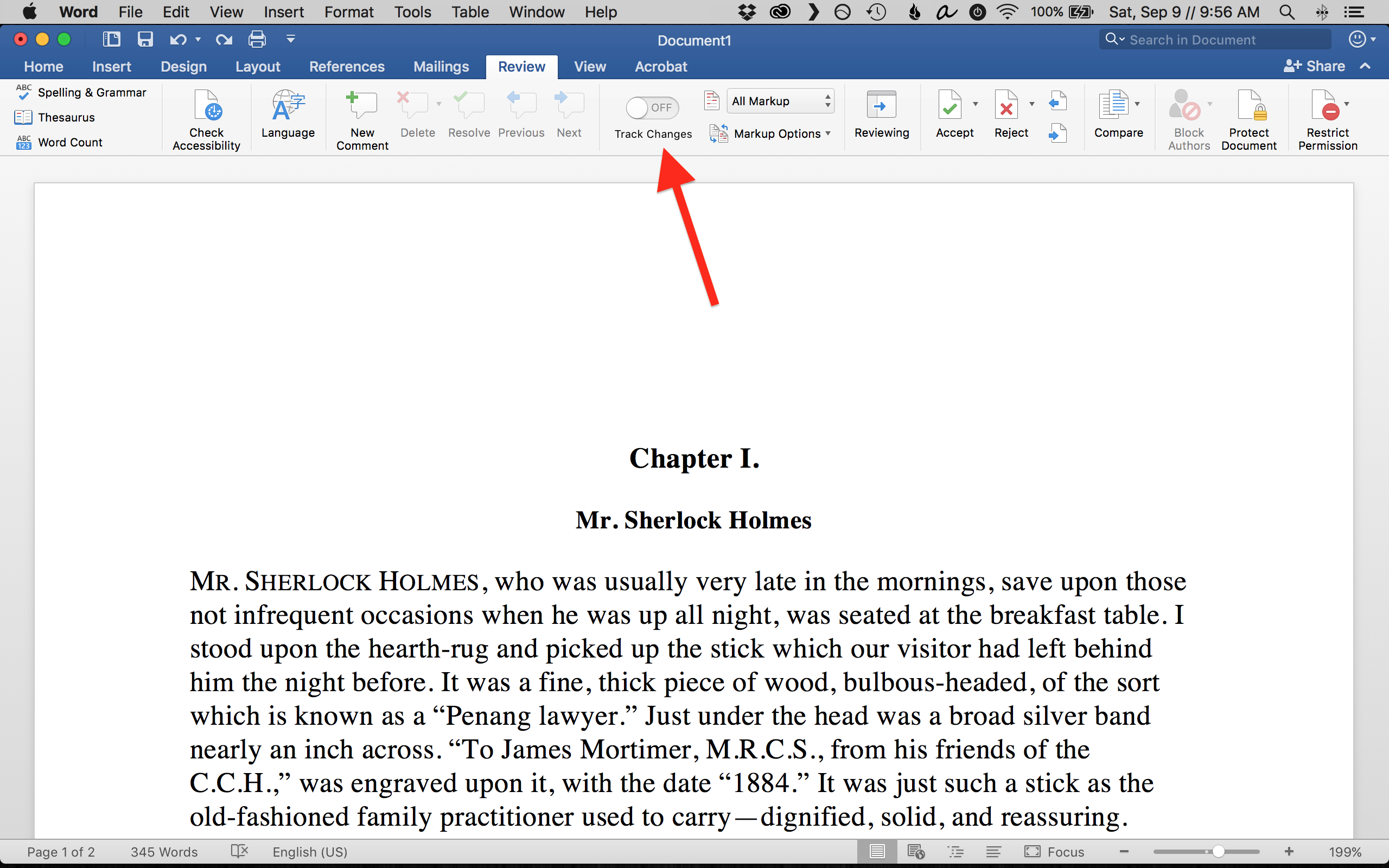
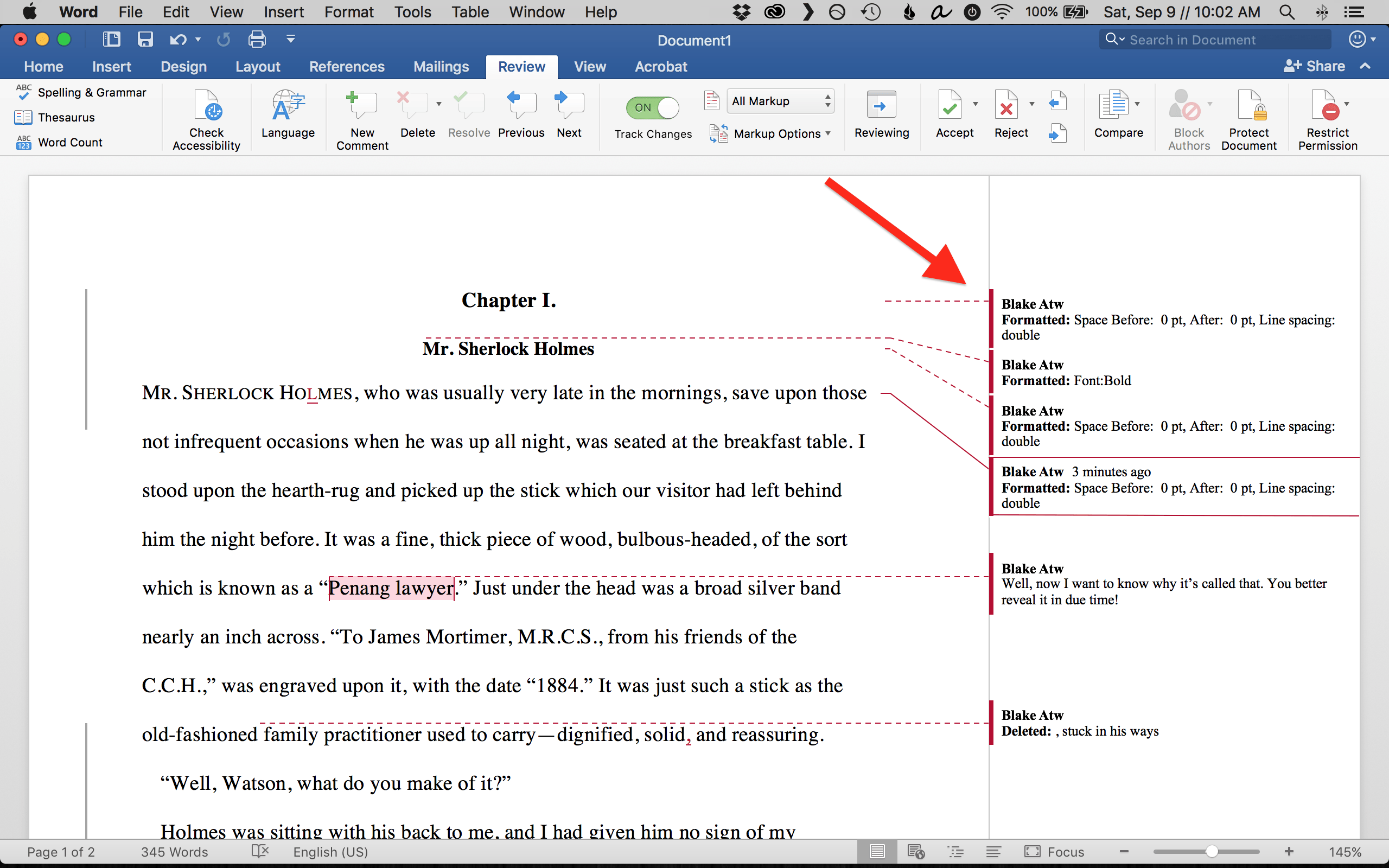
    To see what work your editor has accomplished, click the Review tab, then locate the toggle button titled Track Changes. Click that button to turn Track Changes on.

    Once clicked, you should immediately see a sidebar appear to the right of your text containing your editor’s edits and comments.

    How to use All Markup and Markup Options

    If the Track Changes sidebar fails to appear, try three more actions before contacting your editor to see if they may have sent you the wrong document.

    1. Near the Track Changes button, two drop-down menus show All Markup and Markup Options (or Show Markup on Windows). Clicking on the All Markup drop-down reveals its options:

    • Simple Markup denotes edits with a line on the left-hand side and reveals editorial comments. However, because it’s so simple, it doesn’t show where the precise edit occurred.
    • All Markup reveals every edit inline. This mode shows exactly what your editor did.
    • No Markup presents the edited version to you but without sidebars and without revealing what edits were made. It’s a clean version of the final product after your editor’s edits.
    • Original presents the file as it was before the editor attacked it. This mode may be useful to make comparisons between your version and your editor’s version.

    If this drop-down menu was set to No Markup or Original when you turned on Track Changes, you won’t see any changes. If it’s set to Simple Markup, you may only see minimal changes.

    When you’re first working with an edited document, be sure that All Markup is selected.

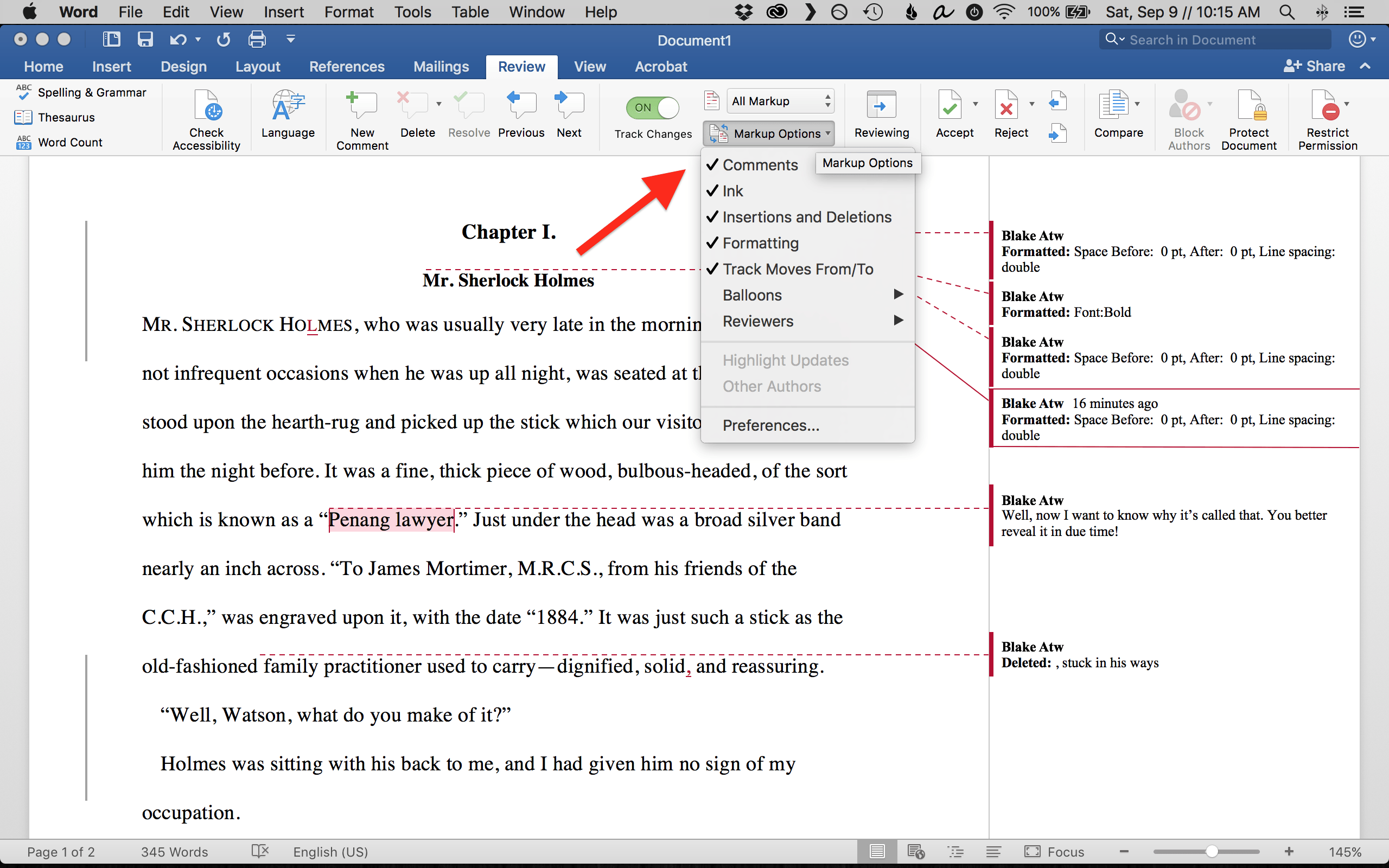
    2. Next, click the Markup Options drop-down menu and ensure that all its items are checked: Comments, Ink, Insertions and Deletions, Formatting, and Track Moves From/To.

    If you only want to remove seeing any of those types of edits, uncheck the selection. For example, to only see insertions and deletions, uncheck every other item.

    3. In that same drop-down menu, go to Reviewers and ensure that All is checked. If you had multiple editors work on the same document (which isn’t recommended) and only want to see one editor’s changes, ensure that they’re the only name checked in this menu.

    If you’ve tried each of these steps and still don’t see your edits, contact your editor.

    How to accept or reject changes in Track Changes

    After ensuring your edits appear, now the real work begins: Accepting or rejecting edits.

    Doing this either locks in the edit or prevents the edit from occurring.

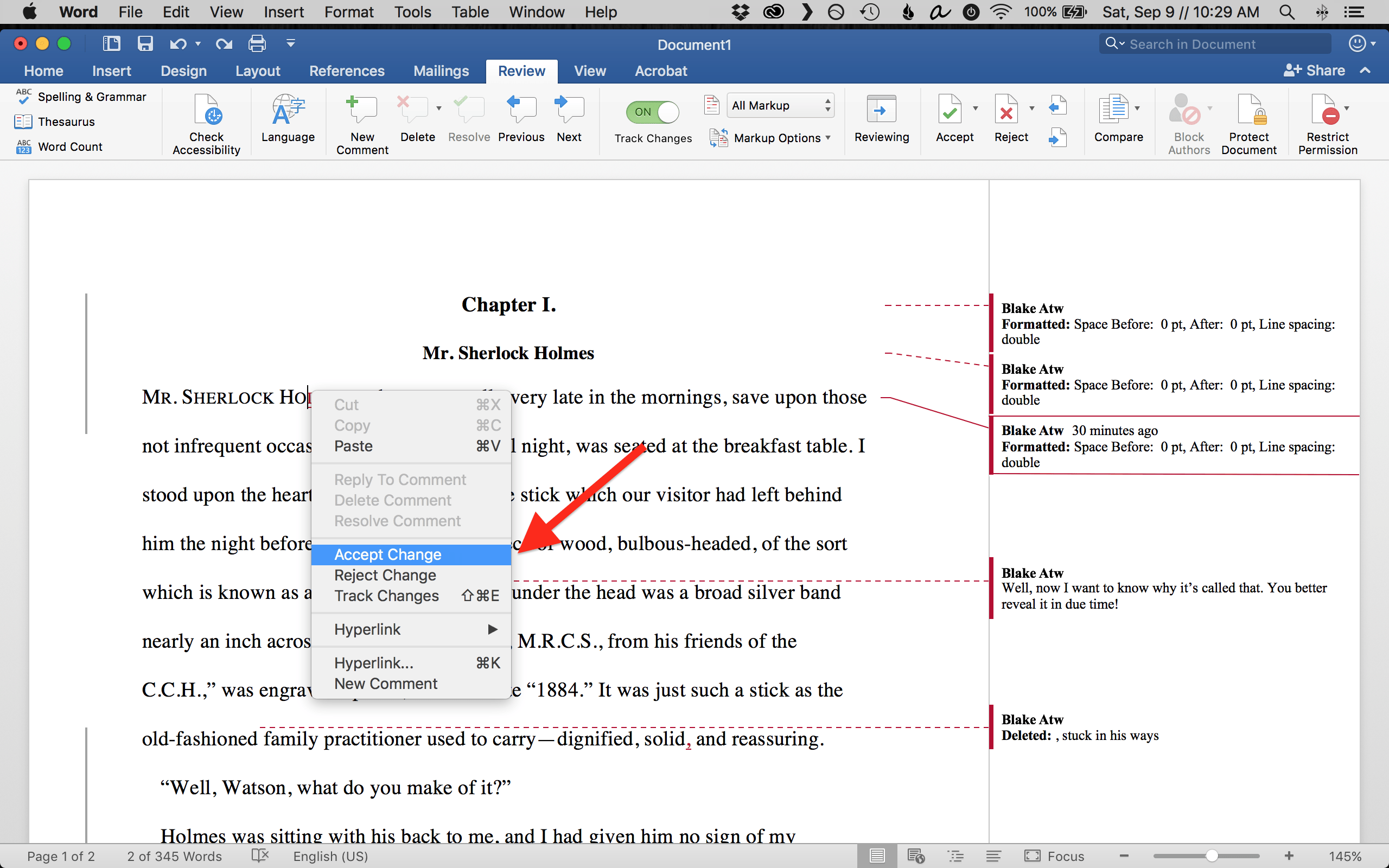
    Within the review tab and to the right of the Markup drop-down menus live the Accept/Reject buttons. To start working through each edit, click within your main text where your first edit occurred or click the first edit in the sidebar. Then, go back to the menu and click Accept or Reject.

    Word will automatically jump to the next edit, meaning that you can continue to click Accept or Reject without having to click back into the main text or the sidebar edits. You may also right-click any edit and select Accept Change or Reject Change.

    How to reply to comments in Track Changes

    Your editor may leave comments throughout your manuscript. Often, they will ask questions to seek clarification.

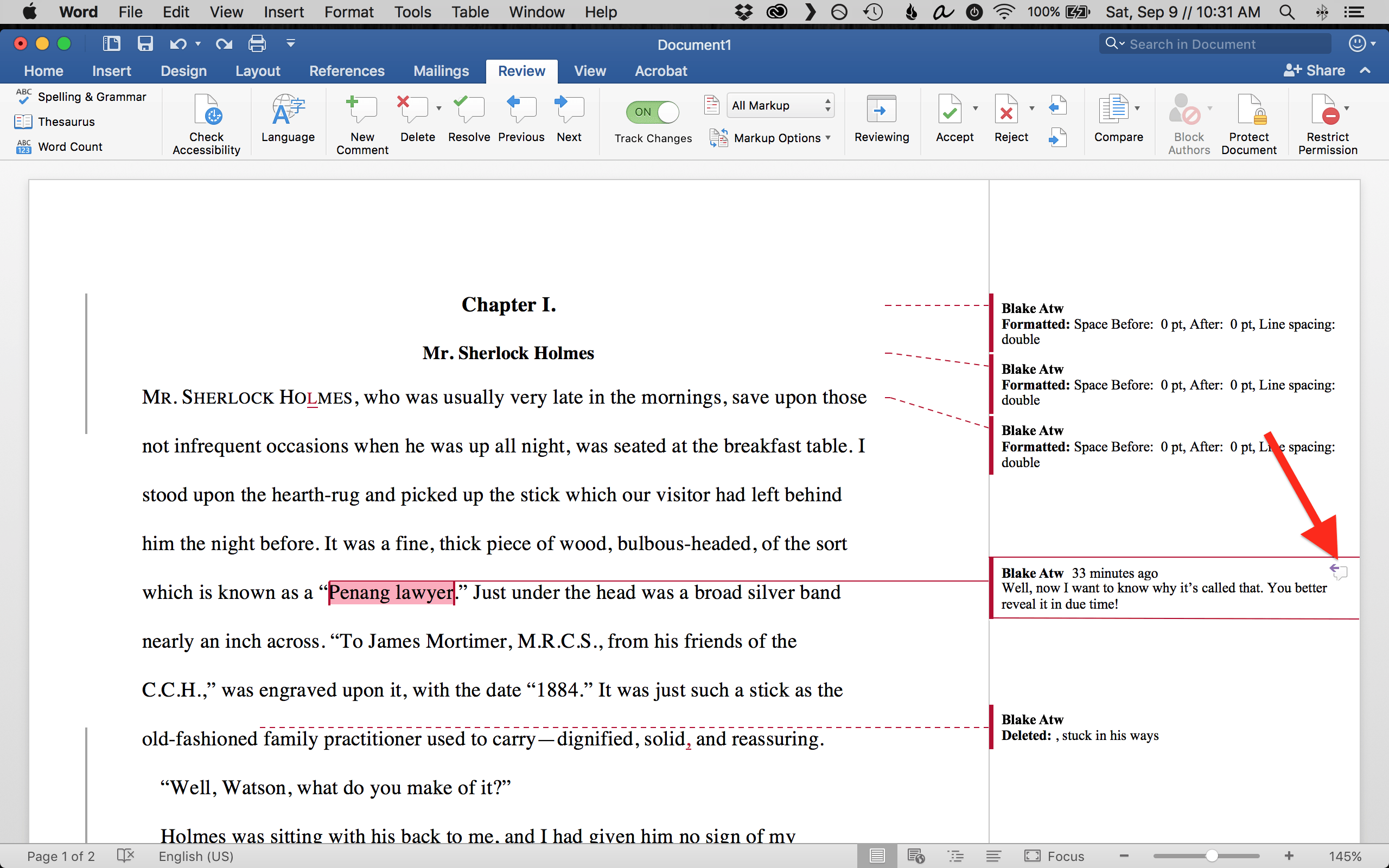
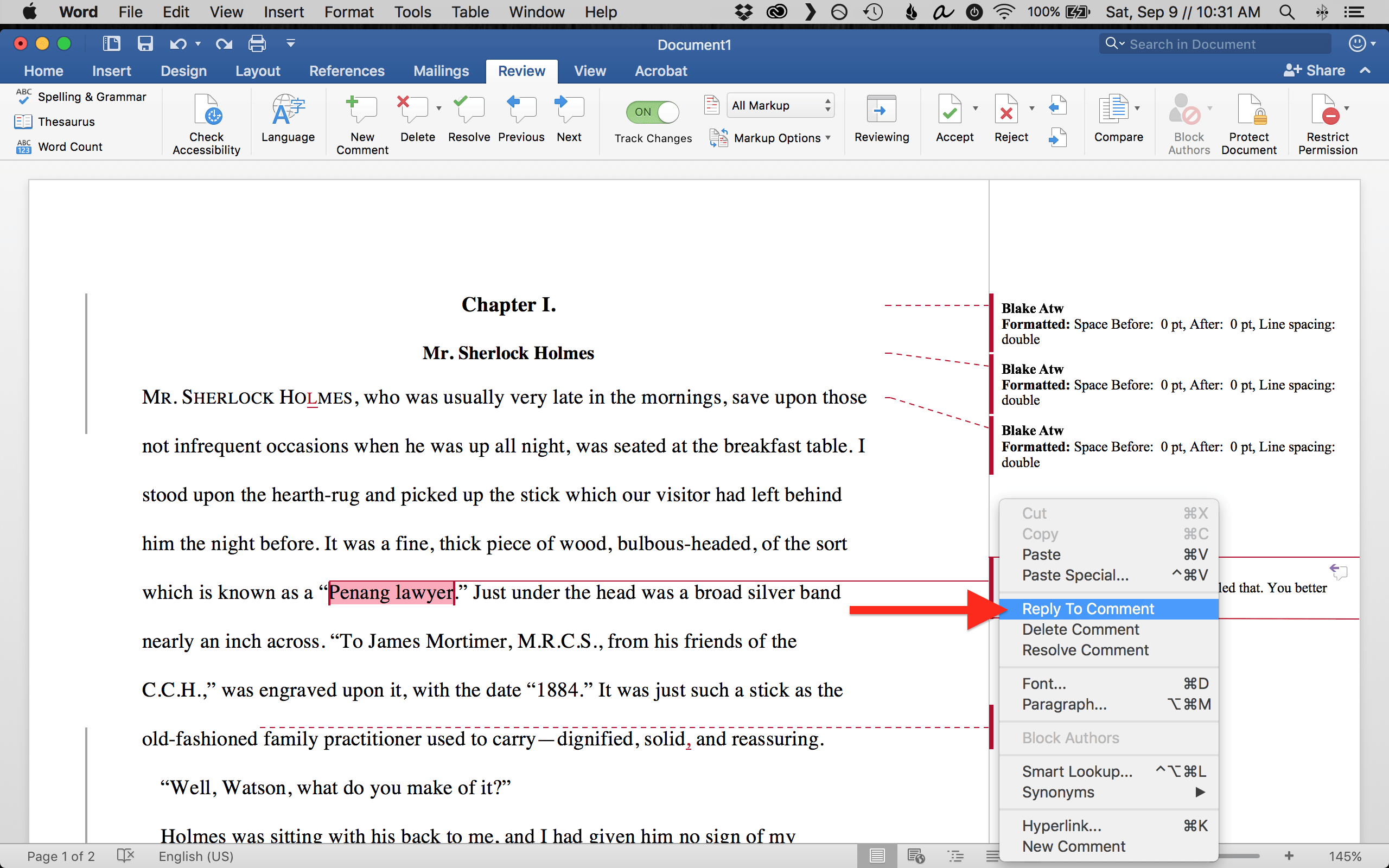
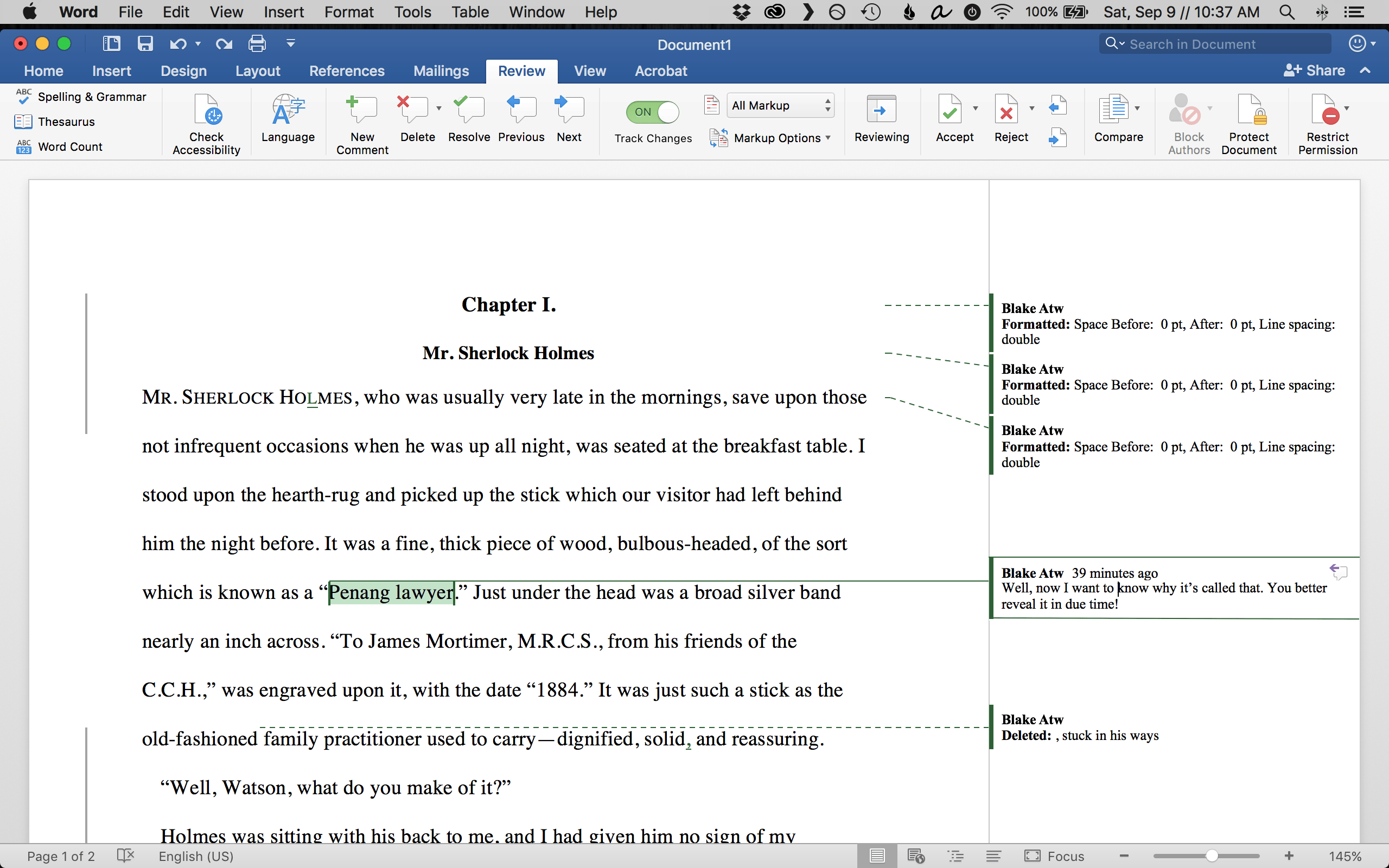
    To reply, either click on the comment icon in the top right of their comment or right-click their comment and select Reply To Comment.

    If a comment needs no reply and you’d like to remove it or archive it, select Delete or Resolve in the Review tab.

    To create your own comments, highlight the part of your main text on which you’d like to comment, then select New Comment in the Review tab.

    This brief, introductory tutorial should give you a firm foundation for tackling edits in Track Changes.

    And if your editor is particularly nice and tech-savvy, they may even use some color other than red to mark up your manuscript.

    If you’ve used Track Changes, what problems have you had? Or, what’s the best comment you’ve received on your writing?

  • What Psychology Says About the First Page of Your Novel

    What Psychology Says About the First Page of Your Novel

    As a psychologist I might be biased, but I believe psychology is the ultimate complement to writing.

    Think about it: Psychology is the study of human behaviour and emotions, relationships and social interactions, psychopathology and human dysfunction.

    What do novels explore and ultimately mirror?

    You’ve got it; What characters do and feel, their relationships and interactions, the worst of humanity and our inspirational best.

    This means psychology can teach us a lot about our stories, our characters and how to engage readers.

    And these are all points we can use to hook our readers from the very first page of our book.

    We all know the first page is key. It’s a flooded market, and readers know they have choice. Give them a solid reason to dive into your words and stay there — rather than moving on to the next cover on their Kindle.

    Here’s what psychology says you need on your first page.

    1.  A question (or two)

    There’s one powerful motivator that led your reader to your first page — curiosity.

    Curiosity brought  us life-changing items like soap, the wheel and alarm clocks (with a snooze button for sleepy writers). Curiosity has us doing completely unproductive tasks like reading news about people we will never meet, learning topics we will never have use for or exploring places we will never visit.

    Curiosity is what captured a reader’s attention when they saw your book’s title, cover and blurb. Their synapses fired. Their mind wanted to know more, because when we actively pursue new information through our curiosity, we’re rewarded with a flood of pleasure inducing dopamine (just like when we eat, have sex or snort cocaine).

    And once you’ve sparked their curiosity, you need to maintain it — the best way to do this is to raise questions in their mind.

    Why does Harry live under the stairs? How will Frodo escape the orcs?

    Sow those little seeds throughout your first page (and every scene after that), and you’ve given your reader a reason to keep reading.

    We’ve all been there, it’s 4 a.m. on a weeknight, with children that are early risers…knowing we’ve run out of coffee — but we just HAVE to know the answer!

    2. Emotion

    Our brains are driven by emotion.

    I know we like to think we’re rational beings, applying the rules of logic calmly to those little and not-so-little decisions, but our every thought and whole perspective is colored by emotion.

    Rather than convince you by giving examples of emotion’s salience in our life, I thought I’d introduce you to a man called Elliot. Tragically, Elliot lost a small section of his brain during surgery for a benign tumour. Before surgery Elliot had been a model father and husband, holding a high-level corporate job, but the operation changed everything. Afterward, Elliot couldn’t make a decision; whether to use a blue or black pen, what to have for lunch and where to park his car. He lost his job, his wife and was forced to move back in with his parents.

    Why? Because Elliot could no longer feel emotion. As a result, he was completely detached and approached decisions as if he was in neutral — every option carried the exact same weight.

    It turns out, emotions are the weight in the scales of choice.

    What does this mean for your reader? Well, if the reader can’t feel what matters and what doesn’t, what’s important and what isn’t, then nothing matters.

    So as a writer, you need to convey not just what happens on that first page (the action), but also how this affects your protagonist, and how your protagonist feels about the events (the reaction).

    That is what your reader is going to connect with. Without emotion, your story will be neutral, boring, and perhaps put down and walked away from.

    3. A compelling character

    If you’re making a sandwich, one we want someone else to take a bite from, then these two previous points are the two slices of bread that hug your pastrami or Swiss cheese.

    The bread is important, without it you don’t have a sandwich. But without the filling, you have…well, bread.

    Who eats that on its own?

    Your pastrami is your character. The Swiss cheese is the protagonist we’re drawn to, that we want to explore.

    Research has shown we have a profound desire to try and understand the thoughts and feelings bouncing around the skulls of people we interact with (how many of us

    consider ourselves people watchers?), the characters on TV and the hero introduced on your first page.

    From an evolutionary sense, our fellow humans are pretty darned important to our survival. It’s why we get a burst of dopamine when someone smiles at us and the same part of our brain associated with physical pain lights up when we’re socially rejected.

    How do we create a compelling character? Luckily, there are multiple paths to this uber-important goal — conflicting characteristics, a challenging situation to handle, powerful prose, a secret, a vulnerability, a driving need, a questionable goal, a primal emotion we empathise with.

    This is where your writer’s mind gets to fly — but make sure you capture it on that all-important first page.

    Capture your audience’s curiosity, connect with their emotions and give them a character that does both of these and you’ve got yourself a first page trifecta — one that will engage, immerse and captivate your reader.

    Just have a look at the first page of your favorite book.

    Does it have all three? I’d love to hear your thoughts, or how you’re planning on capturing your first page trifecta.

  • Get Out of Your Own Way: 6 Creative Tips to Crush Writer’s Block

    Get Out of Your Own Way: 6 Creative Tips to Crush Writer’s Block

    Let’s be honest — being a writer can be torture, right?

    You know what you want to write and the goals you have are real, but sometimes life, excuses and your own fear can get in the way of success.

    There is no magical unicorn that will make the process any easier, but if you make writing a daily habit where you allow room for mistakes and curiosity, you’re on your way to winning the battle.

    How can you make writing be something you don’t dread when you stare at your computer?

    1. Let your words be vomit on the computer

    You have brilliant sparkling ideas dancing around in your head that you envision in such a glowing, perfect spotlight. You sit down to put human, imperfect words to those fantastical ideas and…barf.

    You put barf on the screen.

    You know what? That is the BEST place to start.

    I enjoy writing the most when I give myself permission to let my words be projectile vomit on the computer screen.

    You have an idea in your head right now of what you want to write about, don’t you? It’s so easy to ignore those ideas and convince ourselves they’re just ideas that wouldn’t lead to enough material to write about.

    But you don’t know where the ideas will lead if you don’t try to find out. And finding out means a very messy drawing board and permission to majorly junk it up.

    Instead of pressuring yourself to find perfection,I take a backseat and see where my writing goes. I write very incomplete, incoherent lists, ideas and images. Sometimes I’m able to go back and polish it up relatively quickly. Other times, I’m not, so I walk away and let it simmer, trying not to stress at the huge pile of incomplete garbage I just created.

    The cool thing about ideas is that they evolve from day to day. I’ll be in the shower or driving to work, and the vomit I laid down on my computer soon starts to turn into something more cohesive. Sometimes it matches what was in my head, and sometimes it’s even better if I stay with it.

    2. Quit playing the “writer’s block” card

    Writer’s block is code for “I’m too intimidated I won’t crank out perfection, so I’ve decided to watch Netflix and eat ice cream instead because I know I won’t fail at that.”

    No more. I won’t have it. You can do better.

    If you follow step one of not caring that you have vomit on your computer screen, you will not be blocked.

    The pressure is gone, and you’re left with you and your ideas, working together happily instead of scowling at the screen, wondering why you just couldn’t be something normal like an accountant.

    Writer’s block is saying you’ve put the bar too high, and you’re afraid of not measuring up. Take the bar and put it much lower for the first writing session, so you have permission to simply play with your ideas and words instead of trying to whip them into submission.

    [twl_reusable_block post_id=41455]

    3. Put some fire in your belly

    Although writing should be an activity you look forward to, it’s not a bad idea to put some pressure on yourself to complete projects.

    You have to put deadlines in place or else everything else will always come first like family, friends, work, binge-watching Top Chef — the list goes on.

    I don’t have the luxury to be able to write all day, so I give myself an hour.

    It cuts out the wiggle room to check Facebook or pet the dogs. The hour is my precious time to get to it without second-guessing myself. I almost never get done what I wanted to, but it leaves me hungry for more the next day, and hungry for writing is what I need to be when the alarm goes off at 5 a.m.

    4. Stay organized before your ideas drift away

    Part of holding yourself accountable is making sense of and organizing all the ideas bouncing around in your head.

    Try using Trello to track your ideas and keep you on a solid, tangible path to completion rather than being overwhelmed by all you want to do. If you’re a visual person who likes to see how much you’re completing, this might really work for you.

    And don’t let whispers of ideas get away from you. I jot down everything that zips through my head and go back to it. The other day I wrote “Facebook friends–not really even friends” in my Google docs document. I went back to it later in the week and started fleshing it out and quickly had a very successful blog post on my hands called,  “If I Die Tomorrow, Would My Facebook “Friends” Come to the Funeral?”

    I didn’t know exactly where the piece was going, so I just jotted down the messy, imperfect ideas as they came to me, and eventually the ideas turned into solid sentences and new ideas I didn’t have when I started.

    It was a thread I kept tugging at that started with an idea I had at my day job, but had I not started with the simple act of jotting down my ideas, the piece wouldn’t have been born because it would have remained trapped in my brain that is easily distracted and pulled.

    5. Stop devoting all your time to reading books about being a better writer

    It’s so great to learn from people who have more experience that they want to share with you, but constantly reading books on how to be a better writer is yet another excuse to not write.

    Writing conferences and networking are important to keep your head in the game, but in order to be a part of that game, you first have to write.

    There is no way around simply putting your butt in a chair to write.

    6. Don’t wait for the perfect time to start writing

    I used to be the master at doing everything under the sun before I would park my procrastinating butt down to write.

    I would make excuses like, “I can’t focus on writing if the house isn’t clean.”

    The truth is, there will always be something to pull us away from writing if we let it, but at the end of the day, if we do let it, it means we’re not making writing be an important part of our lives. And that means we won’t succeed.

    The perfect time to write is right now because you are the only you in this world who will put your spin on ideas. We’re not looking for perfection — just you and your ideas you’ve given permission to dance imperfectly onto the screen.

    These steps won’t magically lead you to a land of daily effortless writing. Writing is hard because you care about what you want to say and how you want to reach people. If you didn’t care, it wouldn’t be hard, and you wouldn’t be a writer.

    Now, sit that butt down, write some garbage and keep coming back to it with patience and an open mind. Do the same tomorrow and the next day.

  • Start With Why + Other Writing Tips to Cut Through The Noise

    Start With Why + Other Writing Tips to Cut Through The Noise

    A friend of mine is a passive aggressive tweeter. You know the kind I mean, right?

    “Dear Uber driver, it’s six degrees outside! What’s the deal with having all four windows open!?”

    Rather than politely ask the driver to close the windows, he opts instead to make a noise on the internet during his cold, uncomfortable ride to work.

    While the din often seems loudest on social media, noise abounds online in general. Everywhere you look, you see articles claiming to have “5 super fast ways to do this!” and “103 best ways to do that!”

    These ideas aren’t necessarily bad. If the article delivers on its headline promise, you’ll be 103 ways better off.

    Unfortunately, it’s more often than not wishy-washy clickbait. In addition to annoying the reader, this kind of content damages your reputation as a writer.

    As I was drafting this post, a piece on Gorilla Marketing by Seth Godin landed in my inbox (serendipity I love you). The excerpt below offers a soberingly accurate description of the ‘noise’ I’m referring to.

    “Today, because noise is everywhere, we’re all surrounded by a screaming horde, an open-outcry marketplace of ideas where the race to be heard appears to be the only race that matters. And so subtlety flies out the window, along with a desire to engage for the long haul. Just a troop of gorillas, all arguing over the last remaining banana.”

    Why do you write?

    If you’re a freelance writer, chances are you’re trying to turn your writing business into a money-making machine. As a blogger, perhaps your focus is more on getting your brand out there. In which case you’re likely after guest post opportunities.

    In each of these cases you’re clear on what you’re getting out of the deal: money, recognition, maybe even both (if you’re lucky).

    But how much consideration do you really give to what the reader is gaining from the transaction?

    The world is inundated with information

    According to Worldometers (a website that counts the number of blogs posts written on any given day), more than three million have been published today so far.

    No wonder the human attention span has dwindled to a point where it’s lower than that of a goldfish. Although to be fair, if our finned friends had access to smartphones they’d probably be just as easily distracted (just not by cat videos).

    Given how busy life is nowadays and how much harder we have to work to stay ahead, it’s understandable that we writers sometimes forget how easily distracted our readers are.

    It’s not an excuse, obviously, but when the deadlines are piling up alongside the dishes and the bills, it’s bound to happen. We need to change that, but how?

    The ‘adding value’ pact

    It starts by making a pact with ourselves that we’re going to quit squabbling over bananas and instead engage for the long haul. No more excuses.

    Let’s make a deal with our readers that from now on, we’re putting them first.

    There’s a reason why good SEO practice dictates writing for humans first and search engines second. Writing for the latter may well get us to the top of page one on Google, but what’s the point if what we’ve written amounts to nothing more than keyword-littered noise?

    We’re human and it’s human connection we’re after (Google’s spider bots don’t make for great coffee companions, or so I hear), so let’s focus a little more on what we can give. Approach it from that angle and the ‘what we can get’ part will take care of itself.

    Start with why

    For once I’m not referring to Simon Sinek’s ridiculously popular TED talk (32,658,808 views and counting). If you haven’t seen it you should absolutely set aside the next 18 minutes to rectify that.

    We’ll wait.

    In this instance, I’m talking about something I learnt from my ex-boss. She told me she won’t write a single word unless she’s one hundred percent clear on her ‘why.’ As an inbound marketing aficionado, she walked her talk.

    Purpose is different for everyone.

    For my boss, it meant ranking for a specific keyword or generating new leads. Freelance writers might be looking to land new clients or impress existing ones. Bloggers are likely focused on increasing page views or building a reputation as a thought leader in their niche.

    Content is about more than purpose

    My boss was on point. Purpose is key. But purpose is about more than ranking for a specific keyword or increasing page views. While certainly important, these goals are secondary to our ultimate goal of adding value.

    This means writing for the sole benefit and enjoyment of our future reader. Yes, getting paid is important, as is achieving whatever other goals we may have for furthering our career. But first and foremost we should be thinking about how we can add value in a world that’s marinating in information.

    When we do that, everything else will follow: money, happy clients, soaring pageviews and more. Why? When we write intentionally people will take notice, for the simple reason that it shows we give a damn.

    These are some of the questions we need to ask ourselves every time we sit down to write.

    • Will this help the reader?
    • Is it worth their time to read it?
    • How will it make them feel?
    • What can they do with the information?
    • Will it make them think?
    • Will it make them act?

    We’ve all read something so captivating that the world around us just disappears. There’s no room for noise here, no room for anything but the words we’re so intent on absorbing. It’s a magical place to be (until you look up and realize you’ve missed your stop).

    Seth Godin summed it perfectly at the end of his blog post on gorilla marketing when he said, “We don’t need more hustle. We need more care and generosity.”

    When we sit down to write, that’s what we should aim for. We may well fall short of our mark, but that doesn’t mean we shouldn’t keep trying.

    Photos via Walnut Hills Golf