Tag: freelance writer

  • 6 Big Ways to Say YES to Your Writing Career

    6 Big Ways to Say YES to Your Writing Career

    What would your life be like if you said “yes” more often?

    That’s what powerhouse TV producer Shonda Rhimes wondered after her sister told her, “You never say ‘yes’ to anything.”

    These words shook Rhimes to her core and inspired her to accept her sister’s challenge: Say yes to every opportunity that came her way for one full year. She documented the experience in her best-selling book, Year of Yes: How to Dance It Out, Stand In the Sun and Be Your Own Person.

    While those of us who love writing aren’t necessarily making appearances on Jimmy Kimmel Live or producing Grey’s Anatomy and Scandal, pursuing your dream of being a writer can be equally scary to the activities Rhimes said “yes” to during the year-long experiment.

    When it comes to being a writer, the easy thing to do is to stay tucked away in a writing nook, typing away at a keyboard, keeping your drafts hidden away, never to be seen (until they’re perfect, that is).

    The harder, scarier and much more rewarding thing to do is to step outside your comfort zone and say “yes” to writing opportunities that will help you grow, thrive and share your words with the world.

    Take a note from Shonda Rhimes and say YES to these potentially anxiety-inducing writing activities.

    1. Pitch a guest post to your favorite writing blog

    One of the best ways to gain exposure as a writer and build your personal brand online is through guest posting. When you publish a guest post on a big or popular blog in your industry, your work is shared far wider than your personal network and you begin to establish credibility.

    Pitching a guest post can be scary, but I often encourage writers to consider the worst-case scenario. The very worst thing that can happen is the blog editor declines your post and you pitch it to a different site or publish it on your own blog.

    As writers, we need to learn to deal with rejection, so take any “no” you receive as a chance to practice patience and keep moving forward.

    Ready to pitch your first guest post? Be sure to check out this guide to knock your next guest post out of the park.

    2. Join a writing critique group

    No doubt, sharing your work with others can be a terrifying experience. After all, these words, characters and worlds live inside our hearts, brains and souls.

    However, joining a writer’s critique group either online or in-person can both give you a network to lean on (accountability, people!) and also help strengthen your writing. What makes sense to you because you are so close to your work may not make sense to someone seeing it for the very first time.

    Developing a relationship with a critique partner or group gives you a much-needed outside perspective on your story.

    Still not sure how to find a critique partner or group? We’ve rounded up 40 places to find your perfect match.

    3. Attend a writing conference, retreat or residency

    Physically step out of your comfort zone to take your writing offline and into the real world.

    Consider applying to a writing residency for a set amount of uninterrupted writing time in an often-beautiful and inspiring setting. Similar to a residency, but often shorter and without the need to apply, writer’s retreats are a wonderful way to change up your surroundings to find new inspiration.

    Looking for a more educational experience? Professional development opportunities like attending a writing conference are a great way to hone your skills, meet other writers and walk away with new ideas, tips and tricks.

    4. Find an agent to represent your work

    Dream of being traditionally published? You’ll need to find a literary agent to represent your work and pitch your book to publishing houses.

    To find the agent that’s right for you and your work, check out the acknowledgement pages of the books you love in your genre. This is a great way to see who handles the type of book you’d like to publish. Similarly, research agents online and via social media to determine fit.

    Once you’ve identified a list of agents you’d like to work with, you need to write a query letter to pitch your book and explain why you want to work with that particular individual.

    5. Self-publish your book

    As traditional publishing becomes much harder, more and more writers are turning to self-publishing.

    While self-publishing isn’t the simplest route, it often gives writers more control, freedom and flexibility.

    As author Linda Formichelli explains in this post, “There are no gatekeepers telling you what you can and can’t publish. No one telling you what to charge, and no one taking most of the money and giving you a paltry 15-percent royalty. No ten-month lag time between starting your book and seeing it published.”

    Self-publishing your book is a big step. Consider your decision carefully.

    6. Start a blog

    Get comfortable sharing your writing online by starting your own blog.

    When you blog, you begin to develop your unique voice and style, write more consistently and learn how to market yourself and your writing online. These are all important skills for being a successful writer or author in today’s digitally-charged world.

    Oh, and if you’ve been dreaming of starting a blog, but are still feeling hesitant… don’t let excuses hold you back.

    Staying within your comfort zone is just that; it’s comfortable. However, we all know that the most rewarding things in life are just out of reach — just a few steps outside your comfort zone.

    Be brave. Take a chance on yourself. Say “yes.”

    What writing challenges have you faced recently?

  • 5 Ways Becoming a Mom Made Me a Better Freelance Writer

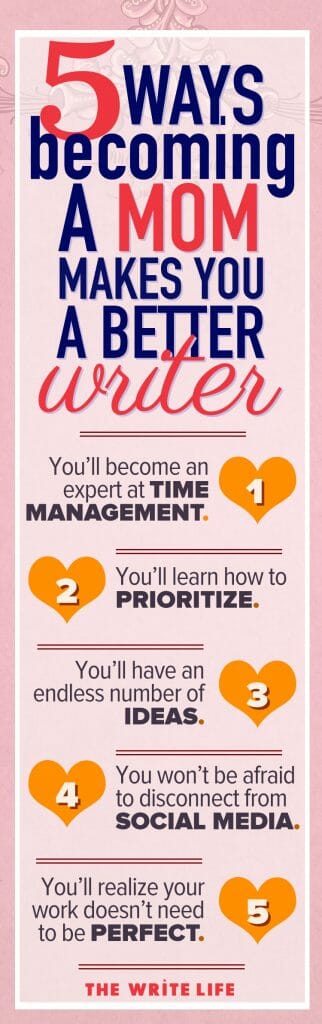
    5 Ways Becoming a Mom Made Me a Better Freelance Writer

    When I had a baby last April, I was worried my freelance writing career would take a hit.

    But since having my son, I’ve been published in two of my dream publications and even landed a copywriting gig for a national chain!

    In many ways, being a mom has made me a much better freelancer. Here are five things I’ve learned about my freelancing career in the past five months.

    1. I’ve become an expert on time management

    I have two daily nap times during which to get things done. They can last anywhere from 30 minutes to two hours, which means as soon as the pacifier’s in his mouth and the sound machine is on, it’s go time!

    Procrastination isn’t an option — if I spend even a few minutes poking around Pinterest, a third of my work time could be gone.

    I also find time in the “fringe hours” to get personal development done: I’ll listen to inspiring podcasts, like Smart Passive Income or Being Boss, while in the car, or read books on entrepreneurship while breastfeeding.

    2. I know how to prioritize

    When you’re so short on time, you need to think about the long-term picture.

    Being a busy mom has helped me to feel confident in raising my prices, because I just don’t have time for projects without a payoff. I also need to pitch projects that don’t require a ton of outside research or interviews, since I have a baby who might start suddenly crying. It’s helped me laser-focus my dream clients and go after them with intention.

    Being a mom has also encouraged me to focus on more copywriting and content marketing because the pay is much steadier.

    Do I miss the fast pace of freelance journalism? Sure, but I can still pick up those projects on lighter weeks.

    3. The ideas are endless

    Kids are full of imagination, and they make you see things in such a different way.

    My son is fascinated by silly things like the ABCs or his stuffed frog. He also has literally no social filter, meaning he’ll just stare at someone for an hour if he thinks they look interesting.

    He helps me slow down and think about the world in a different light.

    mom writers

    4. I know things don’t need to be “perfect”

    The perfect, Instagram-ready office with a white desk, flawless manicure and hot coffee? Ha!

    Most of the time, I’m working from my husband’s cluttered desk while listening for the baby monitor. There’s often drool on my shirt, a stuffed animal at my feet, and a baby’s sound machine playing in the background. When you have so much going on around you, you can’t depend on your muse or just decide you don’t feel creative that day. You need to power through and get things written.

    And if you’re not waiting for your setting or mood to be perfect, you can get a lot more done. I definitely don’t need the perfect set-up or atmosphere to get work done; I now feel like I can work anywhere at any time!

    5. Disconnecting from social media has been good for my brain

    Since having my son, I try to limit the amount of time I’m on social media around him. I don’t want him to think my iPhone is his little brother.

    Less time scrolling through my Instagram feed means less time comparing myself to other writers, being overwhelmed by an excess of media, and feeling the constant need to “hustle.”

    That means I’m in a way better headspace when it’s time to sit down and write.

    Overall, being a mom has helped my freelance career thrive. I feel inspired, driven and further in my career than I ever have been. So although I might spend most of my day singing Disney songs and playing “Patty Cake,” I’m happy I can continue my craft and still be a successful freelancer.

    New parents, how have you balanced freelance writing and getting accustomed to your new role?

  • Beyond Freelance Writing: How to Be an Entrepreneur

    Beyond Freelance Writing: How to Be an Entrepreneur

    Freelancing is often seen as the first step to entrepreneurship.

    But as a freelance writer you probably run a one-person business, trading time for money, while dreaming of living the laptop lifestyle, posting pictures from Mauritius and Thailand while working in your yoga pants.

    How do you make that happen? How do you stand out from the thousands of others with online businesses who call themselves entrepreneurs?

    Every freelancer wants to break free from the time-for-money cycle and become a successful online entrepreneur. But it’s a crowded marketplace, and for your dream to turn real, you must stand out from the competition.

    So how do you separate yourself from the rest of the herd?

    Here are five offbeat ways to differentiate yourself as a freelance writer.

    1. Make your customer the hero

    Your freelance writing business isn’t about you. It’s about your customer. No matter how brilliant or unique your product or service may be, do not blow your own horn. Do not project yourself as the hero waiting to rescue a customer in distress.

    Your customer is the hero, not you.

    Identify what your customers want, why your product or service will appeal to them, how it works, and in what way your customers will benefit. Make it about them. They are the hero. You’re there to assist them in their journey.

    2. Have a long-term plan

    Writing articles for $100 per hour is okay for paying bills. But it isn’t what is going to help you realize your dream of being an online entrepreneur.

    When you trade time for money, cutting down your hours hits your income; while working long hours takes a toll on your health, and sick days mean income loss.

    A successful entrepreneur is someone who makes money without burning out. Doing so requires a long-term plan. Your plan could include starting a coaching program for writers or a creating a digital marketing course for small businesses.

    Every freelancer finds his footing by offering services at an hourly rate, but you must have a vision to take your business higher than that.

    3. Know your limits

    Are you someone who takes pride in doing everything by yourself? Do you think asking for help is a sign of weakness?

    If you answered yes to that, you’re far from being alone. We live in a society where being busy is a status symbol. But there’s only so much you can accomplish in 24 hours, and it’s perfectly OK to seek help managing certain parts of your business.

    Get an accountant for bookkeeping, or a web developer for website fixes. If you’re too busy running your coaching program or writing your book, get someone to ghost blog for you in the meanwhile.

    Outsourcing tasks helps you focus on the most important aspects of your business. A smart entrepreneur isn’t someone who doesn’t need to seek help; it’s someone who knows their limits.

    4. Create brand value

    Your customers make you what you are. How is your product or service making a difference in their lives?

    As a freelance writer, your brand doesn’t begin and end with writing articles. You must sell promises. Remember, your customers are always looking for ways to improve their lives. They want to be less busy and more productive. They want to be less stressed and more happy. Your brand value lies in helping them achieve that.

    Maybe you provide lifestyle stories and tips that inspire women to celebrate their identity. Maybe you help stay-at-home moms build their own online biz. When people identify with your brand, they buy from you because they believe in you.

    Make a positive impact. Sell promises, not features or benefits.

    5. Be different, not just better

    There are thousands of freelance writers out there. If your focus is on being better, then you’ll never achieve that. Focus on being different instead.

    In a world where everyone’s trying to be better than the other, the best way to stand out is by being different. Find out the gaps in your field that your expertise can fill in. How you place yourself in a crowded marketplace can make all the difference.

    Transitioning from a freelance writer to an online entrepreneur may not be all fun and games, but it needn’t be daunting either. By carving a niche for yourself in the market, you can be a stand-out freelance writer moving steadily towards your dream lifestyle.

    What steps have you followed to take your freelance writing business to the next level?

  • Can You Be a Successful Freelance Writer With a Pen Name?

    Can You Be a Successful Freelance Writer With a Pen Name?

    So you want to be a freelancer… but you don’t want to write under your own name.

    Maybe you want to be able to write political essays without your employer recognizing you, or submit personal essays without your family recognizing you (Hi, Mom!). Maybe you’re a woman who wants to write about a topic like game development, but worries about harassment.

    There are plenty of legitimate reasons to want to start your freelance career under a pen name.

    The question is: should you?

    Is it possible to be a successful, pseudonymous freelancer?

    Pen names and personal brands

    I bet you can name at least 10 writers with nom de plumes without having to do any research. George Eliot (real name: Mary Ann Evans). Currer Bell (real name: Charlotte Brontë).

    The literary world is full of Mira Grants and J.D. Robbs and Robert Galbraiths, pseudonyms all.

    But those are authors, not freelance writers. They might have agents and editors ready to help them develop their pseudonym as part of their brand — a brand which often includes connecting the pen name to the real person behind it, the way Robert Galbraith quickly revealed herself to be J.K. Rowling.

    A freelancer writing under a pseudonym has a different challenge.

    Are you going to develop the pseudonym and brand — complete with writing website and active social media profiles — before you start pitching?

    Or are you going to try and sell an editor on the idea that your as-yet-created pen name will be a better choice than your existing name and reputation?

    Like it or not, today’s editors often look for freelancers who are able to both write well and share articles to Twitter followers, respond to comments or otherwise interact with the publication’s online community.

    They’re looking for writers who bring their own personal brand and reputation to the publication.

    All this is hard to do if you’re starting from scratch with a pen name. Not impossible, of course. Just harder.

    “Real names” vs. writer names

    Now that I’ve clarified the difficulty of writing under a pen name, I should also clarify that you are in no way required to write under the name on your birth certificate.

    Plenty of freelancers have developed their own professional identities.

    If you want to use your initials and your last name — like J.K. Rowling — or if you want to use your first and middle names, or even if you want to create a new writer name that feels right to you, that’s fine.

    Part of freelancing is getting to craft your own career, and that includes the name you want to put out into the world.

    The difference between this kind of name and a pen name is that you are creating an identity, not obfuscating one. You’re not trying to avoid being recognized; you’re giving your personal brand a name that you can stand behind.

    Occasional anonymity is different

    Let’s say you’ve already started to build your brand under your own name and you want to write an anonymous piece — or an anonymous column, a la Dear Sugar.

    Or let’s say you’ve never written anything before but you want to pitch and write an anonymous first-person essay about a personal experience.

    That’s fine. The anonymous article or column is a standard part of the writing genre.

    An anonymous piece differs from a pen name piece in that the anonymous work states to the reader that the author does not wish to be publicly recognized.

    A pen name, on the other hand, deliberately misleads the reader into thinking that a person with that name exists.

    Some editors will be happy to run anonymous work and others may take a bit more convincing. If you want to run an article or essay anonymously, be up front about your reasons and be ready to pitch that article to a different outlet if an editor is unwilling to consider anonymity.

    So. Back to our original question.

    Can you become a successful freelance writer with a pen name?

    Here are my thoughts, from both the writing and editing perspective:

    It is possible to build a freelance career under a professional identity that is different from your legal name.

    There are many reasons why you might want to make this choice, whether you’re choosing a name that fits your gender identity or avoiding a name that has already been “taken” by another writer.

    It’s a lot harder to build a freelance career under a pseudonym.

    Today’s freelancers can’t live passively behind their bylines; they need to actively share, discuss and promote their work while connecting with readers, writers and editors.

    We’re at a point in time when sharing your writing means sharing who you are, at least to some extent. If readers don’t have some idea of the person behind the name, they become less interested in what you have to say.

    If you’re considering using a pen name because your employer has rules against moonlighting, be careful.

    Don’t jeopardize your day job for a $50 blog post.

    If you’re worried about harassment, talk to your network.

    If you’re considering using a pen name because you are worried about harassment, reach out to other writers working in that beat and ask them about their experiences and how they both deal with harassment and also protect their privacy.

    Be ready to defend your choice.

    If you want to use a pen name because you don’t want anyone in your personal life to know your true opinions on politics or social issues, expect a good editor to push back.

    As an editor, I understand there are some situations in which anonymity is necessary — and there are other situations in which I need to work with a writer to develop their ideas to the point where they feel comfortable sharing them under their own name.

    If you’re thinking about pitching a piece of writing that makes you uncomfortable, it might mean that there’s something about the pitch that isn’t quite right yet. Even an anonymous — or pseudonymous — piece should be something you’re ready and willing to send out into the world.

    Have you ever asked an editor to run a piece under a pen name? Was your request granted? What advice do you have for writers considering pen names?

  • How to Prepare for Maternity Leave as a Freelance Writer

    How to Prepare for Maternity Leave as a Freelance Writer

    When I first began freelancing, I was looking for a flexible, part-time work option that allowed me to be home with my infant and toddler during the day.

    Nearly two years later, I am freelancing from home full time and expecting the arrival of my third child within the next month.

    As someone who took partially-paid maternity leaves from my job working for a large company for the births of my two older children, preparing for maternity leave while self-employed has been an entirely new experience.

    Honestly, there were times during this pregnancy when I found myself wondering if taking a leave would even be possible, due to a short stretch of unemployment for my husband and the needs of some of my regular clients.

    Knowing how important a little down time would be to my physical and mental health, I began asking around and checking with other freelancers who had recently welcomed a baby into the world.

    I found a few helpful strategies for getting ready for maternity leave.

    Apply for short-term disability coverage

    When you are self-employed, you miss out on a lot of the benefits that come with working full time for a large business.

    Don’t be too quick to assume there’s no way to replace some of the more attractive benefits that come with working a full-time job. Short term disability coverage is available to freelancers if you are able to make room for the monthly premiums in your budget.

    This maternity planning option will only work for freelancers who are planning ahead — way ahead. Preexisting conditions, including pregnancy, are exempt from short term disability coverage; you’ll need to apply for coverage before you conceive.

    To file a claim for maternity leave, you are required to have been paying for a policy for at least 12 months, so keep that in mind as you begin to make plans to grow your family.

    Pay for your maternity leave with cash

    With no sick days or paid vacation days available, most freelancers who are expecting a child will enter maternity leave without a cent of paid time off.

    One solution is to work with your partner to create a baseline budget for your family for the time you wish to take off from work, and to begin saving as soon as you get a positive result on a pregnancy test.

    Saving a large amount of money can be challenging if you are already living on a tight budget, but freelancers have the advantage of having a variable income.

    Consider picking up extra freelance work during your pregnancy or asking existing clients if there are any additional projects you can take on to prepare to fund your maternity leave with cash.

    Work ahead by negotiating discounts with clients

    Personally, one of the biggest difficulties I faced when planning for my maternity leave was planning to continue to work for clients who required weekly work, year round.

    Eventually, at the advice of one of my peers, I emailed one of those clients and offered a small discount if they would meet with me a few months before my anticipated delivery date to create an editorial calendar for my time off.

    They were happy to oblige, and we worked together to plan out every blog post they would need so I could deliver them as a package before I took my maternity leave.

    Keep working during your leave

    Before you write me off as crazy, give me a minute to explain why working through your maternity is a realistic option when you are a freelance writer.

    As freelancers, we enjoy a uniquely flexible work schedule that can be arranged around the demands of rest of our lives, including our children.

    Outside of a week or two of adjustment and recovery, you can anticipate spending a lot of your maternity leave feeding your little one and napping. If you are a first-time-mom or your older children are in school during the day, it is totally plausible to squeeze at least part-time work into the margins of your new life as a mom.

    In fact, many of the moms I spoke with reported they felt a unique burst of creative energy immediately following their child’s birth and created some of their best work during that time.

    As for me, I’m anxiously awaiting the arrival of my third child and feeling prepared to take some time off: I’ve set aside a small nest egg and arranged to submit my work for my two-month leave ahead of schedule.

    Planning a maternity leave as a freelance writer may feel overwhelming — at least, it was for me — but the use of one or a combination of the strategies listed above should equip you for maintaining your career while caring for and celebrating your new baby.

    Parents,  how did you maintain your freelance-writing career after your little one arrived? Share your tips in the comments!

  • How to Cope When a Freelance-Writing Client Dumps You

    How to Cope When a Freelance-Writing Client Dumps You

    Sooner or later, every freelance writer will get the dreaded phone call or email: Your client’s business is shutting down.

    Or they’re restructuring and bringing the work you did for them in house.

    Or maybe they just say you’re no longer a “good fit” for them.

    No matter the details, the result is the same. You just lost a client.

    What do you do now?

    1. Don’t panic

    While it’s tempting to jump straight to freak-out mode when you find out you’re losing a client, don’t.

    Losing a client, especially one you really enjoy working with or who is particularly lucrative, is certainly disappointing. It’s OK to take some time to mourn the loss.

    Take an afternoon off and go for a long bike ride or meet up with some friends for happy hour. You’re allowed to be disappointed for a while.

    But don’t let the situation drag you down for too long, because you have some important work to do.

    2. Review your finances

    Take some time to figure out what losing this client means for your business and your finances.

    Calculate how much money you typically receive from that client each month or year.

    Not every client is equal. If you lose a $200-a-year client, you might just need to sell an extra article this month to stay on track.

    But if you’re losing a $20,000-a-year client, you may have to do some major financial reshuffling.

    If you need to cut some financial corners in the next few months, evaluate your budget and make a plan to cut non-essentials as needed.

    3. Consider your emergency fund

    Check your finances to see if you’ll be able to cover your bills in the near future. If not, consider whether you’ll need to tap into your emergency fund.

    Most financial planners recommend having an emergency fund with six months’ worth of savings set aside.

    While six months of savings seems quite ambitious and not attainable for many people, many freelancers have some sort of “rainy day fund” to cover unexpected client loss or other situations that may come up.

    If you don’t have one, consider setting some money aside each month once you’re back on your feet, to cover just such an event in the future.

    4. Get paid

    If the client you’re parting ways with still owes you money, be sure to act immediately to get paid. If they’re financially solvent and pay on time, it may be as simple as submitting your final invoice.

    But if they’re going out of business, make getting paid your top priority. If a business is filing for bankruptcy, it may not be able to pay all its creditors (including you), so contact the company as soon as possible.

    If you’re having a hard time getting paid, a strongly worded letter from an attorney has been known to do the trick to expedite payment. You may have to take the client to small claims court.

    However, especially if they’re folding, your client may simply not have the money to pay you. This threat is a good reason never to let a client’s balance build up too high.

    5. Evaluate what went wrong

    After you’re set-up to financially weather your client loss, take some time to figure out what happened. In many cases, losing a client has nothing to do with you or your work. Sometimes clients change their direction on a project, merge with another company, bring work in-house, or go out of business.

    These things happen, and they’re all part of every freelancer’s life. Don’t take them personally.

    But, as hard as it is to face, sometimes the reason you lost a client may have to do with you.

    Did you miss a deadline? Did you and your client have different expectations? Were they disappointed with your work?

    Or, maybe they can’t afford you anymore, and want to replace you with a less-expensive freelancer. If this happens, don’t cut your rates. Instead, find clients willing and able to pay you what you’re worth.

    If the reason you parted ways is out of your control, you may just shrug your shoulders and move on.

    But if you missed a deadline because you were disorganized, figure out how to get organized and learn how to manage your time so you don’t have the same problem in the future.

    Recognize that even if you made a mistake, it’s not the end of your freelance writing career. Any freelancer who has been in the business for a while has a tale or two of an epic screwup. The key is to learn from these mistakes and avoid making them in the future.

    6. Find a replacement client

    Once you’ve tended to your immediate financial needs and analyzed the situation, it’s time to look ahead. Make some time to fill your client gap.

    Contact editors you’ve worked with in the past and let them know you’re looking for work and have availability.

    If you’re looking for work in a hurry, cold-pitching usually isn’t the best way to go. It’s usually more efficient to reach out to the tried-and-true clients you’ve already worked with in the past and see if they have more work for you.

    But if you do end up with time to seek out brand-new clients, send out a few letters of introduction and pitches to potential clients to work on forming new connections.

    7. Plan for the future

    As hard as it is to recover from losing one client, once you’re back to business, it’s important to start preparing yourself for the next one you’ll lose.

    It’s not fun to think about, but it will happen again.

    After you’ve weathered your first client loss, make a plan for the future to be even more prepared for a similar situation. You might bulk up your emergency fund or further diversify your income streams.

    If one client makes up 80 percent of your income, losing them is a huge blow. Many freelancers prefer to have at least three or four key clients so the loss of any one of them won’t be as devastating.

    Every freelancer has a different strategy to prepare for the future, but now is a good time to reflect on what worked and what didn’t work when you lost a client — and how you can prepare best for the future.

    Freelance writers, have you ever lost a major client? How did you adjust?

  • 6 Lucrative Freelance Writing Clients to Add To Your Portfolio

    6 Lucrative Freelance Writing Clients to Add To Your Portfolio

    When freelance writers look for work, they often look in the same few places. They pitch their favorite blogs, they email the one client who hired them a year ago and they try to figure out which Craigslist posts are scams.

    Meanwhile, there’s writing all around you that you’re not seeing. Book jacket blurbs, product descriptions and more — and all those words need writers.

    Last year, we released 71 Ways to Make Money as a Freelance Writer, packed with writing gigs you might not yet have considered.

    I helped put this ebook together, and I wanted to highlight six of these options. Consider these six new clients to add to your portfolio.

    1. Corporate blogs

    If you’re not already blogging for corporate websites, it’s time to get involved in this lucrative market.

    Companies are often very interested in having talented writers compose informative articles for the blog section of their website — I’ve written articles about A/B testing and landing page copywriting for Unbounce, for example — and they generally pay $200-$300 per piece.

    Ask your editors if they know anyone looking for a business blogger, and get ready to feature your best corporate clips on your writer’s website to attract more clients.

    Corporate writing can be a great way to build relationships that lead to even more corporate jobs; for example, you could get paid to write About Page copywriting or white papers.

    2. Authors who need book-jacket blurbs

    This writing gig is right under our noses — literally — but most writers never consider book jacket writing as a potential client opportunity. Once you get book-jacket clients on your roster, you can earn $300-$600 or more for every blurb you write. Plus, think of all the great books you’ll get to read before everybody else does!

    How do you get book jacket clients? Here’s what we suggest in 71 Ways:

    Add this service to your website, spread the word to your network, and offer it as an add-on option for clients whose books you’re editing or formatting for Kindle.

    If that feels like a lot of work, don’t forget — all that practice blurbing your own skills will make you a great book jacket writer!

    3. Authors who need editing

    See that “clients whose books you’re editing or formatting for Kindle,” above? If you don’t have any freelance editing clients currently in your portfolio, it’s time to add them. If you drop into our Facebook group, for example, you’ll notice writers asking where they can find good editors for their work. Why not market yourself as the answer to their question?

    Write up a list of the services you provide — proofreading, formatting, constructive critiques — and figure out a fair rate for your services. We suggest $30 to $100 an hour depending on the project size and scope.

    4. Businesses that need product descriptions

    Every product description you see, either online or in a catalog, was written by someone.

    Product descriptions are usually relatively easy to put together — you’ll get a list of product attributes to include, and it’s your job to craft those features into descriptive text — and you can make anywhere from $25 to $150 per hour.

    How do you get these clients? Start looking for job listings on sites like Indeed, or use your network and ask your current clients (or your writing-forum friends) if they know of anyone looking for catalog copy work.

    If you’ve already got a copywriting job or two in your portfolio, you’ll be in an even better position to get some great leads.

    5. Fan-fiction readers

    Yes, it’s time to get paid for writing fan fiction. Amazon Kindle Worlds will pay writers 35 percent on sales for 10,000+ word stories on The Vampire Diaries, G.I. Joe, Gossip Girl and more.

    Why not try your hand at some fan fiction and see if you can gain a few fans in the process?

    6. Yourself

    As a writer, you need to be your first and best client. This means figuring out how to earn as much money from your own work as possible: monetizing your blog with sidebar ads, using affiliate programs to earn money by promoting your favorite writing tools, creating and marketing your own digital products and Kindle books, and even holding your own classes and webinars.

    So take a look at your current writer’s website and portfolio and see how you can improve it.

    Imagine if you were working for someone else, and that person asked you how they could make money off their website. Then, incorporate those suggestions. Or, take a look at your favorite writers’ websites, figure out how they’re monetizing their sites, and borrow those ideas.

    Try spending the next month working towards landing one of these six freelance writing clients. Then take a look around you and see what other writing opportunities you might have missed — or read 71 Ways to Make Money as a Freelance Writer for more ideas.

    What’s the most unusual writing gig you’ve landed? Share your stories in the comments!

  • 5 Ways to Set Yourself Up for Full-Time Freelance Writing Success

    5 Ways to Set Yourself Up for Full-Time Freelance Writing Success

    A year ago, I received a check for my first paid writing assignment.

    In college, I wrote for free for the student newspaper, a few travel blogs, and Thought Catalog. I had a ton of experience, but it took me a while to figure out how to get paid for my work.

    I didn’t understand what my writing was worth until this past January. Since I wasn’t thrilled with my day job, I decided to commit to freelance writing as a side hustle in 2016.

    Luckily, I was already in supportive writing communities. I also found invaluable online resources to help me pitch my ideas.

    Last month, I left my marketing position to pursue freelancing full time.

    The following five steps helped me manage the jump from part-time to full-time freelance writing.

    1. Find a system to track your income

    Tracking your income from the beginning is incredibly important.

    It helps you keep a record of your work. It helps you track down any delinquent clients that haven’t paid you. It also shows your progress as you accept more assignments at higher rates.

    To this day, I still use a Google sheet. As an extremely organized person, it works for me. I break columns down by headline, publication, rate, date published, date paid, date hired, date invoiced, and published link.

    Before I found this method, I was writing everything down in a notebook. Tracking dates helps me understand how quickly (or slowly) a publication completes edits, adds my story to their editorial calendar, and pays me.

    As your business grows, consider using more professional services, such as Freshbooks or Quickbooks. You might even want to outsource your accounting altogether, or maybe hire a virtual assistant to manage your finances.

    2. Create income goals

    I started with a freelance writing goal of earning $1,000 a month. Although I didn’t meet that goal in January, I exceeded it in February.

    But I found myself working too much in certain weeks, while other weeks, I’d hear crickets from my clients.

    Then, I set a weekly goal of $400. That first week, I remember only making $12 until Thursday, where I was hired for a $1,250 assignment over the next two months.

    By this point, I was focusing on developing steady relationships with editors (more on that below). Rather than cold pitching editors constantly, I pitched ones I previously worked with. Additionally, I wasn’t afraid to pitch higher-paying publications.

    My day job was a safety net if I didn’t meet my weekly goal. I also live in an area with a low cost of living, so my expenses are fairly minimal. However, I usually met my goal.

    3. Build an online presence

    During the last week of December, I created a free website with Wix. I published it on New Year’s Day.

    I also focused on improving my social media following, focusing on growing my Facebook writer page. Even today, I’m constantly inviting new friends to like my page.

    On Twitter, I started participating in Twitter chats. Once you’ve participated in one for a bit, consider finding out how to host or moderate it. Or even create your own! There are also hashtags worth following like #writing #amwriting, #writingcommunity, #instawriting, and #writinglife.

    Social media is crucial for writers because creating a platform for an audience to follow you helps clients find you.

    The larger your following is, the more potential you have to connect with future clients online — because you never know when someone who follows you on Twitter or Facebook might need a writer.

    4. Schedule your time strategically

    If you work a traditional 9-to-5 job, determine possible times of day to work on freelance projects. Are you a morning or a night person? Can you dedicate your lunch hour to freelancing? Consider working over the weekend if you don’t have plans.

    Within those time blocks, prioritize timely tasks over others, and don’t cram in too much. Your quality of work might suffer.

    I use a Passion Planner to schedule my days. I’m also a fan of basic yellow pads for to-do lists. I’m constantly writing down things to do and remember. Likewise, I prioritize the most important and timely tasks.

    Fortunately, my day job had flexible hours. If I had a larger assignment that required more time, I could leave work early to go home to work on it.

    I may not have been able to do this if my job weren’t so relaxed. However, before transitioning to full-time freelancing, it was sometimes difficult to balance time. I typically worked over the weekend.

    5. Foster relationships with previous clients

    If you’re pitching publications, focus on editors you’ve previously worked with rather than cold-pitching new ones. If you were successful with the first assignment, previous editors will know your work and trust you for future assignments.

    Not only are you more likely to receive a response, but you’re also more likely to be hired.

    The more you write for a publication and build a rapport, the more likely they’ll start turning to you for a more permanent role. Maybe they’ll come to you with a timely assignment. Maybe they’ll consider you for a regular contributor role.

    Once you’re more in tune with your earnings, scheduling, and clients, you have a better understanding of improvements need to be made.

    Have you made the leap to full-time freelancing? How did you set your financial goals?

  • Freelance Writers: How to Take Time Off (Yes, Really!)

    Freelance Writers: How to Take Time Off (Yes, Really!)

    No doubt about it, the freelance life has some perks.

    You can work on a deck with a glass of lemonade or even put together some prose at your local museum.

    Sometimes, you can set your hours and make time for a mid-morning yoga class or make a doctor’s appointment for the middle of the day.

    But despite these perks, it’s hard to really, truly get away as a freelancer. Sure, you can work from a hammock (full disclosure: I am typing this from a hammock on my back porch right now).

    But you’re still working.

    But getting away — not just from your typical surroundings, but also from your phone or email inbox — is possible.

    Here are a few tips for taking a real vacation — or as close to one as you feel comfortable taking.

    Pick your destination with unplugging in mind

    It’s hard to ignore a blinking message light on your phone.

    What does that little green flashing light mean? Does it mean your editor hates the piece you submitted? Is a new editor excited to work with you on a time-sensitive piece?

    It could mean anything, really, and it’s tempting to succumb to temptation and check your messages, even when trying to “disconnect.”

    The surefire way to avoid this notification anxiety? Go somewhere your phone doesn’t work.

    It’s not too hard to find a campground with no cell phone service, data connection, or Wi-Fi. Even just a weekend where you’re disconnected can go a long way towards unwinding.

    Of course, it might also make you a nervous wreck who drives 30 miles for a data connection twice a day just in case. Some people find it less stressful to “unplug” somewhere they can check in once a day or so for five minutes and turn their phone off the rest of the time.

    A “disconnected” vacation doesn’t have to mean being disconnected 100 percent of the time. Trial and error is the best way to figure out what works best for you.

    Communicate ahead of time

    If you don’t normally work on the weekends, going far out of cell phone reception for one weekend isn’t likely to be something that requires advance communication with clients.

    But if you’re disconnecting for a longer period of time, it’s important to communicate when you’re going to be unreachable. And this doesn’t mean just slapping up an auto-reply on your way out the door saying you’ll be gone for the next month.

    If you’re heading away from cell phone reception for more than an afternoon or so, look at the calendar to see which clients might need to get a hold of you during the period you’ll be away.

    Are you expecting to receive edits on a piece soon? Is it a client’s busy season where they frequently send you last-minute assignments? There’s definitely a bit of guesswork involved, but it’s important to consider what might happen while you’re away.

    A lot of this depends on how long you’ll be gone for. If you’ll be gone for an afternoon, you likely don’t need to do anything at all, since you can respond to your messages in the same evening.

    But if you’ll be gone for a month, you’ll have some serious work to do ahead of time.

    Tie up loose ends

    Before you leave town, let your clients know you’ll be mostly unreachable. Be sure to do this well ahead of time. Don’t just send an email blast to every editor you’ve ever met.

    If an assignment is due soon, try to turn it in early, letting the editor know when you’ll be unreachable and that you’ll be happy to address edits before you leave or after you return.

    Likewise, if you’re expecting edits on a piece soon, let the editor know a few weeks ahead of time so you can hopefully complete any necessary editing before (or after) the trip.

    Of course, from time to time, you’ll still have to spend some time working on the road. But using this system can definitely cut down on the amount of time spent working when you’d rather be relaxing.

    Dealing with a freelance disaster

    No matter how well you prepare, the occasional freelance disaster is inevitable. What do you do if this happens while you’re disconnected?

    If you’re completely disconnected, you likely won’t know about the disaster until you return to the land of Wi-Fi and cell phones. The thought of this makes some people’s skin crawl, but others find freedom in the idea.

    Whether or not being completely disconnected works for you is something every freelancer has to figure out for themselves.

    But if you’re checking in once a day or every few days, you might just check in one day to find trouble brewing.

    The extent of such a potential disaster largely depends on your line of work. If you work as a PR consultant and your big client has a major problem and needs spin control pronto, you’ll likely have to jump into work mode for a significant length of time.

    But if it’s just a client who needs a quick copy edit? That’s easy enough to refer to a trusted freelance colleague.

    In order to minimize stress if a disaster requires you to respond to while on vacation, be sure to have what you need with you on the road. Bringing any passwords you might need and important documents on a flash drive can make responding to the situation much easier. Also consider storing important documents on the cloud for any access anywhere.

    Another great option to consider is using the buddy system.

    Use the freelance buddy system

    Working in an office comes with a built-in backup system. If you’re out of town, you can set up a voicemail message and email auto-reply saying when you’ll be gone and asking people to contact another team member with urgent needs and concerns.

    Freelancers don’t typically have these built-in systems available. But that doesn’t mean you can’t create your own. Knowing other freelancers, especially those in your field and those who write for similar clients, is invaluable.

    Take some time to get to know other freelancers and consider working out an arrangement with those whose work you trust and respect.

    Leave their information as an “in case of work emergency” contact, and work out with them ahead of time what they will do if they are contacted on behalf of one of your clients.

    Of course, you need to trust this person and everyone needs to be clear on expectations.

    But it can be a great way to get a reprieve from your phone and email while leaving any work concerns in the hands of someone you trust.

    And, of course, you can return the favor when they go on vacation.

    What do you do to prepare for an unplugged vacation?

  • 4 Ways Pro Freelance Writers Boost Confidence to Defeat Impostor Syndrome

    4 Ways Pro Freelance Writers Boost Confidence to Defeat Impostor Syndrome

    The kids are finally asleep, the decaf coffee is hot, and you have a list of prospective freelance writing clients pulled up on your hand-me-down laptop…and then the panic sets in.

    What if this person laughs off my email pitch?

    Who’s possibly going pay me to write for them?

    What makes me think I could be good at freelancing?

    Congratulations. You’re officially a freelance writer because you’re dealing with a bout of impostor syndrome!

    Impostor syndrome is a well-documented psychological phenomenon in which someone who’s qualified in a field starts to experience extreme feelings of self-doubt and inadequacy about their performance.

    And without years of experience to reassure them they’re qualified, newer writers often succumb to impostor syndrome to the tune of decreased performance, accepting low rates, or even giving up on their business before it gets started.

    And that’s simply unacceptable.

    Let’s look at four ways established freelance writers overcome impostor syndrome whenever it pops up — even long after their newbie days are over.

    Redefine confidence

    As a freelance writing mentor, I’ve noticed a major problem in how new writers develop confidence. When new writers experience fear, they often think it’s a sign you’re doing something wrong, when in fact it’s just a sign you’re doing something new.  

    Far too often, we think of confidence as our permission to do what we’re doing, Gina Horkey, the entrepreneur behind the 30 Days Or Less to Freelance Writing Success course, says. But that’s the opposite of how real life works.

    “Confidence is just the belief that I can do something,” says Horkey. “It’s not proof that I’ve already done something. It’s the possibility. And when it’s low, it means I’m letting fear win. When it’s high, then I’m letting my belief in myself win.”

    The next time you feel fear and you wish you were feeling more confident, remember that confidence is a result of success, not a cause of it. It’s up to you to step forward and try new things, even when you’re feeling afraid.

    Take action to scare away fear

    When Andrea Emerson first started freelancing, she wasn’t worried about finding clients because she knew how to get into her prospect’s head. In her previous job, she’d been in charge of hiring freelance writers.

    But she was worried about generating enough work to sustain her in the early days of her business, and keeping her workload consistent over time.

    Her solution? Taking action.

    “I’ve found that taking action is a great antidote to fear—even if you start with teeny tiny steps,” says Emerson. “In terms of keeping my workload consistent, I persuaded clients to move to a retainer arrangement as soon we’d completed a successful project or two and I sensed they had a recurring need for content.”

    Horkey agrees that taking action is a huge part of not feeling fear. Her husband quit his job to be a stay-at-home dad the year before she made the leap from predictable income to variable income, so it was all riding on her.

    “I try to always do something when I get scared, because I know that fear is paralyzing,” she says.

    “Taking that next step forward is the only way to work through fear. I don’t think I’d have gotten to this point without constantly busting through fear, doubt and uncertainty,” Horkey admits. “Fear will always be there, it’s just stronger during some times more than others.”

    Reframe your fears

    “Mindset is huge when you’re your own boss, and often the defining factor between success and failure,” Emerson says. “Prospective clients can sense confidence or fear in their interactions with you. They’re incredibly drawn to the former, and repulsed by the latter.”

    Emerson also emphasizes the extent to which confidence is rooted in knowledge and training.

    “Confidence comes from recognizing your skills and the tangible value they can deliver to clients,” she says. “It’s also a byproduct of understanding your prospects — what they need and how to deliver it. It turns out, for instance, that content marketing generates 300 percent more sales leads than traditional marketing. Prospects with big marketing budgets know that, and also know they can’t get those kinds of results without writers. That bit of industry knowledge is a great confidence booster.”

    While much of a newbie freelance writer’s opportunities and client interactions might change from day to day, Horkey credits staying positive as one of her top fear-busting habit recommendations.

    “I used to focus on ‘What’s the worst that can happen?’” she says. “But now, I’ve flipped it on its head to ask, ‘What’s the best thing that can happen?’ Now I’m not expecting the worst; I’m wondering if the best thing that can happen makes it worth it to try!”

    Combine fear with persistence

    At the end of the day, that rad cat poster from the 1980s was right: You just need to “Hang in there!” But more than a passing motivational tip of the hat, you need to make a personal connection with persistence.

    As a generic phrase, “Be persistent” is annoying and trite. But when you look at day-to-day struggles, it’s an effective in-the-moment practice to say to yourself, “This intimidating client phone call is a small blip in my journey. This situation will be over soon, and I’ll be glad I stuck it out.”

    What’s at the heart of this fear is the drama of not knowing you’ll make it through, the “Will she or won’t she?” of every movie. What you can do today is decide you will, which eliminates the sense of conflict and allows you to focus on the long term.

    “I’m not ‘fearless’ because I’m making money online,” says Horkey. “Often my fears are now bigger than ever. But I’m not about to let them stop me.”

    The cure for impostor syndrome will be different for every writer. But it’s vital that we all understand that it’s normal to experience, and there are indeed cures out there for each of us to try.

    Do you struggle with impostor syndrome? How do you boost your confidence?