Blog

  • Into Kindle Publishing? Under New Payment Rules, You Should Write Longer Books

    Into Kindle Publishing? Under New Payment Rules, You Should Write Longer Books

    Authors who use Amazon’s KDP Select program, which includes the Kindle Lending Library and Kindle Unlimited, will be compensated in a new way as of July 1, 2015.

    Previously, ebook authors earned money each time a customer downloaded their book through Lending Library or Unlimited. KDP Select authors will now be paid based on how many pages readers view, instead of the previous system that paid based on “total qualified borrows.”

    What do these new changes mean for you?

    If you publish a 200-page book that’s read in its entirety 100 times during a given month, you will earn twice as much (from the KDP Select Global Fund) as an author whose 100-page book was read in its entirety 100 times during the same month. Only first read-throughs count; you don’t earn extra when people re-read your book.

    Of course, if your 200-page book was read halfway through 100 times, you would earn the same as the 100-page author whose book was read in its entirety 100 times that month.

    The new Amazon KDP Select system

    Amazon says the new system is a result of feedback it received from authors who requested changes to the old “pay per download” payment method, pointing out “great feedback we received from authors who asked us to better align payout with the length of books and how much customers read.” It’s similar to Spotify’s “pay per track” model, which the music streaming service uses to pay artists.

    What does this mean for authors?

    Some writers believe this new system will reduce the advantage that short book authors used to enjoy. Many authors use a strategy of publishing lots of short books, then rely on Amazon’s recommendation engine to suggest new titles to readers who have purchased their other work. But the new system also incentivizes writers to make sure their content is something people will read through to the end.

    Chris McMullen, author of A Detailed Guide to Self-Publishing with Amazon and Other Online Booksellers, writes on his blog that he believes the platform will provide all authors with more equal footing, saying, “What Amazon has really done is remove the advantage that some short books used to have.”

    With the old system, many authors worked to create a number of different titles in their series in order to increase their profit, as they were paid for every sale. The pay-per-download system, regardless of book length, led to some authors breaking down what could have easily been one regular-length novel into a series of short stories (which would each count as an individual download) to increase their profit. The new system will let these authors simply release one book (with the same number of pages as the combined series) and make the same profit.

    How does Amazon count pages?

    So what counts as a page under this new system?

    The company has instituted a standard page-counting measure to ensure that authors don’t game the system by placing five words on each page or using 20-point font. This new scale is called the Kindle Edition Normalized Page Count (KENPC) and standardizes each book for page count purposes by using a common font, line spacing, line height, etc.

    Readers can still customize their reading experience and adjust font size and other factors through their devices, but this measure helps standardize the page count for fairness. Images, illustrations, photographs and graphs will also count towards the total page count, though Amazon has not disclosed how many words each image will count for.

    If you’re an Amazon author, you can find Amazon’s KENPC calculation for your ebooks by looking at your Bookshelf, then clicking “Promote and Advertise.”

    But don’t count on people rapidly flipping through your book to boost your earnings. “Readers will also have to linger on a page long enough to read it before it’ll count for a royalty check,” The Verge warns.

    And what about super-slow readers? Those won’t hurt your total sales. If someone reads your book over several months, you’ll be paid for the pages they read each month.

    How do authors feel about these changes

    A.J. Cosmo is one author who will likely be affected by this change. He writes short children’s books, including “My Babysitter is a Monster” and “The Monster That Ate Our Keys.” He predicts the overall quality and artistry of books will decline as authors focus on sales and figure out how to earn the most from the system.

    “The ebook market is flooded, dominated by search keywords and highly competitive,” Cosmos says. “Gone are the days of writing from the heart. Now you research what to write and do A/B split test the results until you get a salable product. This is wonderful for making money but something artistic dies in the process.”

    While some authors fear declining profits and may pull their short books out of the running, that could leave a larger share of the KDP Select Global Fund for authors who stick around.

    Regardless, this change will incentivize authors to create content that people want to read cover to cover — and that’s always a good move as far as readers are concerned.

    What do you think of Amazon’s recent changes to this payment policy?

  • Here’s What a Literary Agent Looks for in a Query Letter

    Here’s What a Literary Agent Looks for in a Query Letter

    Here’s my confession regarding query letters: I don’t pay much attention to them.

    As a literary agent with Kuhn Projects, I know there are entire how-to book chapters and webinars and conference sessions dedicated to writing “the perfect query” or “the query that will let you skip the slush pile.” And if your plot (in fiction) or central argument (in nonfiction) is exceptionally complicated, yes, by all means, walk me through it in a concise cover letter.

    But I don’t need a sprawling, Mad-Men-worthy pitch, especially if you’ve included the first several pages of your manuscript or proposal, which my agency and many others require you to do. If all I need to do to get to your actual material is scroll down on my computer screen, chances are I’ll do that regardless of the query letter. After all, I’ll eventually be selling your manuscript, not your query.

    This, however, is not to say that I can’t imagine some hypothetical flawless Dream Query floating around out there. So I thought I’d share some key features from that vision, in no particular order.

    Here’s what literary agents like to see in a query letter.

    1. A personalized salutation

    This means using my name in the introduction as opposed to “Dear Agent,” “Dear Sir or Madam,” or simply “Hello.”

    When I see one of these generic openers — especially if it’s paired with the fact that I’ve been bcc’d instead of emailed directly — I immediately doubt that this project is going to be a good fit for me.

    This email has likely been blasted to dozens, or maybe hundreds, of other literary agents, probably without regard to what kind work any of us represent, and odds are good that one of those other agents will be able to jump on this before I can, even if I do end up liking the project.

    2. Why you picked me

    Include one or two lines on why you’re writing to me or Kuhn Projects (if you’re coming through our submissions account).

    How did you find me or us? What made you decide to write to us about your project? Is your novel or nonfiction project similar to one of our authors’?

    3. Your manuscript’s genre

    What genre are you writing in? You might answer this question with specific descriptors like “political thriller” or “self-help,” or you might tell me what other well-known books yours is similar to, like “Malcolm Gladwell’s The Tipping Point” or “Joseph O’Neill’s Netherland.”

    (Though if you compare your book to a very famous one, explain what the two titles have in common. E.g. “Like Netherland, my novel is set in post-9/11 New York and features a disillusioned businessman as its protagonist.”)

    4. Your manuscript’s word count

    If you’re pitching fiction, share the total word count of your novel, which ideally will fall somewhere between 70,000 and 110,000 words.

    5. Zero indication that what you’re sending me is a first draft

    This is as simple as not referring to your manuscript or proposal as “the first draft of my proposal” or “my first complete draft.”

    An agent you’re contacting cold shouldn’t be the first person to read what you’re writing, and even if she is, it’s in your best interest not to tell her that.

    (You’d be surprised by how many query letters say something like “I hope you’ll consider my novel, TK TITLE, the first draft of which is now complete at 90,000 words.”)

    6. Good writing, spelling and grammar

    Give me a sense of your vocabulary and grasp of syntax, or at least show me nothing that makes me think either is a problem.

    A typo in a query letter isn’t a deal-breaker for me, but the use of one word when you clearly meant another (e.g. “once and a while” instead of “once in a while”) or an especially tortuously structured sentence puts my guard up.

    One way to cover this base is to… well… be an excellent writer. Another way is to keep your query brief, simple and straightforward.

    7. A note about any simultaneous submissions

    Include one line about whether your proposal or manuscript is currently on submission to or under the consideration of another agent or agents.

    8. A note about this manuscript’s previous submissions, if any

    Have any editors or anyone else at a publishing house has ever seen any version of this project? Include a line letting me know, though no need to mention this if not.

    9. A note if you’ve self-published this project

    If you’ve already self-published this book or manuscript, tell me. I shouldn’t be left to find this out on my own.

    10. Any relevant background info

    Have you been published before and, if so, where and when? Do you have a website? Do you have a professional (or personal) background that lends credibility to the subject you’re writing about?

    If you’re submitting a novel, do you have a degree in creative writing? From where?

    If the answer to all these questions and any similar ones is no, just let me know this will be your first book and sign off. But if there’s any outside information I should know as I read, this is the time to send that information along.

    Again, the above is a checklist for my ideal query letter. I routinely read submissions whose queries are missing many of these features because, at the end of the day, it’s the material that I’ll actually be working with if the author signs with me.

    But if a query comes through my inbox that checks all of the above boxes, I’ll begin reading with great confidence and enthusiasm. And that confidence and enthusiasm will put the project ahead of many other projects that come my way.

    What other questions do you have about query letters?

  • 14 Ways to Annoy Your Editor: How NOT to Pitch a Guest Post

    14 Ways to Annoy Your Editor: How NOT to Pitch a Guest Post

    I recently had a snafu with my submission to a website, where I’m sure I pissed off the editor, and they pissed me off a little, too.

    On my part, I had a pitch accepted and I submitted the finished guest post in a timely manner, or so I thought. I realized a few days later that I had attached the wrong version, a scrappy early draft. I quickly sent the correct version with my apologies. When I had not heard back three weeks later, I assumed they had scrapped it (deservedly) because of my mistake.

    Then, one day, I received their newsletter and my post was the headline! I was really excited until I realized they had posted the draft version. It was really bad, to the point of being unfinished, and I thought it reflected poorly on both them and me.

    I reached out immediately via email, and direct social media messaging to let them know the problem. There was only a general submissions email, and no way to get in touch with a human directly. After many attempts to reach someone, I finally promoted it the next day because I felt it my duty as a contributor, but it was painful. It has been almost a week, and I have not heard a peep from them.

    Since there are lots of things both bloggers and editors can do (and not do) to make life easier for each other, let’s take a look at both sides. This is the first piece, from an editor’s perspective, and the companion piece is from a contributor’s perspective.

    I reached out to many editors to find out what contributor/submission behaviors irritate them the most, and this is what I found!

    1. Lacking integrity

    If you submit your piece to a site, don’t submit it to 10 other sites at the same time. Editors are not amused when they promote your piece only to see it run on another online publication simultaneously, or a short time later. This may ensure that you are not invited back.

    Along these same lines, plagiarizing is completely unacceptable. One editor shared that she received a submission from a professional writer, that turned out to be completely plagiarized. It was locked in for a place in their editorial calendar, and they didn’t find out it was a copy until the last minute, so you can imagine the chaos it caused.

    2. Not promoting your work

    When you find out when your piece is going to be featured on a specific site, be sure to set aside time on that day to promote it. (For those of you saying “But they don’t tell me when they are going to run it!”, sit tight! We’ll cover that in my upcoming article about things that piss bloggers off.).

    Promotion includes things like sharing it on social media and in some cases, a teaser post. A teaser post should typically go up the same day as the piece, not a week later. If you are unsure of how and when you should promote your featured piece, ask the editor. Most will probably be more than happy to answer that question, since it will benefit them. You should also put the badge for the site (if they have one) in your sidebar, and/or on your “Featured Writing” page in a timely manner.

    One editor specifically disliked it when an author she worked with used the entire first half of her featured post, word for word, in her teaser post, giving readers little incentive to click over to the host site to read the full post. Check out 5 Tips For Writing A Traffic-Inducing Teaser Post for tips on how to do this correctly!

    You also want to be sure to brush up on your social media do’s and dont’s. For example, don’t start your tweet with @nameofsite. This is seen as a reply in the Twittersphere, and will only be seen in the feeds by that site and people following both of you.

    3. Being lazy

    This can relate to any communication with your host site. If, for example, you respond to your editor’s request for your social media links two weeks before it will be published with “I’m on a bus right now, but you can Google them yourself,” you might piss off your editor.

    4. Not following the host site

    It should go without saying that if you are submitting to a site, you should be following them on their social media platforms and subscribed to their newsletter. Surprisingly, this is often not the case.

    This etiquette can go a long way, though. In fact, one editor makes her first order of business, when reviewing a submission, to check and see if the author is already a fan of her site on Twitter and Facebook. If they’re not? Automatic disqualification.

    5. Not responding to comments

    When you are published on a site other than your own, most editors expect you to follow the comments once your post goes live and respond often, especially on the first few days it’s up.

    6. Not being assertive

    Be honest and upfront with your editors. Remember, they’re human and they make mistakes. If they’ve chosen a photo that rubs you the wrong way, or if they’ve written a promo that isn’t a good representation of you, please tell them. In many cases, they’ll change it.

    7. Being a bad sport

    This runs the gamut from complaining directly to editors to publicly calling out an editor for rejecting your piece(s) on social media. I’ve seen it, and it’s ugly. Passive aggressive behavior doesn’t gain you any points either.

    8. Not following directions

    Editors create submission guidelines for a reason, and not reading and following them is a huge pet peeve for editors.

    One editor who provided feedback is very clear about guidelines but often has submissions that don’t follow them. This results in a good bit of time spent doing the work the author should have done like fixing grammar, editing to meet word count requirements and hunting down bios. Similarly, be sure that you are not asking questions about submission guidelines when answers have already been clearly provided on the site.

    9. Not being accessible

    The main gripe of editors here was not that bloggers didn’t get back to them, but more that they can’t easily figure out how to reach people, because a correct email is not included with a submission.

    On a related note, it drives editors crazy when there is no email on your personal website. In many cases, editors will find something on a personal blog and want to proactively reach out to a blogger to ask about syndicating it. It’s frustrating when there is no email on your Contact page. Embedded contact forms are not ideal either, and generally create an extra “barrier” between the blogger and people who would like to reach out.

    10. Freaking out

    Whatever you do, don’t go nuts when there is a hitch with your submission. Remain calm and keep your arms and hands in the blogosphere at all times.

    Several editors noted their irritation with bloggers who contact them in a panic wanting to change something after the post goes live, or who want to include a photo when they didn’t submit anything initially. These are not emergency situations.

    Be thorough in your initial submission to avoid issues like this as much as possible. Nasty emails in the heat of the moment are not good for anyone. Take a deep breath and reach out calmly. Editors will usually accommodate, but a cyber freak-out or irate email may signal the end of your publishing with a specific site. For many editors, being featured is as much about the pleasure of working with someone as it is about the quality of their writing.

    11. Missing deadlines

    This can be having a pitch accepted but not delivering the entire piece by the deadline, or it may be that the article has been delivered, but the editor is left waiting for additional requested information, like social media links, a bio, etc.

    Having to be “chased” down, by your editor is probably a pretty good way to get crossed off the list of welcome contributors in the future.

    12. Not editing before submitting

    Some editors self-identify as “neurotic” about basics like spelling and proper punctuation, so you should be too. Horrible spelling and grammar can overshadow even the best submission.

    Most editors are going to proofread your work, but the less work they have to do, the better it will reflect on you.

    13. Pitching posts that aren’t a good fit

    Or in the wise words of one editor: “Submitting crap and hoping it works.”

    Reading and developing a clear understanding of the tone and content of a site is a must before submitting. Don’t say “You probably won’t like this but I figured I’d try anyway.” You might as well say “I don’t value your time at all.”

    Cold pitching also goes in this category. This would be where a blogger mass-submits something without knowing what the site is about and then is confused as to who they are even talking with when an editor responds.

    14. Being unresponsive to edits

    Difficulty communicating with an author during the editing process can cause editors to wring their hands. This can include not responding to edits in a timely fashion, continuing an endless back and forth of changes, or not being technically savvy enough to participate in editorial discussions or do basic Microsoft Word formatting.

    On the flip side, we received lots of feedback on the types of submission behaviors editors love to see (and do see!). Here are just a few. Bloggers who:

    • Promote not just their feature, but the site in general via social media
    • Write a great teaser post
    • Add the site’s badge to their personal blog
    • Share their post via social media and share other posts from the site the same week their post is featured
    • Submit a well-edited post on time (or ahead of deadline!)
    • Are open to editing suggestions and are supportive of the editor having the final say because they know their mission, standards, formatting and audience best
    • Have a pleasant attitude and a high level of professionalism

    Hopefully this helps some bloggers to sharpen their pencils around submitting work. I run a site about submitting work, and even I learned some things from this feedback to improve my submitting game. I hope you did too.

    If you’re an editor, do any of these behaviors sound familiar? Would you add any others to the list? If you’re a contributor, are any of these suggestions a surprise to you?

    This post originally appeared on Beyond Your Blog.

  • This Writer Reads 365 Short Stories a Year. Here’s Why

    This Writer Reads 365 Short Stories a Year. Here’s Why

    It is hard to deny the power of a short story. A good one can command your attention, present unique characters in unpredictable situations and deftly tie up all the loose ends by the end.

    Unlike a novel, a short story doesn’t give an author sixty thousand words to shoehorn in every possible idea or to resolve complex situations. Short stories have to contain tight plots and believable (but not clichéd) characters, and they have to convey everything concisely.

    This is no easy feat, which is why reading and understanding short stories offers an author so much value — and why I now read one every day.

    Why writers need to read short stories

    About a year ago, already an avid novel reader, I resolved to read more short stories. My rationale was simply that I hadn’t read enough of them, and should be more familiar with the form.

    After reading more than 50 of them, I realized I intuitively understood far more about the craft of writing fiction than I ever had before. It wasn’t an instantaneous progression, but as I worked on my own short stories and novels, as I fleshed out characters, as I reworked plots, my writing became more fluid and I felt like I had a sudden wealth of stories to draw on.

    I’ve been reading and writing regularly since I was seven years old, so why would I suddenly understand more after a few weeks of a new habit?

    Because short stories offer a condensed version of everything a novel does.

    Short stories aren’t missing any important elements of fiction; they still contain a complete story arc and developed characters, they still reach a climax and include a denouement. While they may be notably shorter in length, short stories include all the same elements as novels, crafted extremely well to preserve space.

    This is why I was suddenly improving so rapidly. A regular short story reader can quickly become familiar with hundreds of plots, hundreds if not thousands of characters, new settings, styles and other elements of the story. While reading a novel might show you a particular author’s interpretation, plot structure and character development, a collection of short stories can easily provide 15 or 20 “case studies” in the same size book — so you can learn much more quickly.

    But then there is the problem of actually reading them. How many short stories have you read? Is it more than novels? It should be. After all, they’re shorter. But most of us decline the opportunity and favor longer works instead.

    There is comfort in reading novels because once you’re familiar with a character, you can enjoy a fairly long journey together until the end. In a short story, however, you only have each other for a handful of pages before it’s over. Appreciating each short story requires a little extra focus and dedication, and this makes it easy to say, “another time maybe. Today, a novel.”

    How to make more time to read

    Everything is easier when you have a habit in place. If you take time off from work to write but don’t have any habits or schedules, you’ll eventually crawl back to your cubicle, forced to admit that you somehow spent the entire staycation browsing the Internet, binge watching Netflix and eating Nutella straight out of the container.

    This is a normal human behavior (well, maybe not the Nutella part): Without an effective schedule, it is entirely too easy to push off the work you want to do and prevent yourself from being productive in the short term. It is a myth that reading or writing requires a lot of time.

    Create a daily habit

    First, set a goal. Having seen the benefits of reading short stories, I’ve resolved to read 365 a year — one short story, every single day.

    The best way to solidify a daily habit is to decide to do it before anything else. The earlier in the day you enlist a new habit, the more likely you will do it because you don’t have any good excuses. If you plan to do it before you go to bed, you’ll tell yourself you’re tired, you’ll do it tomorrow night, you pushed it off too long. If you do it first thing in the morning, however, you wake up and there it is, your new habit.

    I’m sure if I was really dedicated I would read my story before making coffee, but that’s too extreme for me. So I get up, make coffee, and start my day by drinking coffee and reading a short story. As it probably takes me 20 minutes every morning to drink my coffee anyway, it doesn’t even impact my morning schedule. If you’re a habitual morning rusher, then maybe get up 10 minutes earlier. You don’t need a lot of time.

    The first day I tried this habit, I didn’t expect I would like it. Before even cracking my first anthology of short stories, I anticipated it would feel weird — usually, I’m a night reader — and mornings are meant for boring productive things like newspapers and shaving, not reading stories about pro bono detectives searching for missing husbands in stairwells. But I went ahead and read a story anyway.

    It was awesome. I felt more awake after I finished it. I spent the day occasionally thinking back to it, processing themes and concepts, and — most importantly — even if I got jammed up at work, wrecked my car and got lost in the Amazon with nothing but a toothbrush and some duct tape, I had already read a short story. No matter what, I met my goal for the day.

    Enjoy discovering new inspiration

    It proved to be an easy habit to initiate and an even easier one to maintain. Set a deadline first thing in the morning, be aware of the big picture (365 stories a year) and stick with it.

    If it seems like a simple suggestion, that’s because it is. This isn’t a groundbreaking system, just a way to familiarize yourself with almost 400 extra plot lines, tons of fascinating characters, and great examples of pacing, narration and sentence structure, all while drinking your morning coffee.

    Do you read short stories for inspiration or to improve your craft as a writer? Have you noticed a difference in your work?

  • How One Writer Used Crowdfunding to Raise $12,775 in 30 Days

    How One Writer Used Crowdfunding to Raise $12,775 in 30 Days

    Jon Yongfook didn’t even intend to write a book at first. But the growth-hacking expert and software entrepreneur decided to give it a shot when Guy Vincent, founder of crowdfunding platform Publishizer, dropped him a note and suggested he throw his hat in the game.

    “I was in a sassy mood,” writes Yongfook on his website, “so I replied ‘ok.’” And then he raised $12,775 in 30 days.

    While crowdfunding has long been a popular way for musicians, inventors and artists to raise money and develop interest in their work, it’s becoming a more common option for authors as well.

    Crowdfunding a book basically involves taking pre-orders. If there’s enough interest to hit a preset funding goal, the author will write and publish the book. This fundraising method offers several benefits for authors, depending on which site you choose, such as a guaranteed payout if you meet your minimum fundraising goal, and no obligation to write a book if you don’t find enough of a market.

    If you’re considering crowdfunding your next book, studying Yongfook’s campaign for Growth Hacking Handbook could help you achieve similar success. Here’s his best advice for aspiring crowdfunders.

    Build your audience first

    Yongfook’s buyers didn’t appear out of thin air; he already had a network in place, including his Twitter and Facebook followers as well as a mailing list.

    “I think anyone launching a crowdfunding campaign needs to have some assets or network built in,” he said. “It’s almost impossible to do it without it.” Before you decide to create a crowdfunding campaign around your brilliant idea for a novel, make sure you’ve put some work into building an author platform.

    “My advice would be to keep blogging about the subject you want to write a book about, build that community, build that mailing list and use it when it’s time to crowdfund that pet project!”

    Spread the word

    Since Yongfook’s foray into publishing was unexpected, starting with the note he received from Vincent, he didn’t have a lot of time to plan a marketing strategy. He did find and pitch some of his media contacts, but he found most were not interested in covering his crowdfunded book launch.

    Instead, he focused on social media and guest posts. He used his personal social media accounts, including Facebook (and a promoted post) and Twitter, and sought out retweets from influencers. He wrote a guest post for The Next Web and volunteered for an “Ask Me Anything” with Tech In Asia.

    Be ready to work hard

    “During the campaign, it was almost like a full-time job keeping up the momentum and the marketing activities,” Yongfook said. He didn’t anticipate marketing would require quite so much footwork.

    “I guess I did naively think it would be a ‘set and forget affair’ though,” Yongfook said. “Like I would just click ‘upload’, sit back and enjoy a whiskey, and then a few weeks later, I’d have the funding for my book. In reality, it was a day-to-day hustle and the campaign needed constant maintenance to keep the momentum going.

    However, he was always confident he would reach his goal, and he believes that self-assurance is key to a successful campaign. “I was quite confident,” he said. “I think as long as you are very determined and have a good idea for a book that the market (and more importantly, the network around you) wants, then you’ll meet your goals.”

    Stay positive

    We asked him what he found to be the most challenging part of the campaign. “The most difficult is the ‘dip’ or the ‘lull,’” he said. “Statistically, most of your crowdfunding activity is going to come at the start and the end of the campaign. Between those two points, the backings can trickle in quite slowly and it can be hard to keep motivated.”

    “There was a point in the middle of my campaign where I was quite shocked as it looked like it might not make it, and my confidence went down. You have to power on through that — there will be more activity towards the end.”

    Consider the lasting impact

    “[Crowdfunding] is just a win-win situation all round,” Yongfook said. “The backers get a book they are interested in, I get to write a book with no huge undertaking of risk.”

    When the campaign finished and Yongfook was still receiving emails from people who wanted to buy the book, he created an email list to notify them when it launched.

    “After I launched the book and sent the copies to the original backers, I then emailed that mailing list that the book had launched, and instantly had another $2k in book sales (in one day!). So I guess my point is, the positive effects of a successful crowdfunding campaign go far beyond just the campaign itself!”

    How to launch your own crowdfunding campaign

    While Kickstarter is likely the most popular crowdfunding platform, a few sites specifically focus on writers and their needs. Here are a few of the options to consider:

    Publishizer

    This is the platform Yongfook used for his campaign. To begin, simply submit a 1,000-word proposal for approval, then choose your campaign’s length (one to 45 days) and funding goal.

    If your campaign is successful, Publishizer collects a 5 percent fee on pre-orders, plus 2.9 percent and $0.30 per transaction for Stripe. You retain all rights to your book.

    Pubslush

    Pubslush’s mission is “to give authors the opportunity to get out of the slush pile.” They do this by helping authors create crowdfunding and pre-order campaigns for their books, 30 to 60 days before their release dates.

    The site charges a 4 percent commission and third-party processing fees after the campaign concludes. You keep all rights to your work.

    Unbound

    Unbound works similarly to the other sites, though they focus on U.K.-based authors. Authors do the bulk of their fundraising until they hit the 70 percent mark, and then Unbound jumps in with marketing and promotion assistance to help them reach their target.

    However, Unbound does take 50 percent of profits (after costs) and keeps the rights to your book. For more details, check out the site’s FAQ.

    Have you crowdfunded a book? Would you consider it? We’d love to hear about your experience in the comments!

  • Which Writers’ Conferences are the Best to Attend?

    Which Writers’ Conferences are the Best to Attend?

    “What writers’ conference would you recommend? Which one is the best to attend?”

    I get this question all the time. I’m guessing that people decide they’re going to “do it right” and hit up a big event — and they are just trying to make sure that they get some serious bang for their buck.

    Now, to answer the question, let’s just acknowledge immediately that there is no definitive answer. It will be different for everyone, so we must examine three things: 1) the different kinds of writers’ conferences, 2) how money plays into a decision, and 3) what you want to get out of the event.

    Different types of events

    1. General writers’ conferences. These are just what you think they are — writers’ conferences that are general in nature and geared toward all categories and levels of writers. There are hundreds of these nationwide every year, and a lot of the biggest fall under this category.

    2. Writers’ conferences with a specialized focus. There are plenty of these, too. These gatherings have a unique focus to them — and that usually means they are all about romance writing, or Christian writing, or children’s/juvenile writing, or screenwriting (& TV), or mystery/thriller writing. Example: Author Advantage Live – for nonfiction and fiction authors.

    3. Writing retreats. A writing retreat is unique in that the focus is about craft and actually sitting down to write. There are usually no literary agents present, because that is not the purpose of the whole thing. You find a serene location somewhere and just try to focus and write. Lots of MFA profs, etc., teach these things, and there are even several overseas.

    Let’s talk money

    Yes, money can and should play into your decision. Obviously, it’s a lot easier to drive 20 miles to a conference and be able to come home each night to tuck the kids in than it is to fly to Alaska for four nights. And let’s face it: A lot of events are expensive — and not every up-and-coming scribe can manage the required dough.

    The first thing I recommend you do is look local. There are tons of events every year, so there’s a good chance a conference may be near you. Try simply using Google and search “writers conference” and “(city)” or “(state)” and see what comes up. Example: Perhaps you live in Virginia? There are sizeable events in Newport News, Hampton Roads, Richmond and Roanoke. Then there’s the regional SCBWI conference that varies locations between Virginia, DC and Maryland. That’s a lot of nearby opportunities!

    Check out the regional chapter sites for the SCBWI (kids’ writers), MWA (mystery writers) and RWA (romance writers). All three large organizations have many regional chapters, plenty of which put on an annual or biannual event.

    If money is an issue, consider just attending part of a conference. A lot of conferences have various options that affect your fee — attending dinners, participating in pitch slams, access to special sessions, etc. Pay attention to any and all pricing options.

    Lastly — and I don’t know why more people don’t take advantage of this — consider combining a conference and a vacation (or work trip). Two birds with one stone. Got a relative in San Diego or Atlanta? See them and hit a conference on the same trip to save travel costs. Plus, you can write off most of your expenses next April.

    [twl_reusable_block post_id=41455]

    What do you want to get out of the experience?

    This question, obviously, is key.

    Perhaps if you want to just sit down and write — maybe finally start that novel — then an intensive writing retreat is just what you need.

    If you’re not sure what you need (perhaps you’re creating a lot of different stories and writing projects), then a general conference sounds like a good bet.

    If you’re actively looking for writing critique partners and beta readers, then aim local, so you can meet other local writers and form a group that will pay off with valuable peer edits down the road.

    If your work is polished and the only thing on your mind is pitching, then you’re looking for an event that has not only a sizeable number of agents and editors attending — but more specifically, a good amount of professionals who seek the genre/category you’re writing. If you attend a large conference and pay $600 to schmooze with 20 agents, it won’t be of much help if only one or two will consider that travel memoir you’ve composed.

    If you want eyes on your work, look for a conference that offers editing of your novel or work. Some even offer a variety of critiques from pros, so you can hear different perspectives and opinions on your work.

    If you want to visit someplace beautiful, you can certainly do that. I will rarely turn down an invitation to instruct in Jackson Hole, WY (gorgeous! hiking!) or Las Vegas, NV (craps! more craps!). Certainly, a particular locale can be enticing for one reason or another.

    If you want to immerse yourself in your category, seek out a specialized conference. The national events for the SCBWI, MWA and RWA are absolutely huge, and are constructed all around the genre(s), so you won’t be short on relevant sessions or agents who will consider your story. Christian writing and screenwriting conferences can also be a good option, as well.

    If your whole goal is “The bigger the better,” I can throw out some of the biggest events in the country. Again, I stress that while big conferences grow large for a reason (they are often awesome), that does not mean they’re the absolute best option for you. Money, location and goals must all be factored in. Plenty of small events are great and have helped attendees have success.

    Choose wisely

    My best guess is that there are approximately 200 writing conferences a year in the United States alone. That’s a lot of options — so take your time, do some research and see what a conference has to offer. If possible, use Google to find testimonials from writers who have been there and done that — and pay attention to what they liked and disliked about an event.

    No matter what conference you choose, I simply urge you to go to conferences. Get out there! I am a huge proponent of events, as they are an incredible opportunity to learn, get critiques, meet professionals, and make writing friends for life. They are, without a doubt, worth the effort to attend. If you had personally had a good experience at an event (and you’re not on the organizing committee for the event), feel free to say so in the comments here and spread some objective praise about a great writers’ conference other people may enjoy, as well.

    I hope to see you at a conference this year!

    Other TWL Guest Posts by Chuck Sambuchino:

    This post originally ran in July 2013. We updated it so it’s more useful and relevant for our readers!

  • Writing a Book? How to Know When to Stop Editing and Move On

    Writing a Book? How to Know When to Stop Editing and Move On

    You’ve done it: written a novel, revised it, sought outside opinions and revised some more. Maybe your magnum opus has gone through endless drafts.

    But something’s still not right. Either it’s not shaping up into the book you hoped it would be, or it’s not getting the reception you want from agents and publishers.

    It’s tempting to keep re-working the manuscript. I spent years laboring over a historical novel set during a yellow fever epidemic in New Orleans. How many iced mochas did I down in the coffee shops where I did my writing? How many hours did I spent in library archives perusing microfilm copies of 19th-century newspapers? There’s no telling. Even with all that effort, the story never quite worked.

    Sometimes, the best thing you can do for your writing career is to shelve your project and begin anew. Here are some things to keep in mind when you’re wondering, “Should I stay or should I go?”

    Quantity trumps quality

    Fail Fast, Fail Often tells a story about a ceramics class. Half the class is graded on the quantity of work they produce, and the other half is graded on its quality. Anyone in the first group who makes fifty pounds of pots gets an A. Anyone who produces a great pot in the second group gets an A, even if she makes only one pot for the whole semester.

    Spoiler alert: The students in the quantity group make the best pots. While the quality kids are hemming and hawing over how to make the perfect pot, the quantity kids are experimenting, learning from their mistakes and getting pretty darn handy with mud.

    Writers could benefit from adopting this quantity-over-quality mentality, as well as remembering writing is a craft that benefits from repetition.

    You may be holding yourself back from your best work

    Stephen King is one of my favorite writers, and the man is prolific — he’s penned 54 books. But compare book one (published in 1982) of The Dark Tower series to book five (published in 2003). In between those volumes, he published 26 novels.

    King becomes a much stronger writer after he has written dozens of books. Where would the world be today if King had spent a decade polishing Carrie? We wouldn’t have The Stand, The Shining, Cujo, Christine… the list continues.

    It gets easier

    My debut novel, which comes out next month, is not my first, second or third manuscript. It’s actually my fourth full-length novel. And while it is better than the three that came before it, it is nowhere near as good as my fifth manuscript, which I’m plugging away at now.

    Each time, the process gets a little easier and the outcome gets a little better. I’ve learned plotting, pacing, dialogue, conflict, how to cut away the dead weight and recognize the sound of my own voice — by doing these things again and again. If I was still working on the same novel I’d started in 2004, I’d be very much like the proverbial dog returning to its vomit. (It was a really terrible draft.)

    Don’t become emotionally attached to your work

    Writers often use birth as a metaphor for the writing process. They describe their relationships with their manuscripts as a sort of dead-end romance.

    But a manuscript is not a baby. It is not a lover. While I understand why writers develop emotional attachments to something that occupies so much of their time, minds and hearts, this is not a productive way to use your energy. Give those words a beginning, middle and end, and move on.

    Starting anew is a sign of success

    A lot of writers believe if they “abandon” their manuscripts, they’re admitting failure, that they’ve wasted their time. Starting a new project isn’t failure. In fact, it’s the opposite of failure.

    Every sentence you write is a success. Every sentence you write lives inside you forever and makes each subsequent sentence better. No sentence you write is ever wasted.

    Have you ever struggled with whether you should let go of a project or give it one more revision? How did you make your decision?

  • How to Market Yourself as a Freelance Writer: 4 Mistakes to Avoid

    How to Market Yourself as a Freelance Writer: 4 Mistakes to Avoid

    Wondering how to market yourself? When you start a business as a freelance writer, you’re bound to make some mistakes. No matter how many advice columns and guides to freelancing you read, some lessons on how to market yourself can only be learned in the trenches.

    I’ve made many blunders since launching my side gig as a freelancer: letting a pitch sit so long without followup that it’s gotten cold, not keeping my social media voice consistent, not making myself stick to a writing schedule, and more.

    Here are a few of the big mistakes new freelancers tend to make, errors that keep writers from landing the best freelance gigs — so you’ll have a better chance of avoiding them before they bite you.

    1. Scattered, inconsistent presentation

    How to market yourself well comes down to every foothold you have on social media being consistent.

    How confusing would it be if you liked a brand and decided to find out more about it online, only to discover all of its profiles were different?

    Its website was recently rebranded under a new name, one of its social media accounts was full of misspellings, and another account’s latest post was in 2011.

    A lot of freelancers treat their personal brands in this haphazard way, rather than making every platform work together to attract clients.

    The fact is that if you don’t make yourself easy to find, customers won’t take the trouble to hunt you down. And if your offerings aren’t clear, they won’t hire you. Making the message on all your profiles match eliminates confusion and helps you turn inquires into solid leads.

    If your online persona is so fragmented that every account looks like a different person, remedy this by choosing the same professional profile picture and pithy bio for every site.

    Narrow your social presence to just a few sites, like your personal website or blog, LinkedIn and Twitter.

    Lastly, choose a brand voice and stick with it.

    Kristi Hines (known on Twitter as @kikolani), has this down pat with her professional presentation and focus on content marketing. Sports writer Nick McCarvel (@NickMcCarvel) is another good example of consistency. He injects some personal observations and colloquialisms into his Twitter commentary while keeping it businesslike in his commentary articles.

    2. Random posts and self-promotions

    Posting and sharing without any sort of master plan on how to market yourself lessens your chance of attracting good work.

    If you miss direct messages, share little about your industry (other than pleas for someone to hire you), and frequently pop off with curses or squabbles, you’ll alienate potential followers and limit your credibility in marketing yourself.

    For a more tactical approach to social media, start by figuring out when your followers are most active online, and how wide your reach already is. This will help you determine how to market yourself in the best way possible.

    Free monitoring tools can also help with this part. You’ll want to schedule most of your updates for those windows when your followers tend to be online.

    If you don’t think you can come up with something to say every time, start a backlog of drafts that you can release when traffic is high. The frequency with which you post will depend mainly on how often you feel you can say something substantial and relevant.

    When it comes to how to market yourself, it’s better to have a few consistent, quality posts than a full timeline that just sounds like you’re making things up as you go.

    Once you have a basic posting schedule arranged for maximum engagement and an understanding of the tactics of each platform, you should decide exactly what your take on the market should be:

    • Will you position yourself as an expert, here to inform?
    • A learner, posting about your journey as you gain familiarity with the industry?
    • A skeptic, scrutinizing everything you see and sharing how it could have been better?

    Whatever angle you choose, keep it in mind when selecting your brand voice.

    The only thing worse than tacky self-promotion is no self-promotion. Don’t be so falsely humble that you never actually say how good you are at writing, and what you can offer to others.

    Check out Graphic Design Blender’s guide to promoting yourself without tearing others down, being outdone by bigger competitors, or overlooking valuable opportunities.

    Some of their suggestions include promoting yourself offline through strategic relationships and impressive print pieces, and being specific about what you bring to your market niche.

    3. Irregular networking

    Networking is tough. Whether you’re a designer, a writer or an editor, we all experience similar struggles in knowing how to market yourself. But these few tricks can make networking easier.

    • First of all, be bold. Go for the clients you want; don’t just send up little online flares and hope your dream collaborator sees one. A short email introducing yourself and explaining that you’d love to help with any work they have in your field is entirely appropriate. Here’s how to write a tasteful pitch.
    • Don’t assume your family and friends can’t help you just because they aren’t familiar with freelancing. Take time to explain what exactly you do, and they may just know someone who needs your help. “Freelancing” may come across as a lofty concept; they might understand it better as “working with whoever needs you for a one-time job.”
    • Don’t overlook your local market. Dozens of businesses nearby may need you to write copy for them, but they can’t hire you if they don’t know who you are. Chamber of Commerce and similar memberships can offer valuable local connections.
    • Stay humble. Don’t strike out on your own so confident in your previous experience and market knowledge that you don’t think you’ll need help from an old coworker or industry expert. Seek out advice from former connections to show that you still value your relationships with them.

    When networking, the number of inquiries you get will be directly related to the effort you put into making people see you.

    4. Unfamiliarity with competitors’ strategies

    In any business, you’ll have competitors. This isn’t much of a concern when you’re a nine-to-fiver, particularly at a national company where your salary is mostly safe.

    As a freelancer, though, you are the company, and your salary is directly tied to how well you outdistance your competitors. If you’re unaware of current trends, the myriad of other writers who do exactly the same thing as you will snap up available jobs because of their greater savvy.

    One of the most effective strategies is to study the competition. See how they weave their voice into their posts, both on their own platforms and in the work they’re hired to do. Take note of any mistakes they make, and identify how you could do better.

    Going even farther than that, you could try befriending other freelancers in your space. Send them a message offering to meet up (if they’re in your area) or chat online to share ideas, talk about potential collaboration and share tips on how to market yourself.

    Guest posting for each other’s blogs could help both of you, so that’s an option, too.

    Other freelancers are sometimes the only ones who understand your struggles, so you may end up with some true friends after working together, or at least some insight into how other freelancers in your space do business. If you’re craving community as a freelancer, check out the Freelance Writers Den.

    What other mistakes should freelancers avoid? Let us know what you’ve learned the hard way during your time flying solo. You may even make some friends in the comments!

    Need to learn how to do social media better as a writer and author? Check out this free training that we’re offering with Self-Publishing School.

  • How Elance Writing Jobs Helped One Writer Earn $113,553 Last Year

    How Elance Writing Jobs Helped One Writer Earn $113,553 Last Year

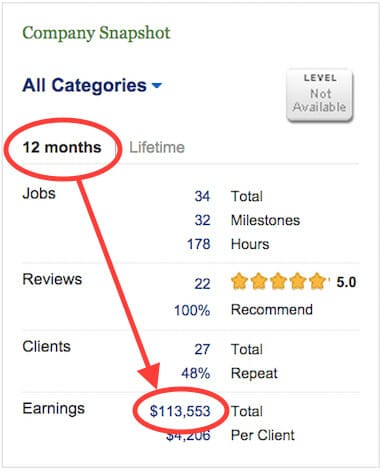
    Most people are surprised to find out that I earned six figures in 12 months using Elance as my only source of clients.

    I get it: In the minds of most writers, freelancing platforms like Elance tend to conjure up images of penny-per-word hell.

    There’s a good reason for this reputation. Many clients are attracted to freelancing sites because they can hire writers at a discount.

    But that’s only part of the story.

    In my experience, Elance also offers writers a great opportunity to make an excellent living — without all the hassles of “real world” freelancing.

    Nor was building up my six-figure Elance income as mysterious or challenging as you might think it would be — especially once I decided to reject conventional wisdom and stop following the masses.

    Even if you’ve had a bad experience freelance bidding sites, bear with me: Here’s how I make money as a freelance writer on Elance.

    Company Snapshot

    Getting started as a freelance writer

    When I set out to become a copywriter and start freelancing in July of 2012 — with no previous experience to speak of — Elance seemed like a good way to get my feet wet.

    So I spent dozens of hours researching the idea, devouring blog posts, articles and forum threads on the subject. Unfortunately, my main takeaway from all this reading was that there seemed to be an invisible “cap” on what an Elance writer could earn.

    But a few weeks into my Elance adventure, I’d already landed two $50-an-hour jobs. At that point, I realized that one of two things was true:

    A) I’d been super lucky and managed to find the only two decent-paying clients on Elance, or

    B) There were more of those decent-paying clients out there, and I could make great money if I could figure out how to attract them.

    So I spent the next few months developing strategies and tactics specifically designed to pull in the highest-quality clients Elance had to offer.

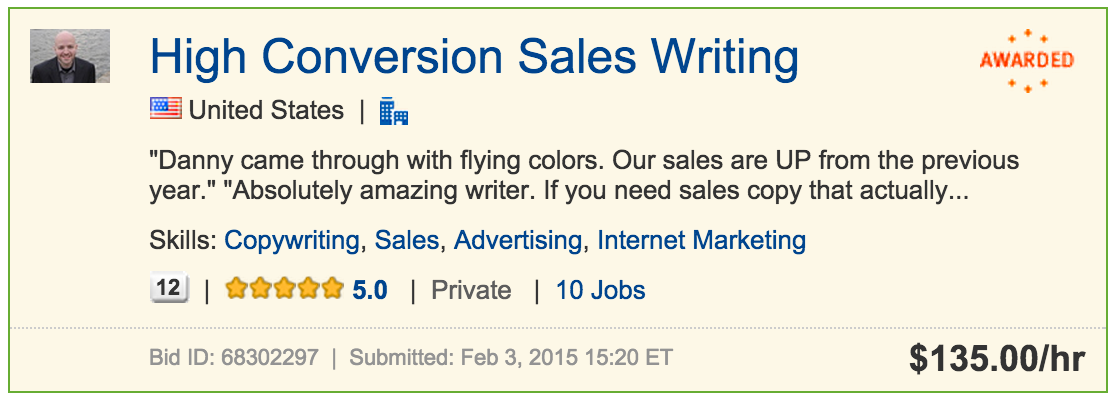
    It wasn’t long before my hourly rate rose from $50, to $75 and ultimately, $125 and beyond.

    High Conversion Sales Writing

    The challenges most freelancers experience on Elance have less to do with supply and demand, and more to do with not knowing how to find and secure the best-paying work.

    Here are some counterintuitive approaches I’ve used to overcome these challenges, winning more work and charging higher rates than my competitors — while spending less time grinding away at the keyboard.

    1. Don’t compete on price

    Lowering your price on Elance can seem like the right way to deal with low-bidding competitors. But it’s a game you won’t win, and can’t even afford to play.

    Personally, I love seeing gaggles of writers racing to the bottom on price: It tells me there’s a lack of quality options available to clients.

    Writers who charge bargain rates don’t have time to hone their craft; they’re too busy working their way to burnout. So I go the opposite way — offering high-quality work for a premium price.

    There’s nothing mysterious about this plan. I spend a lot of time educating myself about my craft and my niche, and it makes me more valuable than most of my competitors.

    Mostly, this strategy involves reading. I regularly pore over a plethora of writing blogs (like the one you’re reading right now) and books like Made to Stick by Chip and Dan Heath (a must-read for all writers), all of which have helped me improve my skills in different ways.

    You might think that all of your competitors are gaining the same knowledge as you are through reading, but they aren’t. This simple habit gives you a huge advantage in the marketplace and allows you to charge above-average prices.

    2. Choose a specialty

    Most Elancers are scared to choose a niche, for fear of shutting out most of the clients they encounter.

    So they stick to being the “Jack of all trades.” Or they choose several niches, and misguidedly try to tie them all together (e.g. Resume Writer / Novel Editor / White Paper Author).

    My advice? Forget about “most clients.”

    Successful freelancing isn’t about catering to the masses. It is, to paraphrase Seth Godin, about finding the “weird” clients who are a perfect fit for you.

    The irony of choosing a specialty on Elance is that, far from limiting yourself, you’ll now appear even more valuable to the clients who want and need you the most. It’ll be easier for them to find you, and easier for you to charge them what you’re really worth.

    3. To win big, aim small

    Bigger jobs on Elance come with a paradox: Though they offer more income potential, they also draw out more competition.

    Like this one:

    Job Ad

    Snagging these long-term or recurring jobs can seem like winning the lottery. But you’re also competing against about as many other people as you would in the actual lottery. Instead, I’ve developed a strategy to flip the odds in my favor.

    Rather than trying to get the client to award me the whole enchilada, I offer them a small trial job. This has many benefits, like:

    • Helping me stand out from the crowd (who are all pushing for the “big contract”)
    • Making it easier for the client to say yes, since there’s less commitment required
    • Giving me added credibility and posture (i.e. I don’t appear desperate)
    • Offering me a chance to test the waters, just in case the client turns out to not be a good fit

    For the job above, instead of forcing the client into the big decision of hiring me for a three-month blogging contract, I suggested we start with a single blog post.

    As you can see from the screenshot below, this approach worked out great for both of us, and has been a great income stream for me over the course of a just a few months.

    Blog Writer - Fixed Price

    (Of course, this strategy requires some confidence, which goes back to expertly honing your skills. As the great Jim Rohn said, “Work harder on yourself than you do on your job.”)

    4. Tap into the “Hidden Elance Economy”

    The only thing more fun than finding lots of clients is having them find you.

    While Elance’s jobs marketplace is great for finding new work, many of the best clients use the “search” feature to scout for writers before they consider posting a job.

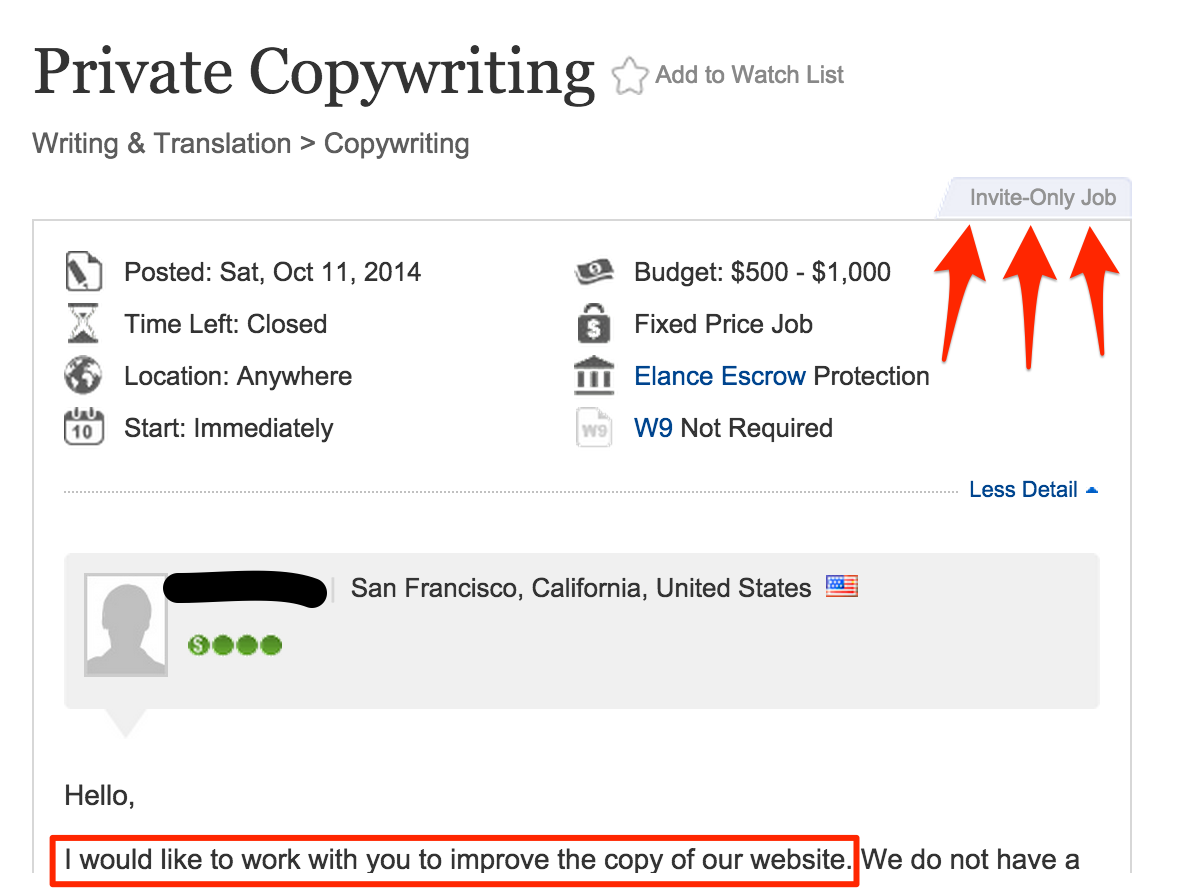
    If one of these clients likes what they see in your profile, they just might go ahead and invite you to a job they created just for you. Like this one:

    Hidden Elance Economy

    I call this the “Hidden Elance Economy” because it’s totally invisible to anyone but you!

    Receiving high-quality, private invites like this one allows you to charge more for your work, and gives you a passive stream of new leads to choose from.

    Here are some tips for taking advantage of these opportunities:

    • Word your profile carefully so clients can easily see exactly what services you offer and the type of client you work best with (if you aren’t sure, don’t worry, you’ll figure it out once you get a feel for the market)
    • Over-deliver to clients so they write you the sort of amazing reviews that attract even more awesome clients
    • End your profile with a call-to-action letting clients know they can invite you to a private job (otherwise, how will they know?)

    Have you found decent-paying writing jobs on Elance?

    In my experience, Elance can be an enormously rewarding source of freelancing business, way beyond what the average writer imagines.

    But you need to choose the right approaches to make it work. “Going with the flow” is just a race to the bottom. Instead, be strategic and you just might find yourself with lucrative jobs and quality clients.

    Have you tried Elance as a source of writing jobs? What was your experience like, and looking back, would you do anything differently?

  • Tracking Freelance Earnings: May Income Report From Nicole Dieker

    Tracking Freelance Earnings: May Income Report From Nicole Dieker

    Hi! If you’re new to this column: I track my freelance income every month and share it with all of you. This is my third year of public income tracking, and my first year sharing my income with The Write Life.

    How often do you stop and take stock of how far you’ve come as a freelancer, and where you’re headed?

    Last month, I focused on taking stock… and now I’m thinking about where I need to go in the future. Having a good handle on how much I’m earning goes a long way toward helping me make those decisions, so let’s have a look at my income for May.

    This month, I met my $5,000/month income goal — whoohoo! — but only received $3,300 in client payments. I also found myself with a snowballing workload. In both cases, I’m planning to solve the problem with a renewed focus on regular contributor gigs and reassessment of how many one-off client assignments I should take on.

    First, let’s take a look at the data: In May, I wrote 57,000 words and had an average per-piece earning of $67. My highest-paid piece was $300, and my lowest-earning piece was $35.

    Completed Pieces: 80

    Work Billed: $5,336.25

    Earnings Received: $3,383.05

    Wow. Although I continued to hit my goal of earning $5,000 a month, only $3,000 got deposited into my bank account. A lot of the work I completed in the past two months won’t get paid until June, and even though I’m expecting a big payday by the end of this month, I still feel a little strapped for cash right now.

    I don’t know how your freelance payments usually arrive, but my regular clients tend to pay either on the 15th or the 30th of the month. When I write a one-off piece for a client, it pays around 30 days after the article is published, but there can sometimes be a three-month lag between final draft submission and article publication.

    So that means you occasionally get months like this May, where you only get paid for a portion of what you bill. The money will still land in my bank account — I’ve only had one instance in my entire freelance career where a client hasn’t paid for the work, and in that case I was able to sell the piece to someone else — but it might take a few months to arrive.

    A new regular contributor gig

    On the positive side, I added a new regular contributor gig to my roster in May, for JoCo Cruise. This is the geek-themed music and comedy cruise I wrote about in my February income report when I described how I rearranged my entire workload to go on vacation.

    I’ve been on that cruise four times, so when the cruise team invited me to blog for their website, I was thrilled. More than thrilled. There may have been some jumping up and down involved.

    Last month one of our commenters asked about how much writing I do “for love” and how much writing I do “for money,” and with this client, I get paid to write about something I love.

    These are the best gigs of all, but they’re also sometimes the hardest; when I’m emotionally invested in a subject, I’m more likely to second-guess myself or overthink my work because I’m so determined to find the perfect way of communicating my emotions. It’s much easier to whip off a quick piece about a goat farm essay contest, and I’d like to think that the ideal freelance career would have a balance between these shorter, easier jobs and the more emotionally involved ones.

    The client snowball effect

    The Matthew Effect applies as much to freelancing as anything else; if you’re a highly visible freelancer, clients contact you to offer gigs, and if you’re not a highly visible freelancer, you have to contact potential clients and ask for work.

    This means that the more freelance work I complete, the more clients contact me to offer new jobs. It also means that I’m now at client saturation, and have started referring new clients to other talented freelancers I know.

    If you’re at the point where you’re getting more client requests than you can handle, don’t just say no; say “no, but I can recommend another freelancer.” That way, you help spread the wealth, and you never know who might recommend you in return. This is how freelancers get jobs that aren’t publicly visible on job boards. Networking is a huge part of the freelancing business.

    Because I’m at capacity, one of my big projects for June is to figure out how to reduce my workload. I have a lot of contributor gigs and plenty of one-off assignments for new clients, and my workday just gets longer and longer. In March, reducing my workload wasn’t a priority. This month, it is my top priority.

    How am I going to cut back? Well, I’m not going to cut any of my regular contributor gigs, since those are both the most rewarding and also provide the closest thing I get to guaranteed recurring income. Instead, I’m going to be a lot pickier about my one-off assignments.

    These assignments tend to take up an excessive amount of my workload, often because each one-off piece comes with a brand new editorial team and a new set of expectations to learn. (Don’t underestimate the value of working with the same editor for over a year. Things go so much faster that way.)

    One-off assignments also, as I noted above, tend to have a several-month lag time between final draft and payment.

    So for June, I have to tell myself: no one-off assignments for new clients unless it’s a dream job.

    How will I know if it’s a dream job? If the idea of taking on this assignment makes me jump up and down, I’m in. If not, I’ll refer the client to another talented freelancer.

    What would you consider a freelancing dream job? Also, do you feel like there’s a difference between the writing you do “for love” and the writing you do “for money?”

    Want to learn how Nicole has come this far in her freelance career? Check out her past income reports for The Write Life: