Category: Craft

  • Is Backstory Killing Your Book’s Plot? Here’s How to Fix It

    Is Backstory Killing Your Book’s Plot? Here’s How to Fix It

    The following is an excerpt from 5 Editors Tackle the 12 Fatal Flaws of Fiction Writing, available now.

    So many new writers start their books with pages — even chapters — of backstory.

    They want to tell the reader all about the creation of their fantasy world. Or they want to make sure readers understand every nuance of Mexican politics in 1956 because it will be critical to the plot on page 103. Or they want to make sure the reader understands every feature of time travel or cloning in the year 2133.

    Then their writing coaches or editors suggest that instead of including all this material in the opening chapters of their book, they should just reveal the backstory through dialogue.

    Aha, the author thinks. Dialogue — of course! But instead of jettisoning their precious descriptions and explanations, they essentially put quotation marks around the same ponderous material.

    Problem solved, right? Wrong.

    Your backstory can slow down the plot

    None of your characters should talk like the narrator. And readers still don’t want a backstory dump, even in dialogue. Your attempt to stuff backstory into dialogue results in long, tedious monologues instead of more believable two-way conversation.

    Let’s take a look at a before-and-after example passage:

    Before:

    Debby started panicking. “You know, John, that we can’t send people back in time without the right amount of energy, and even though we’ve done an excellent job in extracting energy from dark matter, as our last two experiments attest, I fear that there isn’t enough to get Colleen into the past and out of danger. Just look at the flux capacitor levels — the microcosm indicator is off as well, and it needs to be at 90 percent for a guaranteed trip. The flux capacitor is crucial for making a time jump, and needs to be at about 92 percent efficiency to work well. Also you need to contact Clare and Silas and make sure they can divert another 38 gigawatts of energy to the main frame so in one hundred hours she can make her jump back to the present. The main frame can handle up to 50 gigawatts, so that shouldn’t be a problem.”

    Whew, did you find that tedious to read? It was pretty tedious to write, too.

    To make matters worse, these types of monologues often take place in the middle of important action. Readers aren’t going to believe a character will stop and give a lecture when bullets are flying or buildings are blowing up around her. Backstory, even in “active” dialogue, stops the present action.

    After:

    Debby frowned at the bank of blinking lights. “We don’t have enough energy here for Colleen to make the jump.”

    “Is there anything we can do?” John asked.

    An alarm sounded, and Debby hit the panel to the left to silence it. “Don’t know.” She glanced at the flux capacitor level and gritted her teeth. It was nowhere near the 90 percent she needed. “I think you need to contact Clare and Silas. Maybe they can divert more energy.”

    “Sure, but how much?” John asked.

    Debby thought for a moment. “I need another 89 gigawatts of energy.”

    “All right,” John said, jumping up out of his chair. “I’ll contact them — if I can find them.

    In this example, we assume that John and Debby already know a great deal of the backstory and pertinent information because they are in the story. Even if I wanted to make sure that the reader (as well as John) was clear about time travel, a cumbersome description only slows the action and raises more questions than it answers.

    Readers don’t really need to know it all

    Have faith in your characters, and have even more faith in your readers. Allow the reader to enjoy the journey. It can be more fun for them to discover the world and plot along with the heroine.

    Sometimes dense description given through dialogue sums everything up, causing the reader to wonder why they should bother to read on.

    Use a limited amount of shorthand that your readers will understand to convey what’s going on. Use the characters to convey their expertise in their own proprietary language, which can add depth to a character and give a better sense of what’s going on.

    Become the expert in your field of study, and of the world you are developing. But don’t build a time machine piece by piece through your dialogue.

    Backstory keys to success

    Next time you’re weaving backstory into your project, remember:

    • Jettison the dense backstory paragraphs at the beginning of your novel’s scenes.
    • Explain in common, character-driven language some finer points of the plot via dialogue.
    • Trust your reader to pick up on gestures, expressions, and atmosphere as substitutes for direct (and long) explanations.
    • Don’t explain everything. Only include bits that are essential and interesting, and that advance the plot.
    • Don’t build a time machine all in one monologue.
    • No one wants a truckload of information dumped at the start of a story. Readers want to be swept away, transported — not buried under a ton of rock.

    Readers don’t spend as much time as they used to “getting into” a novel or story. It’s your job to put the reader into the action and intimacy with your characters as quickly as possible. The rest will follow.

    How have you introduced backstory in your own writing?

  • Writing Inspiration for Days: 10 Instagram Feeds to Follow Right Now

    Writing Inspiration for Days: 10 Instagram Feeds to Follow Right Now

    Instagram is well known for providing inspiration for travel, cooking, artwork, design, and plenty of other niches.

    But it also offers lots of writing inspiration. From epic bookshelves, cats and dogs snuggling up to a good book, insightful literary quotes, or even just enticing images of a cup of coffee and a good book, every writer can find something to adore in their Instagram feed.

    Check out these 10 sites for a dose of writing inspiration no matter your genre.

    1. Elizabeth Gilbert (@elizabeth_gilbert_writer)

    https://instagram.com/p/8D5h9qxyIv/?taken-by=elizabeth_gilbert_writer


    The author of
    Eat, Pray, Love and recent release Big Magic is relatable not just through her soul-bearing writing, but also through the inspiration she dishes out on her Instagram account.

    Subscribe to Gilbert’s feed to enjoy artsy designs, a variety of sayings and quotes, and updates on her upcoming book projects.

    2. Cheryl Strayed (@cherylstrayed)

    https://instagram.com/p/7q7q2ty-dX/


    Dubbing herself “Writer, mother, light-seeker,” Cheryl Strayed’s Instagram feed offers up selfies, images of her at speaking events, snaps of her books, images of her kitties, and even an opportunity to walk down memory lane with her.

    She sometimes shares photos of her hiking the Pacific Crest Trail, which she later depicted in Wild.

    3. Jon Krakauer (@krakauernotwriting)

    https://instagram.com/p/68C779Raa5/?taken-by=krakauernotwriting
    Outdoor-focused lit lovers will revel in Jon Krakauer’s Instagram stream, which will make you want to run outside and play. From images of people climbing a 130-foot icicle to gorgeous sunsets, mountain shots, and travel images, his stream will leave any outdoor writer inspired.

    He notes as his tagline, “I write books for a living. Been toiling in the writing factory for more than 30 years. Not writing is way more fun.”

    4. Jeff Goins (@jeffgoins)

    https://instagram.com/p/8ESreDDl1b/?taken-by=jeffgoins


    If you’re seeking inspiration for both work and your overall life, check out Jeff Goins’s Instagram account. The best-selling author of
    The Art of Work tells inspirational tale after tale with quotes, sayings, and words of encouragement for any endeavor.

    5. Cat Book Club (@catbookclub)

    https://instagram.com/p/8bp67Po27z/?taken-by=catbookclub


    Instagram is no different from any other corner of the Internet: cats rule. And, as much as you like to read, cats like to read even more — if you to believe the photos on Cat Book Club’s feed.

    If you love furry felines, it’s a great way to watch them cuddle up with a good book (and in some cases yawn or fall asleep on the book). This account will make you want to do nothing more than grab your cat and a novel and sit down for a spell.

    6. Dog Book Club (@dogbookclub)

    https://instagram.com/p/70N-2kkXCx/?taken-by=dogbookclub


    You didn’t think we’d leave out dog fans, did you? After all, who can resist a photo of a cuddly pup snuggling up with a good book?

    This feed contains images of dogs doing everything from reading by lamplight with a glass of wine nearby, to concentrating hard on reading the big words, to scanning an e-reader. These images will make the dog and book lover in all of us smile.

    7. Last Night’s Reading (@lastnightsreading)

    https://instagram.com/p/8dPOoXKo5b/?taken-by=lastnightsreading


    Kate Gavino creates drawings to illustrate quotes from New York City book readings. She draws the author, a quote, and the date of the reading together for a poignant package to encourage writers.

    8. Ernest Hemingway Foundation (@ehfop)

    https://instagram.com/p/y5Fh7wrIxO/?taken-by=ehfop


    The Ernest Hemingway Foundation maintains this Instagram feed full of favorite quotes and notable facts about the literary icon. You can also spot images of vintage copies of some of his works, along with short video clips about some of his stories.

    9. NaNoWriMo (@nanowrimo)

    https://instagram.com/p/29Ev4El76E/?taken-by=nanowrimo


    By now, everyone’s heard of National Novel Writing Month (
    NaNoWriMo). Following along with the organization’s official feed is a sure way to remind yourself that there are plenty of other writers also cranking along on their projects in November — and throughout the year, too!

    10. Jackie Johansen (@wordselectric)

    https://instagram.com/p/3Wp4m5AIoh/?taken-by=finallywriting


    This account has everything from travel photos to mugs of coffee and notebooks at the ready, to inspirational quotes, pets, passports and fun travel pictures. Jackie Johansen offers a world of inspiration for creative copywriters and beyond!

    What Instagram accounts inspire you? Tell us about them in the comments!

    This post contains affiliate links. That means if you purchase through our links, you’re supporting The Write Life — and we thank you for that!

  • Here’s How to Beat Writer’s Block and Get Back to Work

    Here’s How to Beat Writer’s Block and Get Back to Work

    I’ve always made lists to help me write.

    I keep lists of historical details for stories set in different eras, figures of speech I happen to like, and names for future characters.

    I even have a list of great titles, although I haven’t used any of those yet. So if you need a good title, call me, I guess.

    Along with these reference lists, I use lists to come up with writing ideas when I’m stuck.

    I’m a writer in my day job, where no one has time for writer’s block. When I’m working on a story on my own time, I don’t have much patience with it, either.

    I use lists to help me organize my thoughts quickly. Here’s how I do it — and how it can help you get unstuck, too.

    The Fast List Method

    Let’s say I have no idea why the bad guy in the story I’m writing is behaving like a bad guy. I know he wants to kill my main characters and maybe a few hundred of their closest friends, but it’s early on in the project.

    I could stare at my computer screen repeating “What is his motive? again and again, but I have little luck with this method.

    If I look for inspiration online, I have a good chance of getting sidetracked and spending an hour reading about some topic that catches my interest, but doesn’t pertain to my writing project at all. Research is always dangerous for me, because I’m curious about pretty much everything.

    That’s where my list method comes in. I write my question at the top of a piece of paper, like this:

    Hey Bryn, why does your villain want to kill all those people?

    Then I number the page — usually 1 through 20 or 1 through 25.

    Now I write possible answers to my writing question — as quickly as I can.

    Naturally, I think of clichéd or downright stupid answers. I write them down anyway.

    The beginning of the list might look like this:

    1. Uh, he wants to take over the world? To be powerful? Or something?
    2. He was just born evil. Yeah. That’s it. Ooooh, evil.
    3. They all made fun of his favorite T-shirt.
    4. He’s delusional and believes he’s a character in a violent video game, and that someone gets points for every person he kills.
    5. He’s a political extremist and a terrorist.

    By the time I’ve filled out my list, I have plenty of terrible ideas. But I usually end up with at least one idea that works.

    Sometimes I don’t even finish the list, because around number 16 or 17, I land on an idea that makes sense for my story.

    You can use this method for just about any sticky problem you run into in your story. How does the prisoner escape the heavily guarded prison? What makes the spy turn traitor? Why doesn’t the hero just tell the heroine the truth, other than the fact that you’ve based the whole story on a misunderstanding?

    Remember, if you jot down some stupid answers, you’re using the method correctly. Sometimes you’ve got to get the dumb ideas out of the way to get to the good ones!

    Using the Fast List Method for outlining and idea generation

    Although I used an example for writing fiction above, the Fast List Method also works for nonfiction and other types of writing.

    If I’m writing an article or a paper, I prefer to start with an outline. The problem is, I’m not that great at outlining! In my brain, there are so many little things I could include, and things get confusing and complicated quickly.

    Here’s where I make a big list to get all of those things out on paper, generally titled something like:

    25 Things That Could Go Into This Piece

    Once I have this list on paper, I go through and circle three to five of the most important things to include in the piece.

    These are usually easy to put in order. I find that some of the other things on the list can support these important points. And voilà, I have an outline! I discard items that don’t fit in anywhere.

    The Fast List Method also helps me come up with ideas at my job at Hallmark Cards. There, the question at the top of the page might be:

    OK Bryn, what are some things a grandma might want to say to her granddaughter?

    Or even simpler:

    20 ideas for Hallmark website articles. Go!

    No matter what task I use the Fast List Method for, allowing myself to write down a long list of ideas — no matter how good or bad — can help me work toward a solution.

    Do you ever use lists to help you write? Do you have other ways of breaking through writer’s block?

  • Tell Us Your Favorite Writing Websites!

    Tell Us Your Favorite Writing Websites!

    It seems far off on the calendar, but January is one of our favorite times of the year here at The Write Life. It’s a time for new beginnings and new goals. And we want to help you prepare for one of your best years yet!

    That’s where our 100 Best Websites for Writers list comes in.

    After compiling fantastic resources in 2014 and 2015, we’re excited to bring you the ultimate list of your favorite writing sites in 2016.

    Whether your goal for 2016 is to get more freelance writing clients, finish your ebook (and sell it!), or seeing your byline in a major magazine, we’ve got you covered with this list of websites for writers. We want to make sure we include valuable resources, and to do that, we need your help.

    What’s your favorite writing website? Which blogs do you visit for inspiration, information or writing-related entertainment? Which sites have earned bookmark status on your toolbar? Who do you want to nominate for our list?

    Let us know your favorite sites in the comments. We’re looking forward to sharing the list with you in January!

  • Why I Hired an Editor to Help Me Polish My Personal Essay

    Why I Hired an Editor to Help Me Polish My Personal Essay

    You know all those times you pitch a publication and never hear back? After spending weeks or months on what you thought was a pretty awesome story?

    We’ve all been there.

    It’s part of the job, but it’s frustrating nonetheless. It’s hard to know what you did “wrong.” The blank void doesn’t help you fix what needs fixing so you can grow and improve.

    But what if, for every essay you wrote and article you pitched, you received line edits, notes and suggestions for improvements?

    We know hiring an editor is an important investment if you’re working on a book, but what about smaller pieces: the novellas and short stories and personal essays and articles?

    Why I hired an editor to polish my personal essays

    I worked on an essay for New York Times’ popular feature Modern Love for six months. That essay went through a memoir class, an amateur editor, a re-write, a hiatus and finally a few trusted friends. One of those friends was Dara Kaye, a developmental editor at a literary agency.

    I’d never experienced anything like Kaye’s edits. It was my story, but better. They were my words, but tighter.

    I found the magical unicorn: An editor who understood my style while bringing her own talents to the table.

    After half a year tweaking and reworking, my essay was finally perfect. I finally felt confident sending it out into the void. Modern Love didn’t take it, but xoJane immediately accepted my essay. As someone who had never published a personal essay before, I was proud.

    Kaye volunteered her time to review my essay, but I knew I needed to invest in her ongoing editing services.

    If you’re just starting to pitch publications or are branching out into new territory, hiring an editor for ongoing projects could be one of the best career investments you’ve ever made.

    Why hiring an ongoing editor is important

    “Trying to edit your own writing is like trying to lick your own elbow,” says Kaye.

    “You’re just too darn close to the thing. When you read something you’ve written, your mind fills in plot holes and glosses over misspellings, inconsistencies, and awkward sentences. You can’t see them, but they distract agents, publishers, and readers.”

    After realizing Kaye had helped me bring forth the strongest incarnation of my work, I hired her to help with all my essays. I’m balancing client work with personal projects, with a goal of slowly transitioning out my client work and focusing solely on personal essays and fiction.

    It’s going to be a long process, but the quicker I can get into publications I admire, the quicker I’ll create a portfolio to build that platform.

    Running every essay and story past an editor helps me accomplish three things:

    1. Increase my chances of getting published
    2. Give new editors the best first impression of my work
    3. Learn a ton about writing

    Carin Siegfried, owner of CS Editorial (and my first-ever publishing mentor) told me a major benefit of hiring an editor for ongoing work is that “over time, your editor learns both your style of writing and how you best respond to editing, and can tailor their suggestions to work better towards your writing strengths and weaknesses.”

    They can also morph into more of a writing guide as well as an editor. “If you have multiple projects,” added Siegfried, “Your editor might be able to point out that a minor project you were putting on the back burner actually is more marketable or has a better shot at getting published than the front-burner idea you’re really excited about.”

    How to find an editor

    Okay, you’re convinced. Now, where to find this magical unicorn?

    Referrals are a great place to start. Ask published friends for a recommendation or take to social media. Publisher’s Marketplace also has editor listings, but their website can be difficult to navigate.

    How to choose the right editor

    Obviously, you need to find an editor who you not only like, but can also learn from.

    Editors should: Know your audience

    Many editors work in a variety of genres, but your editor should have at least some experience in yours. So if your big dream is to be a war correspondent, don’t hire an editor who specializes in self-published erotica.

    The first editor I hired to help polish my Modern Love piece had never published a personal essay before. Although the price was right, her lack of experience with personal essays meant I wasted my money.

    “You want someone who’s familiar with your genre and dialect,” says Kaye. “If you hire a U.K. editor to work on a U.S. book, don’t be surprised if you end up with a more ‘colourful’ manuscript than you want.”

    You also want to stay consistent once you do hire an editor. “With one editor,” Siegfried told me, “your voice will have more consistency across multiple projects and you will be able to better stay on message. You don’t want some pieces to have a lesser quality than others, making your writing look uneven.”

    You should: Request a sample edit

    Unfortunately, there’s no universal, industry-wide standard for copyediting, developmental editing and proofreading. This is why sample edits are so important.

    Most editors will offer a complimentary sample page edit so you can better understand their style. If they don’t, ask for a sample from a previous project to help align your expectations.  

    Kaye asked me an important question about my expectations: “Do you want someone who will leave everything intact save outright errors? [Or] someone who will dig a bit deeper to suggest alternative wording for unwieldy or repetitive sections?”

    Everyone will approach editing with a different tack, but a sample can catch any red flags about whether your potential editor’s style will match yours.

    You both should: Agree on a communication style

    Have a conversation with your editor about preferred communication style. Kaye was kind enough to share examples of three different editing styles from real manuscripts she’s worked on:

    • Option A “Love this sentence! It’ll read more smoothly if you delete this comma.”
    • Option B: “Comma deleted; these are cumulative adjectives, not coordinate adjectives. (See CMOS 5.90, CMOS 6.33)”
    • Option C: no margin comment, just silent corrections

    It’s entirely up to you. Do you want an editor who’s expressive about their love for your writing? Or someone who just does the work without coddling you?

    I’m in the former camp. If you’re going to criticize, I need a buffer. It’s been great to have an editor who reminds me why I do what I do.

    “Knowing and setting expectations for communication will make the work flow smoothly,” says Kaye. “My favorite clients are the ones always seeking to become better writers. They’re the ones who trust my judgment but are also comfortable asking ‘Hey, can you explain that rule?’”

    Kaye and I have worked together on two pieces so far. By the end of the 2015, I’d love to have a list of bylines or a competition win. But I’m also super happy to have a growing collection of near-perfect personal essays I can pitch until they’re published.
    no
    1
    links

  • NaNoWriMo is Coming: 5 Tips for Preparing to Write Your Novel

    NaNoWriMo is Coming: 5 Tips for Preparing to Write Your Novel

    November is National Novel Writing Month, or NaNoWriMo: a frantic month of writing with the goal of drafting a 50,000 word novel.

    Want to give it a shot? NaNoWriMo season will be here before you know it. But here is a little-known fact that you may not know: most writers who actually accomplish their goals during NaNoWriMo don’t start with a blank page on November 1.

    Does this mean writers cheat and start halfway into their book? No. But an experienced novel writer knows that it takes time to flesh out a story.

    In addition to having a general idea of what your novel will be all about, you should follow these five tips to get your novel done before the end of the month.

    1. Set up your work area

    You need a quiet place to write. Having your writing desk in the middle of the kids’ playroom is obviously not a good idea. However, if you need to keep an eye on a toddler while you’re writing, it’s fine to move your laptop or tablet around the house with you as needed.

    Your work area doesn’t have to be anything fancy. In fact, some writers work inside a closet. It’s a good idea to have a decent chair to sit on, a big-enough computer screen to read the words you type, and a safe place to put your choice cup of caffeinated beverage.

    2. Start writing now

    Have you thought about how many words you’re going to have to write every day in order to write more than 50,000 words in one month? If you don’t take a single day off, then you “only” have to write 1667 words every day.

    *Gasp*

    Does that sound like an incredibly large number? It’s really not. In fact, this article is almost half that amount. Unfortunately, if you’re not used to writing a lot, then chances are, you’re not going to write enough during November, either.

    In order to work your way up to 1667 words a day, you might need to start slowly. Start writing something every day now so you’ll be ready to write a novel in November.

    3. Take advantage of progress-tracking tools

    There are a lot of different tools available for novel writing. Many of them allow you to keep track of your progress and will even send you encouragements and reminders. It doesn’t really matter which of these tools you use as long as you keep track.

    Fortunately, keeping track of word count is easy. Almost every writing program will do it for you, and you can even track your word count through the official NaNoWriMo website.   

    If all else fails, you can put the number of words you write each day on a sticky note on your fridge. You can also share it through social media — maybe you can get your friends to cheer you on!

    4. Write while you wait

    Writing doesn’t have to take up all your spare time, although that wouldn’t be a bad thing for many authors. When you’re in a time crunch where you really have to get a project done, it’s a good idea to work on your novel every spare minute of your time.

    Do you spend a lot of time waiting? Whether you’re on the bus, riding the subway, in line to eat at a restaurant, waiting for a date, or waiting for your turn at the doctor’s office, you should be working on your novel instead of staring off into space.

    Fortunately, there are online novel-writing programs that allow you to write on any device as long as you have internet access. Yes, you could even write your entire novel on your cell phone. But even if you don’t currently own a smartphone or iPad, you can bring along an old-fashioned notebook and type your notes up later.  

    5. Finish the novel before you edit

    National Novel Writing Month is not about getting a novel ready to publish. Instead, you’re only expected to write the first draft of your novel. As much as many authors really hate the editing process, it can be tempting to stop writing and start editing too soon.

    Does that mean you don’t have to edit your novel? No. But it means you should wait until you’ve finished it to edit. That’ll give you something to do in December.  

    Are you ready for NaNoWriMo? What are you going to do to ensure that you finish your novel on time?

    TWL. CTA. Book Outline Template
  • 5 New Ways to Choose Perfect Character Names

    5 New Ways to Choose Perfect Character Names

    Do you agonize for hours over character names?

    I used to. I knew I needed the just-right name to convey who the character was, but I didn’t know how to figure out what that just-right name was.

    It’s a real drag, because you don’t feel like you can move on and keep writing, but you don’t feel like you’re managing your time wisely if you spend a while deciding on a character name.

    Andre Cruz previously offered six useful character-naming suggestions, but if you’re still stuck, never fear. I have five more to help you stop agonizing.

    OK, you might never completely quit agonizing, but these five easy tricks can help you get better at coming up with more names you like — and doing it faster.

    1. Try the Random Name Generator

    I love this thing!

    Just choose your character’s gender and whether you want a common, average, or rare name, and check out what you get.

    A few examples fresh from the Random Name Generator:

    Fawn Spicer: Could a steampunk airship pirate who flies the world with her trusty crew, consisting of Mad Max the one-eyed clockwork man, Bowie the half-parrot boy, and Frida Malark, a shapeshifter trained in the Lost Arts of Wildness who doesn’t talk much but helps run the ship with an iron fist … literally.

    Or what about Illuminada Lo? Sounds like a queen of an ancient lost civilization who lives in an ice palace deep under the ground, but she’s been kidnapped by an evil warlord who wants her to breed children for him. Maybe Fawn should come rescue her.

    Phew. Totally just made all that up based on a couple of names. I would use those. I will use those.

    (Hey, no stealing my character names now.)

    2. Make use of ancient civilizations

    YA fantasy writer Ysabeau Wilce set her Flora Segunda series in the Republic of Califa, a magic- and Aztec-influenced version of California in the 19th Century — think Gold Rush. Many of the names, especially of the villains, reflect Aztec naming conventions.

    It gives the world a particular flair and atmosphere of mystery. Think of the geography and history of your story when you’re looking for naming inspiration.

    3. Be creative with nicknames

    Give your characters silly monikers that either are nicknames or sound like them. Some of my favorites:

    • Tiny Doom (best character name ever!) and Nini Mo, both from Ysabeau Wilce’s aforementioned Flora Segunda series
    • Original Cindy from the TV series Dark Angel
    • Vex and Trick from the TV series Lost Girl
    • Jack Limberleg, from The Boneshaker by Kate Milford

    4. Consider sounds and syllables

    Trinica Dracken. How’s that for a villain-slash-love interest? She’s from Christopher Wooding’s Tales of the Ketty Jay series. With all those hard-hitting dental consonants, you can feel what a tough soul she is. But all might not be quite as it seems.

    Or what about Rath Roiben Rye from Holly Black’s Ironside faerie series? He’s a platinum-haired dark-fey elf with cheekbones that could cut glass. But you didn’t need me to tell you that, did you? It’s all in the name.

    5. Keep a file of names you like

    When you hear a unique name, write it down. My list includes: Chiara Peacock, Puck Steenbergen, Captain F. S. Brereton (he was actually an author), and Fenton Ash (the pseudonym of a late 19th-century author).

    You can use the names straight from the list, but you can also ask yourself what you like about them to get a better sense of how you want your character’s names to sound.

    I like unique names, and I have a thing about rhythm — names with alternating number of syllables often catch my notice (two syllables for the first name, then one for the last; or three syllables followed by two). I also like names that give a sense of personality, that indicate whether this person is likely to be a stodgy old military feller or a cyber-adventurer.

    What other tips and tricks do you use to name your characters? What are some of your favorite character names?

    This post contains affiliate links. That means if you purchase through our links, you’re supporting The Write Life — and we thank you for that!

  • Embrace Your Writing Style: 9 Writing and Grammar Rules Worth Breaking

    Embrace Your Writing Style: 9 Writing and Grammar Rules Worth Breaking

    Rules.

    There are just so many of them.

    I don’t just mean rules in the writing world. I’m talking about rules at home, college, work and even industry rules. It literally feels like everywhere we turn there’s someone waiting to say no.

    Don’t get me wrong, I completely understand that boundaries are necessary, especially in the realm of writing. But, what if people just bent the rules occasionally? Wouldn’t we have more diversity in style, tone and content?

    Sometimes, the desired effect just can’t be reached by sticking to those guidelines.

    So, I’m going against the grain.

    Why not break a few rules? Here are some to start with.

    1. Start a sentence with “And”

    Some people really can’t stand this but, as far as I’m aware, there aren’t any style or grammar guidelines that dictate: never start a sentence with a conjunction. You won’t be banished from the writing world.

    Don’t worry about starting sentences with “and,” “but,” or any other conjunction.

    2. Miss a comma

    I think that commas are one of the most overused punctuation marks out there. While there are rules, people still use them subjectively.

    Some people use commas as an indication of a pause in the sentence. If you’re in doubt about comma placement, remember to read the sentence back to yourself. If it doesn’t sound right, then take the time to consider whether you’ve overused some punctuation marks.

    3. Be biased

    You’re a person with an opinion. If you’ve taken the time to come up with an idea worth sharing with the world, your opinion will be valuable.

    You shouldn’t be forceful, but you can’t always sit on the fence, either. Share your thoughts. Doing so may help someone!

    4. Tell jokes

    Don’t you love it when you stumble across an informative and witty article?

    Having a sense of humor is unlikely to completely alter someone’s perception of you as a writer.

    Having a great sense of humor can also make you more memorable. In fact, if I read an article that can provide me with serious knowledge and make me laugh, consider me a subscriber.

    5. Use cliches

    I’ve always wondered why cliches are considered a bad thing. Consider them a set of universal truths.

    Don’t be afraid to use them if they’re relevant to your writing. After all, good ideas are often recycled.

    6. Throw in a dreaded adverb

    You can’t paint everyone (or in this case, every word) with the same brush. An entire group of words shouldn’t be avoided. Adverbs exist for a reason and should be used when they’re the best option.

    If you want to encourage diversity and creativity in your writing, you occasionally just have to go against the grain.

    7. Say “yes” to incomplete sentences

    This is a style choice. And if you like it…

    Do it.

    You may not want to make it a regular habit, but it doesn’t hurt to try something new once in a while. Incomplete sentences can add a bit of drama to your writing and allow you to emphasise a particular point.

    8. Make it more personal  

    When I say this, I mean don’t be afraid to include yourself in the story. Telling stories enables us to build stronger relationships with one another. You have an opportunity to connect with the audience and become a person that they can relate to.

    Using “you” really can turn content from an article into a conversation; writing in first-person can make your story relatable. Your personal experiences make you a unique writer. Remember to call upon those experiences when they can help you tell the story.

    9. Choose clarity over cleverness

    Writing is all about communication. Using unnecessarily complicated language can create distance between you and the reader. You could completely alienate them or, worse, fail to get your point across. Remember, once you hit the “publish” button, there’s no way to check whether they’ve understood or not.

    The key thing is to make sure that your message is clear — and maybe that’s the one rule you should never break!

    What writing rules do you think are worth breaking?

  • The Drinkable Book: The Only Book We’ll Let you Rip Up

    The Drinkable Book: The Only Book We’ll Let you Rip Up

    Books do a lot for people — they educate, they entertain and they help us understand ourselves and our world.

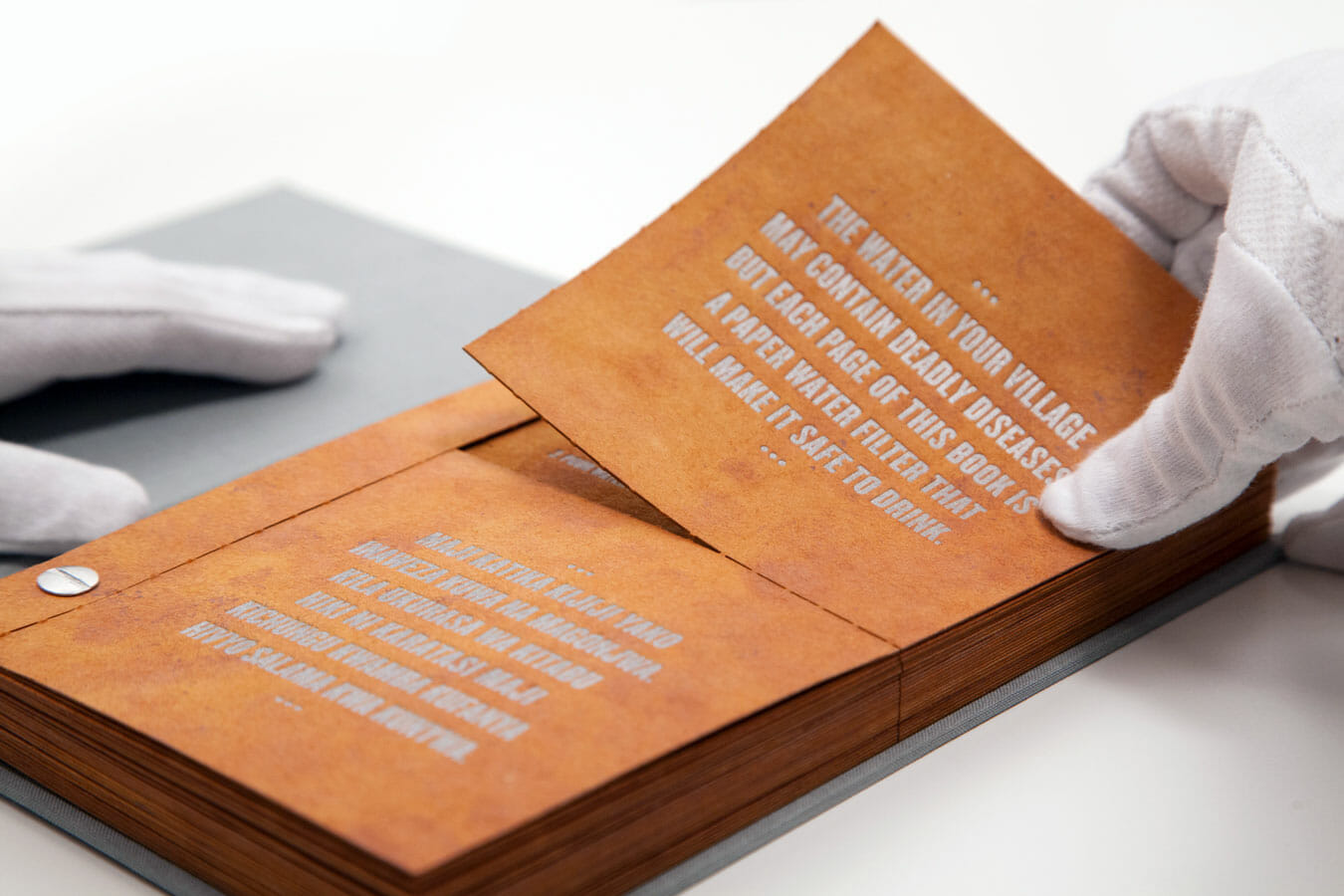
    What if books could do a little bit more? That’s what the team behind the Drinkable Book hopes to achieve with a new book designed to act not only as a text, but also as a water filter.

    As the BBC explains:

    The “drinkable book” combines treated paper with printed information on how and why water should be filtered.

    Its pages contain nanoparticles of silver or copper, which kill bacteria in the water as it passes through.

    In trials at 25 contaminated water sources in South Africa, Ghana and Bangladesh, the paper successfully removed more than 99% of bacteria.

    Read the book, get four years of clean water

    The Drinkable Book serves two purposes. First, its text teaches readers how to maintain clean water and how to avoid contaminating water with trash and human waste products.

    Then, the pages itself serve as a water filter. Tear out a page, place it in a filter box and use it to clean impure water and make it safe to drink. These filters protect against diseases such as cholera and typhoid, and give people who might not have clean water sources the opportunity to make their own safe drinking water.

    Each filter provides 30 days of drinkable water, and the entire book provides clean water for approximately four years.

    See the book and support its development

    The nonprofit pAge Drinking Paper is seeking Indiegogo funding to pilot test the Drinkable Book in various countries. They also need to prepare the Drinkable Book for mass production; right now, every page is made by hand.

    Lastly, they need to ensure there are multiple versions of the Drinkable Book in different languages, as well as versions that use pictures to communicate to people who cannot read.

    If you are interested in learning more about the Drinkable Book, visit page Drinking Paper.

    Is this a cause you would support? What’s the most important way a book has helped you?

  • How to Become a Successful Writer: 5 Daily Habits

    How to Become a Successful Writer: 5 Daily Habits

    Your phone alarm buzzes on the bedside table. 6:30 a.m.

    Before you get out of bed, let’s freeze frame right there. What are you about to do?

    If you’re like everyone else, you’re dreading the day ahead. You think how mind-numbingly boring work’s going to be. Then you will yourself out of bed to get on with it.

    If you’re not like everyone else, your day will start off a lot differently. Instead of dread, you’ll feel energy flow through you. The fire in your belly is stoked. You can’t wait to start writing. You know the moment pen touches paper (or fingers touch keyboard), powerful, pulsating prose will flow.

    This can happen every single day, starting tomorrow. All you have to do is master five habits of highly successful writers.

    “A life of discipline is better than a life of regret,” is a pearl of wisdom most attributed to the late Jim Rohn. When you think about it, that’s really what good habits are about: discipline. Anything worth doing — staying fit, being a better partner, improving your writing — comes down to what you do, day in, day out.

    Uncommitted writers who write when they feel like it have bursts of inspiration that inevitably fizzle out. They blame their circumstances or make excuses, and they don’t have what it takes to be a successful freelance writer or published author.

    Disciplined artists produce refined beauty. All admirers see are the fruits of their labor: the gravity-defying, breath-taking leap across the stage, the masterful strokes across the canvas or the tale that transports you to a different time and world.

    What they don’t see are the stubbed toes, embarrassing, empty exhibitions or the publishers’ rejection letters.

    I’m not going to lie to you: these habits are hard to keep. But if you can stick to them, you’ll be surprised at how much your writing can improve.

    1. Exercise your body

    I don’t need to tell you why exercise is important. Do it first thing in the morning to start the ignition and rev your engine. Your brain works better when your body’s working well, so if you want your writing to improve, get some exercise.

    I’m not asking you to run a marathon. Sit against a wall and reach for your toes. Do push ups. Do squats. Do Tai Chi. Do something. Do it for five minutes first thing in the morning and do it every day.

    2. Exercise your brain

    If exercising is your physical warm up, free-writing is your mental warm up. It’s difficult to hit the ground running (or hit the paper writing, in this case), so this is a great technique that can dissolve stubborn writing blocks.

    There are a couple different free-writing techniques. You can write what comes to your mind, or you can write what comes out of your mouth. You can do Morning Pages or follow writing prompts. It doesn’t matter what type of exercise you choose. The point is to write something to get primed and focused before you write anything meant for readers’ eyes.

    3. Ask your subconscious

    Every writer comes across gargantuan writer’s blocks that just won’t budge. Maybe you’ve arrived at an important point in your story. Maybe you’re writing sales copy for a client and don’t know how to keep to keep the persuasion strong.

    Make a habit of communicating with your subconscious — it could be just what you need to unblock your writing.

    Some writers will literally ask their subconscious out loud what they should do. Obviously, they don’t expect a voice to speak back to them, at least not immediately. It’s really about bringing the issue out into the open where it can’t hide. You can also do this by writing in a journal, taking a walk to ponder the issue, or chatting with a trusted friend.

    Next, go about your daily routine. If your subconscious is ready to tell you how to solve your problem, it’ll pipe up on its own accord. Setting the problem aside for a while can lead to clarity or a fresh perspective.

    4. Schedule nothing

    It’s tempting to keep your schedule jam-packed. A busy writer is a successful writer, right? Wrong. Yes you’re a writer, but primarily, you’re a creator of ideas. Ideas come to you when your mind is empty. That’s why it’s important to schedule time just to exist.

    Even if it’s just half-hour a day, shut everything off and go outside. This is one of the best writing habits you can cultivate.

    5. Make new contacts

    While writing itself can be immensely fulfilling, let’s face it: we’re all in it to get some recognition. That’s why it’s important to meet as many new people as possible to grow your network.

    It doesn’t need to take place in person. Reaching out online counts, too. You could send a fellow author you admire an email. You could send a guest-blogging pitch to one of your favorite sites. You could respond to a blog comment. Connect with others every day and success will find you.

    Surprised that only one of the five habits relates specifically to writing? Writers can love writing so much that we forget true success as a writer involves many people and activities beyond our words on the page.

    How many of these habits can you commit to doing every day?